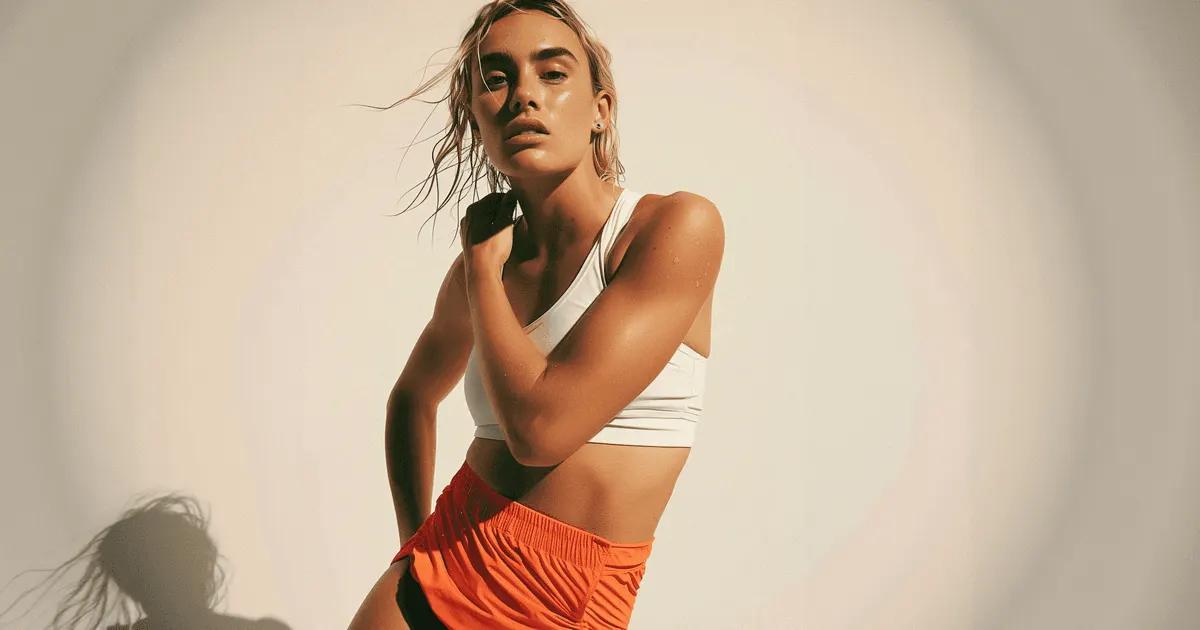
Activewear photography is the set of product images that prove a garment performs. The images have to show opacity under stretch, compression through the waistband, seam construction, and how the piece sits from the back. Amazon’s clothing imaging guide sets crop rules specific to sports bras and leggings, and tells sellers to lead with the back detail when that detail is the selling feature. That one rule reorders the whole shot list.
A standard apparel shoot covers the studio lighting, a fit model and a steamed sample, and it ends on a front-facing hero shot. The buyer looking at your leggings has a different question. They want to know whether the fabric goes sheer when they bend.
So this guide runs on that question instead. It starts with channel rules, because they decide which shots are compulsory. Then it builds the shot list around what a buyer checks. It also shows where generated imagery carries the set and where it fails, how a shoot is priced, and the labeling rules that landed in 2026.
Key Takeaways
- Amazon crops athletic clothing differently from the rest of apparel. Its Seller Imaging Guide specifies a square crop above the navel for sports bras and a waist-down crop for leggings, running from below the ribcage to below the feet (Amazon Seller Imaging Guide: Clothing & Accessories, Spring 2021, which Amazon marks as informational).
- The back can be your main image, and Amazon’s guide says so. The same guide states that if back detail is a key selling feature of an athletic clothing product, it is recommended as the main image rather than the front shot. In that guide, the instruction appears only for athletic clothing.
- Adult clothing goes on a model in the main slot. Amazon’s current product image guide says the main image for adult clothing shows a standing model, and no part of a mannequin may show (Amazon Seller Central, September 2026). An off-figure activewear hero does not meet the rule for the one slot that decides the click.
- Fit drives the returns bill. Coresight Research estimates a 23.4% US online apparel return rate in 2025, on a $201.1bn online apparel and footwear market. Nearly 70% of shoppers who returned clothing bought online named size and fit as the reason (Coresight Research with Alvanon, May 2026).
- AI carries the set unevenly. Backgrounds, colorways, angles and scene variants generate reliably. Compression behavior, opacity under stretch and seam construction are the parts that need a real capture behind them.
- Labeling rules arrived in 2026 and they hit on-model apparel hardest. Amazon now asks sellers to tag photorealistic AI-generated people in listing images, and New York requires conspicuous disclosure of synthetic performers in advertising, where the person making the ad knows about them.
- The measured evidence is about backgrounds, not bodies. One controlled study in this space generated backgrounds behind unmodified products and reported roughly 15% CTR gains (Czapp et al., RecSys 2024).
What is activewear photography?
Activewear photography is product imaging for performance apparel: leggings, sports bras, shorts, base layers and technical outerwear. It differs from general fashion photography because the buying decision rests on physical properties rather than styling. Opacity, compression, four-way stretch, flatlock seam placement and waistband hold all have to read from a still image, because the shopper cannot touch the fabric.
A dress is bought on how it looks. A pair of squat-proof leggings is bought on whether a claim holds, and the image is the only evidence a shopper gets. The rest of apparel gets away with a front hero, a back view and two detail crops. Activewear does not, because three of its selling points are invisible from the front: seat opacity, waistband compression, and the seam architecture across the back.
What Amazon requires for leggings and sports bra images
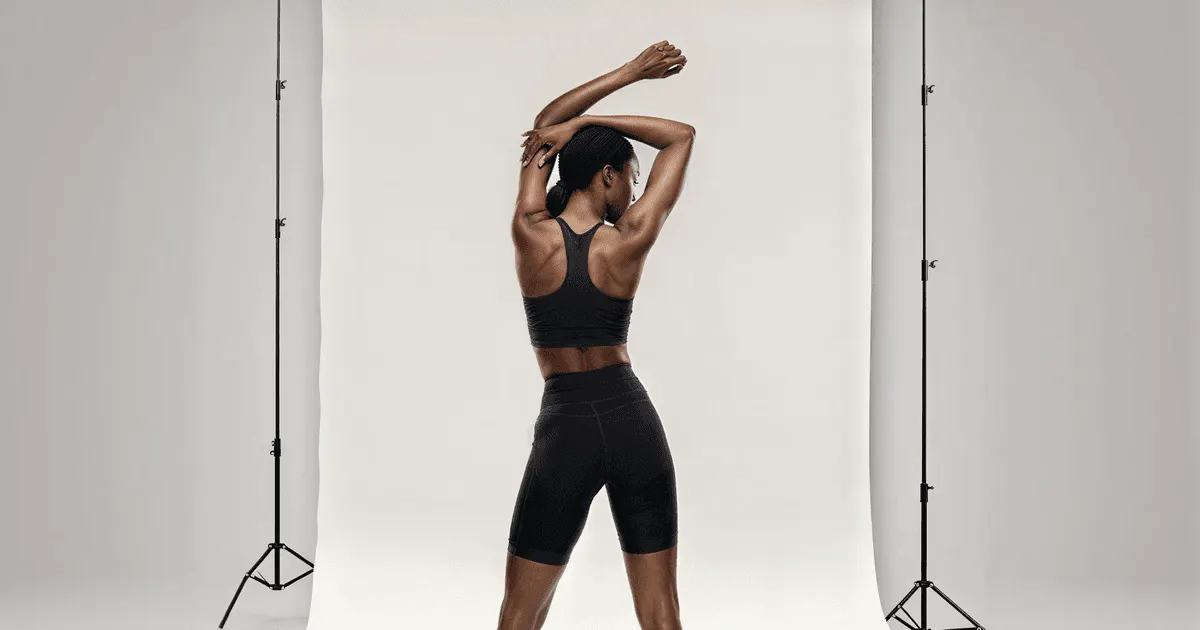
Amazon’s Seller Imaging Guide for Clothing & Accessories sets category-specific crops for athletic clothing. Sports bras take a square crop that falls above the navel. Leggings take a waist-down crop running from slightly above the navel and below the ribcage, down to below the feet. Athletic tops fall below the fingertips and above the knee. Athletic bottoms run from below the ribcage to below the feet. Tailored and casual trousers sit in that same waist-down class, and the trouser version of this crop rule works through what a below-the-feet frame forces into the shot.
Those crops are prescriptive, and they are why a set shot to generic apparel framing gets bounced. The guide is dated Spring 2021 and marked informational, so treat the live category style guides in Seller Central as the governing document. The structure has held for years.
Amazon’s current product image guide adds the hard specs for the main image. A pure white background at RGB 255, 255, 255. The product filling 85% of the image. At least 500 pixels on the longest side, and 1,000 pixels or more to turn on zoom. No more than 10,000 pixels on the longest side. Amazon may remove a listing from search until its main image meets the rules (Amazon Seller Central, September 2026).
Then the rule that catches most activewear sellers. For adult clothing, the same guide says the main image shows the item on a standing model, and no part of a mannequin may show. The current guide adds that the model must be standing, not sitting, kneeling, leaning or lying down. Off-figure shots are legitimate activewear imagery, but they belong in the alternate slots. We cover the wider version of this in what each marketplace requires for AI-generated product images, and the off-figure method itself in ghost mannequin photography.
| Channel | Main image rule | Spec that bites |
|---|---|---|
| Amazon US, adult activewear | Standing model, pure white, 85% of the image | 1,000px longest side for zoom; category crops in the 2021 guide |
| Amazon US, kids activewear | Tight-fitting items such as leotards and swimwear lie flat | No model for those items |
| Google Merchant Center try-on | One garment, front-facing model or mannequin, or laid flat | 512 x 512 minimum, 1024px+ preferred; arms down, sleeves down, zips closed |
| Shopify (your own store) | Your call | Under 20 MB, max 5000 x 5000 or 25 MP, 2048 x 2048 displays best |
Google’s virtual try-on feature has its own requirements and best practices, and they are stricter about pose than Amazon. Google asks for one garment per image, on a front-facing model or mannequin, or laid flat. Its best practices add arms down, no hands or handbags covering the piece, sleeves down, hoods down, zips closed and tops untucked (Google Merchant Center Help, September 2026). If you plan to feed try-on, shoot to that spec from the start rather than reshooting later.
Shopify is the permissive end. It publishes file limits and a display recommendation, and we found no rules about presentation, as of September 2026. So a direct-to-consumer activewear brand selling on its own store can lead with whatever shot converts. Our guide to AI product images for Shopify covers that setup.
Why the back view belongs in the main slot
Amazon’s 2021 clothing imaging guide includes one line written specifically for athletic clothing: if the back detail of an athletic clothing product is a key selling feature, it is recommended to use the back detail as the main image rather than the front shot. No other apparel category in that guide gets the instruction. Amazon marks the guide as informational, so check the live style guide for your category too.
It exists because activewear engineering lives on the back. Racerback and strappy sports bra construction, the seam curve that shapes the seat on a legging, the mesh venting panel, the pocket placement runners care about. Front-facing, all of it disappears.
The practical read is that your hero shot should be chosen by the product, not by habit. A compression legging with a contour seam and a high waistband earns a back-first main image. A plain black short does not. Audit the range before you brief, and split it: back-first for the pieces where construction is the pitch, front-first for the rest.
This has a second effect worth planning for. If the back is the hero, it has to be lit and finished to hero standard, which means the fabric behavior across the seat is now the most scrutinized surface in your whole set. That is exactly where opacity failures show up, and exactly where an underexposed shot hides a defect the buyer will find at home.
The activewear shot list that answers a fit question
Every frame in an activewear set should answer one thing a buyer is silently asking. Build the list that way and the count settles itself. Amazon recommends a main image plus at least six more images and one video (Amazon Seller Central, September 2026).
- Main, front or back. Chosen by which side carries the construction. On-model, pure white, 85% fill, category crop applied.
- The opposite view. Whichever side did not take the main slot. Buyers open this one second, every time.
- Waistband and compression detail. Close crop showing the band depth, the hold, and any drawcord or pocket. This answers “will it roll down.”
- Seam and fabric macro. Flatlock stitching, gusset, mesh panel, texture. This answers “is it built well” and it is the shot cheap catalogs skip.
- The stretch frame. The garment on a body in a position that loads the fabric. A lunge, a bend, a reach. This is the opacity answer, and it is the single most persuasive frame in the set.
- Scale and styling context. Full-length or a lifestyle scene that shows the piece in use, so the shopper places it in their own week.
- Colorway grid or short video. Coverage of the variants, or motion that shows drape settling. AI video tools for fitness and activewear brands covers the clip side.
Four and five are where activewear sets usually fail. A brand shoots six clean studio frames, all standing, and never once loads the fabric. The reviews then do the job the photography should have done, and the returns follow. Coresight Research estimates a 23.4% US online apparel return rate in 2025, on the $201.1bn online apparel and footwear market, roughly $47.1bn of returned goods. Nearly 70% of shoppers who returned clothing bought online named size and fit as the reason (Coresight Research with Alvanon, May 2026, as reported by FashionUnited, 30 June 2026).
Shoot the stretch frame. It is the cheapest returns intervention on this list.
Where AI works on activewear, and where it breaks
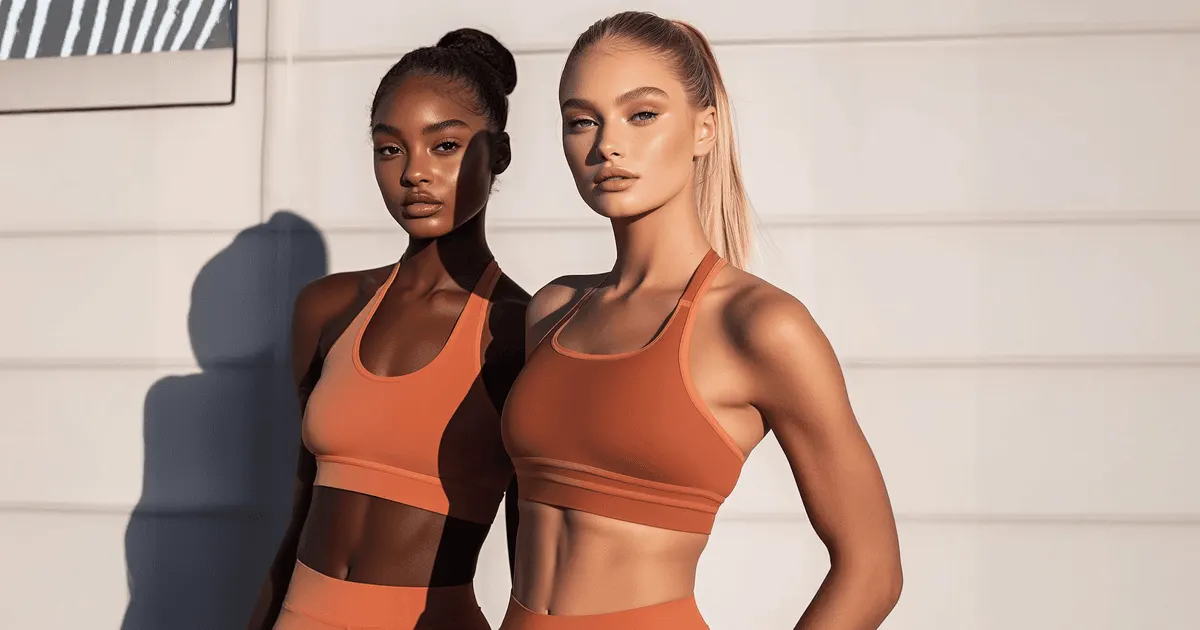
Generated imagery covers some of this list well and some of it poorly, and being straight about the line saves you a rejected set. The useful split is whether the frame carries a claim about the fabric or a claim about the context.
Context frames generate reliably. Backgrounds, locations, colorway variants, angle coverage, seasonal scenes and paid-social crops all derive from one good source photo without changing the product itself. One controlled study in this area works exactly this way: Czapp and colleagues at Taboola generated backgrounds behind products they never modified, then cut the original product back in, and reported roughly 15% CTR gains over baseline in online A/B tests, with a 4% to 40% range across catalogs, significant at p < 0.05 and mostly on apparel (RecSys 2024). Note the scope. Retargeting ad creative, not a product detail page, and background generation, not on-model generation.
Claim frames are harder. Compression behavior, opacity under load, the seam count across a back panel, and how a technical synthetic catches specular light are all properties of the physical garment. A model that has never seen your fabric will invent a plausible version of it, and plausible is not accurate. An invented compression read on a piece that does not compress that way is a fit misrepresentation, and this category pays for that in returns.
| Shot | Generated from one product photo | What to watch |
|---|---|---|
| Background and scene swaps | Reliable | Keep the product pixels intact |
| Colorway variants | Reliable | Check dye behavior on technical synthetics |
| Angle coverage | Reliable | Verify seam continuity between angles |
| On-model, standing | Workable | Review at full crop for logo and seam drift |
| Waistband and seam macro | Risky | Anchor to a real macro capture |
| Opacity under stretch | Not a generation job | Shoot it; it is a claim about your fabric |
The honest working method is a hybrid. Capture the frames that carry a physical claim, generate the frames that carry context, and keep the same real garment as the source for both so the set reads as one product. Where AI product photos hold accuracy and where they drift goes deeper on the review pass, and virtual try-on fit accuracy covers the on-model side specifically.
One more thing worth doing well: body range. Activewear is bought across a wider size spread than most categories, and a set shot on one sample size gives most of your buyers nothing to judge against. Generated on-model frames make range cheap, which is the strongest argument for using them here at all. Diverse AI fashion models covers where that helps and where it is cosmetic.
Performance socks sit inside most activewear ranges and follow a different rule set, because Amazon names socks as an exception to three of its main image prohibitions. Sock photography covers the pack laydown and the arch band detail. Technical outerwear follows the jacket rules, and jacket photography covers the two crop classes Amazon files a jacket in.
How an activewear shoot is priced
An activewear shoot is priced per image, per booking or per hour, and some studios add a project minimum. Published rate cards are the most reliable source here, because we found no survey of this market. Studios and retouching services price the same job in different units, and the unit decides what a range costs you.
| Line item | How it is usually priced | Where to check |
|---|---|---|
| Product image on white | Per image, with a higher rate for a full-body model image | squareshot.com/pricing, September 2026 |
| Model shoot | Per image, with a minimum number of outfits or images per project | squareshot.com/pricing, September 2026 |
| Studio booking | Per photo or per video clip, plus a studio fee per booking | soona.co pricing page, September 2026 |
| Models and styling | Per hour, added to the booking | soona.co pricing page, September 2026 |
| Flat lay or ghost mannequin | Per product | gqstudios.co.uk, September 2026 |
| Gym or fitness space | Per hour | peerspace.com, September 2026 |
| Ecommerce retouching | Per image, by task, or on a monthly plan with a per-image rate | pathedits.com and pixelz.com, September 2026 |
Run your own drop through those units and the shape is clear. A twelve-piece range needing seven images each is 84 frames. Priced per model image, the bill grows with every frame. With a project minimum, a small drop can pay for images it does not need. To estimate a range, count the frames and multiply by the per-image rate. Counting the images before a catalog photoshoot shows the count for a whole catalog. Then add the studio fee, the model and styling hours, the location hours and the retouching per frame. Retouching is usually the cheaper part per frame, which is why the cost conversation belongs on capture more than on post. Ask each studio for a quote in its own unit before you choose.
The gym rental line is specific to this category and the one brands underestimate. An hourly location, on top of crew, is why so many activewear brands shoot the whole range on a white sweep and end up with no in-context imagery for paid social. Our breakdown of what a product photoshoot really costs covers the general case, and cutting fashion photography costs covers the apparel-specific one.
Do you have to label an AI model wearing your leggings?
If the image contains a photorealistic AI-generated person, three separate rules may apply. Amazon asks sellers to tag such images before upload. New York requires conspicuous disclosure of synthetic performers in advertising. Article 50 of the EU AI Act has applied since 2 August 2026. None of them ban AI imagery. All of them ask you to say so. This is general information, not legal advice.
In July 2026, Amazon started asking sellers to tag product images that show a photorealistic person made fully by AI. You add the keyword “contains-synthetic-performer” to the dc:subject XMP metadata field before you upload. Amazon then adds a disclosure where needed. The tag is not needed for real people edited with AI, or for images with no photorealistic people (Amazon Seller Central, September 2026).
New York’s synthetic performer law, General Business Law section 396-b, took effect on 9 June 2026. It defines a synthetic performer as a digitally created asset meant to look like a human performance by someone not recognizable as any identifiable natural performer. If you make an ad and you know it contains one, the ad must say so in a way people will notice. The civil penalty is $1,000 for a first violation and $5,000 for each later one (nysenate.gov, September 2026).
Article 50 of the EU AI Act puts a machine-readable marking duty on providers of generative systems and a disclosure duty on deployers of deep fakes: realistic AI images, audio or video that could pass as real. Deep fakes in clearly artistic, creative or fictional works still need a label, in a lighter form that does not spoil the work. Ads qualify for this only in specific cases (European Commission guidelines, published 20 July 2026, September 2026).
Ad platforms sit differently. TikTok’s advertising policy, updated April 2026, allows ads with AI-generated or heavily AI-edited media if you add the AIGC label or your own clear disclaimer. It lists lighting, brightness and color adjustments, background removal or changes, and denoising as edits that need no label (TikTok ads policy, September 2026). That covers most of what an activewear brand does to a product still. Meta asks advertisers to disclose AI only in ads about social issues, elections or politics. When Meta detects third-party AI in other ads, it adds an “AI info” label under About this ad in the three-dot menu (Meta Business Help, September 2026).
The practical policy for an activewear brand is short. If a generated person wears the garment, tag it on Amazon, disclose it in advertising, and keep a record of which frames were generated. If you only regenerated the background behind a real capture, most of these rules usually do not apply to you. Labeling AI-generated fashion images has the full version.
An activewear set, built once
Build the set once on one garment, then run the same steps on the rest of the range. That is the job in this category: piece twelve has to reach the same standard as piece one, without a studio day or a gym rental between them.
- Upload the real garment. Flat, evenly lit, sharp on the seam and the waistband. Every result is built from this file, so the fabric in the frame is your fabric.
- Make the off-figure alternates. Flat lay and angle coverage from the same source, matched to your existing catalog background. A multi-angle template runs the multi-view pass.
- Put it on a body, across sizes. Virtual try-on makes on-model frames for the main image slot, across a range of body types rather than one sample size.
- Capture the claim frames yourself. Waistband compression, seam macro, and the stretch frame that answers opacity. Shoot these once on the real product and reuse them across every colorway.
- Run the variants and the scenes. Colorways and location context rebuilt from the same setup, which is where the economics change.
- Save it as a workflow. The next drop runs the same steps instead of rebuilding them. A saved workflow holds your brand, your products and your rules.
The app that puts a garment on a model is the same job as a form, so a colleague can run it without opening the workflow. You set the brand once, and the workflow reads it on every run. The same light and framing then reach the twelfth garment. Three critic steps score the results of a run, and best-of-N keeps the best one.
Uploading your own photos and the commercial license start on the Pro plan. AI video, virtual try-on, upscaling, the image editor and the video editor start on the Premium plan. An 8-second clip costs 40 to 560 credits, depending on the model. There is a free plan, and it cannot make video. Team features, shared brand kits and white label are on the Ultra plan, and every plan below Ultra is one seat. Plans and credits are on the pricing page. The DesignerBox page for fashion brands covers apparel work. The activewear photography page covers compression, seams and the back view that answers fit.
The full workflow from the first product photo to the finished ad, in one subscription. For a twelve-piece range, that covers the stills, the try-on, the clips, the editors and your brand record.
Start from a template, add your brand and your garments, and run it. The cost is shown before the run.
FAQ
What is activewear photography?
Activewear photography is product imaging for performance apparel such as leggings, sports bras, shorts and base layers. It is judged on physical properties rather than styling, so the set has to show opacity under stretch, waistband compression, seam construction and back detail. Amazon applies category-specific crop rules to athletic clothing that do not apply to general apparel.
How many images does an activewear listing need?
Amazon’s recommended count is a main image plus at least six more images and one video (Amazon Seller Central, September 2026). For activewear, plan for a main, the opposite view, a waistband detail, a seam macro, a stretch frame, a context shot, and a colorway or video slot.
Can the back view be the main image for activewear?
Yes, and Amazon recommends it. Its Seller Imaging Guide states that where back detail is a key selling feature of an athletic clothing product, the back detail is the recommended main image rather than the front shot. This instruction appears for athletic clothing specifically and not for other apparel categories.
Are ghost mannequin images allowed for activewear on Amazon?
Not in the main slot for adult clothing. Amazon’s current product image guide asks for a standing model there, and no part of a mannequin may appear (Amazon Seller Central, September 2026). Its 2021 clothing guide, which Amazon marks as informational, also lists ghost mannequins under main-image DON’Ts. Off-figure shots, ghost mannequin included, still work in the other image slots.
Can I use AI-generated activewear photos on Amazon?
We found no Amazon rule that bans AI-generated product images, as of September 2026. For clothing, Amazon says only photos are allowed, and it does not say whether a photorealistic AI image counts as one. In July 2026 Amazon started asking sellers to tag images containing photorealistic AI-generated people with the keyword “contains-synthetic-performer” in the dc:subject XMP metadata field (Amazon Seller Central, September 2026). Images with no people, people who are not photorealistic, or only real people do not need the tag.
Do AI activewear images need a disclosure in ads?
In New York, yes, where you know the ad contains a synthetic performer. General Business Law section 396-b requires conspicuous disclosure, took effect on 9 June 2026, and sets a civil penalty of $1,000 for a first violation and $5,000 for each later one. TikTok asks for a label on ads with fully AI-generated or heavily AI-edited media, and exempts background removal, relighting and color adjustment. Meta asks advertisers to disclose AI only in ads about social issues, elections or politics, and adds its own “AI info” label when it detects third-party AI in other ads.
What does an activewear photoshoot cost?
Studios price the same job in different units, so ask for a quote in the unit each one uses. Product images on white are usually priced per image, with a higher rate for a full-body model image. Model shoots can carry a minimum number of outfits or images per project. Studio bookings can be priced per photo plus a booking fee, with models and styling added per hour. A gym or fitness location is priced per hour. Published rate cards for these units sit on squareshot.com, soona.co and peerspace.com (September 2026).
Sources
- Amazon Seller Imaging Guidelines: Clothing & Accessories, Spring 2021, marked informational (m.media-amazon.com), accessed September 2026
- Amazon Seller Central product image requirements, including the standing-model rule and the contains-synthetic-performer keyword (sellercentral.amazon.com), and Amazon’s clothing image guide (sellercentral.amazon.com), accessed September 2026; the July 2026 start date reported by CNBC, 23 July 2026
- New York Senate Bill S8420-A, amending General Business Law section 396-b, signed 11 December 2025, effective 9 June 2026 (nysenate.gov)
- European Commission, guidelines on transparency obligations under Article 50, published 20 July 2026 and non-binding (digital-strategy.ec.europa.eu), accessed September 2026
- TikTok Advertising Policies, Misleading and False Content, updated April 2026 (ads.tiktok.com), accessed September 2026
- Meta Business Help, AI info labels on ads, and Meta’s ad standards for social issue, election and political ads (facebook.com/business/help and transparency.meta.com), accessed September 2026
- Coresight Research with Alvanon, “Shifting the Size and Fit Paradigm,” May 2026 (coresight.com), as reported by FashionUnited, 30 June 2026, read 2 October 2026. The Coresight page shows only the report summary without an account
- Czapp, Jani, Domián and Hidasi, “Dynamic Product Image Generation and Recommendation at Scale for Personalized E-commerce,” RecSys 2024 (arxiv.org)
- Published rate cards: squareshot.com, soona.co, gqstudios.co.uk, pathedits.com, pixelz.com, peerspace.com, accessed September 2026
- Google Merchant Center, “About apparel virtual try-on” (support.google.com); Shopify product media requirements (help.shopify.com), accessed September 2026
- DesignerBox pricing page (designerbox.ai/pricing), September 2026
Channel rules, rate cards and disclosure requirements verified from the sources above as of September 2026. The Coresight figures, as FashionUnited reports them, and the RecSys paper were re-read on 2 October 2026. This is general information, not legal advice. Marketplace category style guides change; check the current spec in Seller Central before briefing a shoot.