
A snack photoshoot has to do what the shopper cannot do online: open the bag. Every image answers one of four questions. What is the pack? What is inside it? How much do I get? When do I eat it? This guide sorts 17 shot ideas under those four questions, for bags, bars, pouches, tubs, cartons and multipacks.
The label rules and the six base shots for packaged food are in our guide to food product photography.
Key Takeaways
- Four questions sort every idea. The pack, the piece, the amount and the occasion.
- The piece needs its own shots. Ten pack shots answer one question ten times.
- A prop can make a claim. US flavor rules treat a picture of a fruit as a statement about flavor.
- Amazon’s main image is the pack alone. The bowl, the hand and the lunchbox go in the gallery.
- A generated scene may change the setting. It may not change the pack, the count or the food.
Why a snack photoshoot starts with four questions
A snack is a sealed product, and the buyer pays before seeing one piece of the food. So each image answers a question the sealed pack leaves open.
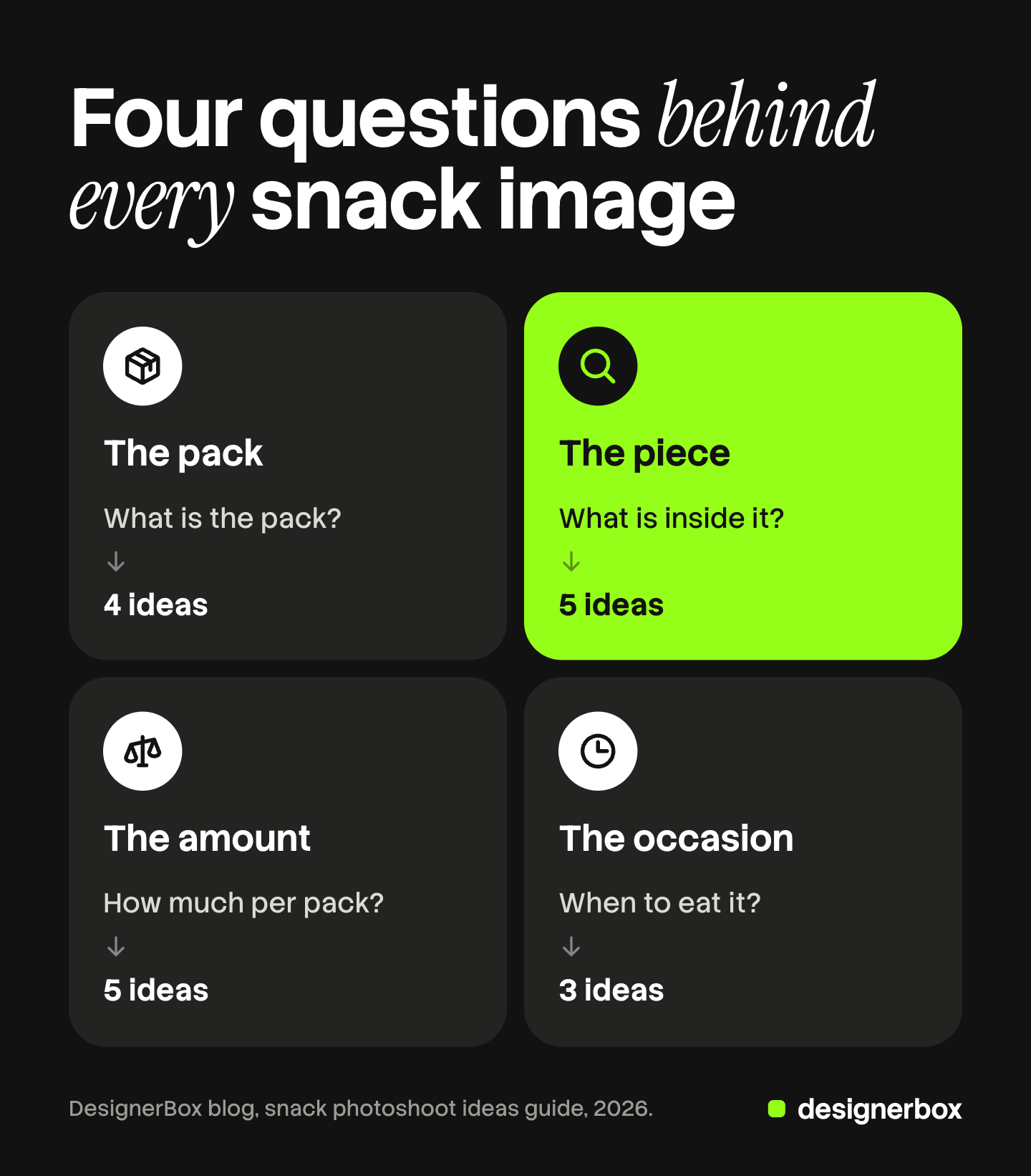
| Question | What the image shows | Ideas in this guide |
|---|---|---|
| What is the pack? | Format, flavor name, size and closure | 4 |
| What is inside it? | The piece: texture, cross-section, coating, crumb | 5 |
| How much do I get? | The portion, the count, the multipack, the variety box | 5 |
| When do I eat it? | Lunchbox, desk, hike, movie night, sharing bowl | 3 |
If a question has no image, that is the next shot. Ideas sorted by image slot are in our list of product photography ideas.
Snack photoshoot ideas for the pack
These four ideas work for any pack format.
1. Front of pack on white. The sealed pack stands alone, square to the camera. It proves the brand, the flavor name and the net weight. It fails when glare covers the flavor name.
2. Three-quarter pack. The pack turns, so one side shows. It proves depth: the gusset of a pouch, the thickness of a bar, the height of a tub. It fails when a close, wide lens makes the pack look larger.
3. Flavor lineup. Every flavor stands in one row, at one scale, under one light. It proves the range and the color of each flavor. It fails when a small bag is resized to match a sharing bag.
4. Closure detail. A close view of the zip seal, the tear notch, the lid or the carton flap. It proves that the pack closes again, which matters for a sharing bag. It fails when a hand covers the closure.
Foil and gloss film reflect the room, so use one large, soft light from the side.
Ideas for the piece: what is inside the pack?
Snack photography needs the food out of the pack. A pack shot cannot answer this question.
5. One piece, close. One chip, cracker, cluster or candy fills the frame, lit from a low angle. It proves the surface: ridges, seasoning, salt, bubbles. In chips photography it separates a kettle chip from a thin one. It fails when you pick the one perfect piece, so choose a typical one.
6. Cross-section. A bar, a filled cookie or a wafer is cut once, with the cut face to the camera. It proves the layers, the filling and the nut pieces. It fails when extra nuts are pressed into the cut face.
7. Break or bite. A cracker is snapped in two, or a bar has one bite out of it. It proves crunch or chew. It fails when crumbs make the food look stale.
8. Coating and seasoning. A close view of the chocolate shell, the yogurt coat, the spice dust or the sugar. It proves the finish. It fails when warm lights melt it or a finger marks it.
9. Open pack, pieces in front. The pack stands behind, name readable, and the pieces lie in front. It proves that this food comes from this pack. It fails when the pile holds more pieces than one pack contains.
For the camera work behind close views, see our guide to macro product photography.
Ideas for the amount: how much do I get?
These five ideas turn the net weight into something a person can see.
10. The whole pack, poured out. All the food from one pack sits in one bowl, with the pack beside it. It proves the real amount. It fails when you fill the bowl from a second bag.
11. One counted serving. The label’s serving lies on a plate, counted or weighed, beside the pack. It proves what one serving looks like. It fails when the plate holds more than the label’s serving.
12. Pack in hand. A hand holds the bar, the pouch or the tub. It proves size faster than any number. It fails when the crop removes the fingers.
13. Multipack laid out. The outer carton stands behind, and every inner pack lies in front in rows. It proves the count. It fails when the count in the frame differs from the count in the title.
14. Variety box grid. Every flavor in the box lies in a grid, with the right number of each. It proves the contents, flavor by flavor. It fails when the grid shows a flavor this box does not include.
Amazon’s multipack standard says the main image must show the total quantity that will be delivered to the customer, and the title must contain the total quantity. For a large variety multipack, Amazon asks sellers to show each type of product and state the total count in the title (Amazon Seller Central, multipack imaging standards, October 2026).
Ideas for the occasion: when do I eat it?
Keep the pack readable in every occasion shot.

15. Lunchbox or desk drawer. A single-serve pack lies among everyday items. It proves that the pack fits a daily habit and a small space. It fails when the props are larger and brighter than the pack.
16. On the move. The bar or pouch sits in a pocket, a gym bag or a backpack. It proves that the snack travels. It fails when the pack is too small to read.
17. Sharing bowl. A sharing bag stands beside a bowl, for a movie night or a party. It proves that the product is for a group. It fails when the bowl holds more than the bag does.
What a snack picture must not do
Four rules sit behind these ideas. This section is general information, not legal advice.
The label must not mislead. Under US law, a food is misbranded if its labeling is false or misleading in any particular (21 U.S.C. 343(a), Cornell Legal Information Institute, October 2026). A shopper reads that label through the product photo.
A picture of an ingredient can be a flavor statement. The FDA’s flavor rule covers the label, the labeling and the advertising of a food. It applies when they represent the main flavor “by word, vignette, e.g., depiction of a fruit, or other means” (eCFR, 21 CFR 101.22, October 2026). A vignette is a picture on a label. So fresh strawberries beside a strawberry-flavored bar say something about its flavor. Use an ingredient prop only when the product contains that ingredient or that flavor.
The fill must be the real fill. A food is also misbranded if its container is filled in a misleading way. The rule calls the empty space slack-fill, and it accepts some reasons for it, such as protecting the contents and settling during shipping (eCFR, 21 CFR 100.100, October 2026). The rule is about the container. Apply the same logic to idea 10: show the real contents, and add nothing.
An ad is read as a whole. The FTC says it will “focus on the ad’s overall net impression” (FTC, Enforcement Policy Statement on Food Advertising, October 2026). A bowl, a prop and a headline are read together.
The words “serving suggestion” do not fix a picture. In the UK, the ASA upheld a complaint in 2019 against an ad that carried those words, because the sides looked like part of the meal (ASA ruling on Parsley Box Ltd, October 2026). The claims side of these rules is in our guide to food advertising.
Which shot goes on which channel
| Channel | Ideas that fit | What to check |
|---|---|---|
| Marketplace main image | 1, or 13 and 14 for a multipack | Pack alone on pure white, with the total quantity shown |
| Marketplace gallery | 2 to 12 and 15 to 17 | The count and the food match the real pack |
| Retailer page | 1 to 4 and 9 to 14 | The retailer’s own image guide |
| Paid social | 5 to 9 and 15 to 17 | The net impression of the whole ad |
| Subscription or variety box | 3, 13 and 14 | The grid matches the box that ships |
Amazon’s main image has a pure white background, and the product shows as 85% of the image. It must not show accessories or props that are not included with the product. The image should also represent the real scale, quantity and color of the product (Amazon Seller Central, product image guide, October 2026). The full list is in our guide to Amazon image requirements. The image spec for five sales channels covers the other marketplaces.
Snack ads: which shots to crop
Snack ads suit the piece and the occasion. Crop ideas 5 to 9 tight, with a corner of the pack in the frame. For ideas 15 to 17, leave empty space for the headline.
What a generated scene may change
An AI image model is useful for the setting around a snack and risky for the snack itself. Sort the 17 ideas again.
- The pack (1 to 4). Photograph these. The main image stays a camera file.
- The piece (5 to 9). Photograph these too. A model draws a plausible chip, which may differ from yours.
- The amount (10 to 14). Photograph the layout once, then count the pieces and the packs in every result.
- The occasion (15 to 17). A model can make these from one pack photo.
A generated scene may change the surface, the light, the setting and the props. It must not change six things.
- The pack artwork. Colors, logo and layout stay as printed.
- The flavor name. Models can redraw small text, so read every letter.
- The net weight. The number stays as printed.
- The count of pieces. A model may add chips to a bowl.
- The real look of the food. No thicker coating, no extra filling.
- The allergen message of the props. The FDA lists nine major food allergens, and tree nuts and peanuts are two of them (FDA, food allergies, October 2026). Whole almonds beside a nut-free bar suggest an ingredient the bar does not have.
The checks for print, logo and shape are in our guide to AI product photo accuracy. Cans and bottles are covered in drink photography.
Snack images for a whole range
DesignerBox is AI creative production for brands and agencies. It makes images, ads and video from a product photo you supply. Anyone can make an AI picture. Making hundreds that still look like your brand is the hard part.
You save your logo, colors, fonts and rules once as a brand. You build the occasion scene once as a workflow. A batch then runs it over a sheet, one pack photo per row. The cost is shown before the run. The same pack photo can feed the listing image, the static ad and a short video. The full workflow from the first product photo to the finished ad, in one subscription. The product side is on the AI product photography page.
The limits are plain. Brand rules guide each run, and a person still compares every result with the real pack. DesignerBox does not publish to a store: you download the results, or send them with a webhook or an S3 step. Uploading your own photos and the commercial license start on the Pro plan. AI video, virtual try-on, upscaling, the image editor and the video editor start on the Premium plan. Plans and credits are on the pricing page.
A free plan for your first run
There is a free plan, and it runs on sample products. Get started free
FAQ
How many photos does a snack product need?
Plan at least one image for each of the four questions. Amazon requires one compliant main image and recommends at least six additional images and one video (Amazon Seller Central, October 2026).
Which snack photo goes in the Amazon main image?
The sealed pack alone, on pure white, as 85% of the image. Bowls, hands and loose pieces are props, so they go in the gallery. A multipack shows the total quantity delivered.
Can I put ingredients beside the snack in the photo?
Yes, when the product contains them. The FDA’s flavor rule treats a picture of a fruit as a representation of flavor, on the label and in advertising. On Amazon, keep them out of the main image.
What should a variety pack image show?
It should show every flavor in the box and the right number of each. Amazon says a variety multipack’s main image must show the total quantity delivered, and the title must state the total count (Amazon Seller Central, October 2026).
Can AI make snack product photos?
It can make the setting around a real pack photo: the surface, the light and the occasion. Photograph the pack and the food yourself, then compare every result with the real pack.
Sources
- Amazon main image rules, the recommended image count and the scale, quantity and color line: Amazon Seller Central, product image guide, accessed October 2026
- Amazon multipack and variety multipack image and title rules: Amazon Seller Central, multipack imaging standards, accessed October 2026
- Flavor representations by word or vignette: eCFR, 21 CFR 101.22(i), accessed October 2026
- Misleading containers and slack-fill: eCFR, 21 CFR 100.100, accessed October 2026
- Misbranded food, false or misleading labeling and misleading containers: 21 U.S.C. 343(a) and (d), Cornell Legal Information Institute, accessed October 2026
- The net impression of a food ad: FTC, Enforcement Policy Statement on Food Advertising, May 1994, accessed October 2026
- The nine major food allergens: FDA, food allergies, accessed October 2026
- An ad marked “serving suggestion” found misleading: ASA ruling on Parsley Box Ltd, November 2019, accessed October 2026
- DesignerBox brand, batch and plan gates: DesignerBox brand page, batch page and pricing page (designerbox.ai), October 2026
Amazon, FDA, FTC, ASA and eCFR facts verified on each publisher’s own page, October 2026. The shot ideas and the channel table are our own working method. DesignerBox features verified on designerbox.ai, October 2026.