
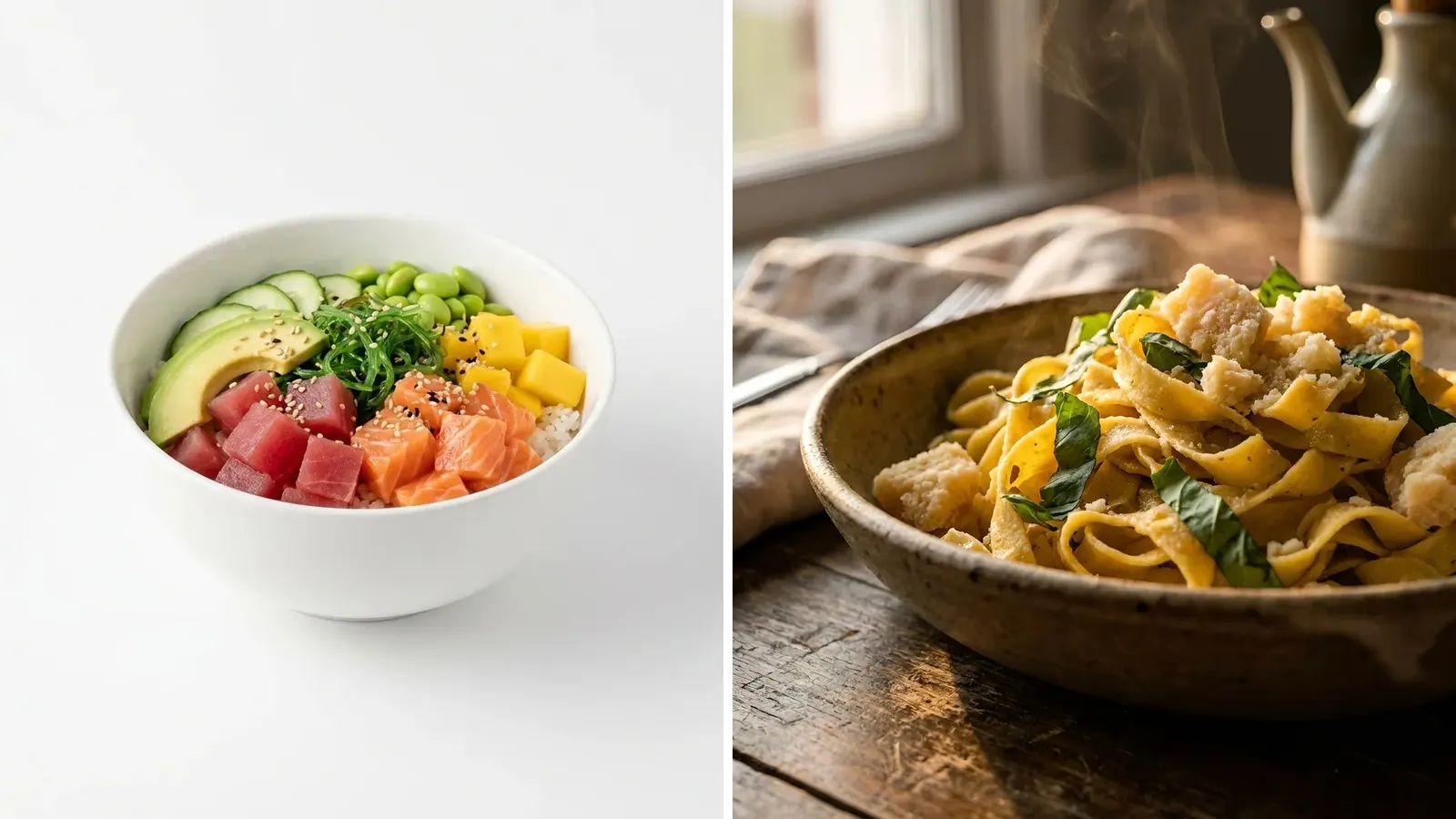
Food product photography is the set of images that sells a packaged food or drink online. Each product needs six shots: the front of the pack, the back of the pack with readable nutrition and ingredients, a scale shot, the contents or texture, a serving suggestion and the multipack. The pack and its label must match the real product in every shot.
This guide covers packaged food and drink sold on a marketplace or in an online store. Plated dishes for recipes are a different job, and so are menu photos.
Three rulebooks limit these images. The marketplace sets the frame, the label law sets what the pack says, and the advertising law sets what the picture may suggest.
Key Takeaways
- Six shots per product. Front of pack, back of pack, scale, contents or texture, serving suggestion and multipack.
- The back of pack is a reading test. US label type may be as small as one-sixteenth of an inch, so the panel needs its own frame at 2,000 pixels or more.
- Amazon’s main image is the pack alone. Pure white, 85% of the image, and no bowl or spoon beside it.
- A serving suggestion is a claim. UK and US regulators judge the whole picture, including food the buyer does not receive.
- AI may change the scene, the surface and the light. It may not change the pack, the label text or the food in a way that misleads.
What is food product photography?
Food product photography shows a packaged food or drink as the buyer will receive it. The subject is the pack: a pouch, a jar, a can, a box or a bottle.
Packaged food photography differs from recipe photography in one way. A recipe photo sells an idea of a dish. A pack photo sells one exact item with a legal label and a net weight, so the image has to be accurate before it is attractive.
Food packaging photography also has hard surfaces. Foil pouches reflect the lights, and clear jars show the room behind them. Drinks add glass and liquid, which our guide to bottle product photography covers in detail. Cans, cartons and multipacks are in our drink photography ideas. Vitamins and powders follow a stricter label rulebook, covered in supplement product photography.
The six shots a packaged food product needs
Amazon requires at least one compliant main image and recommends at least six additional images and one video for each product (Amazon Seller Central, product image guide, October 2026). Six shots fill most of those slots.
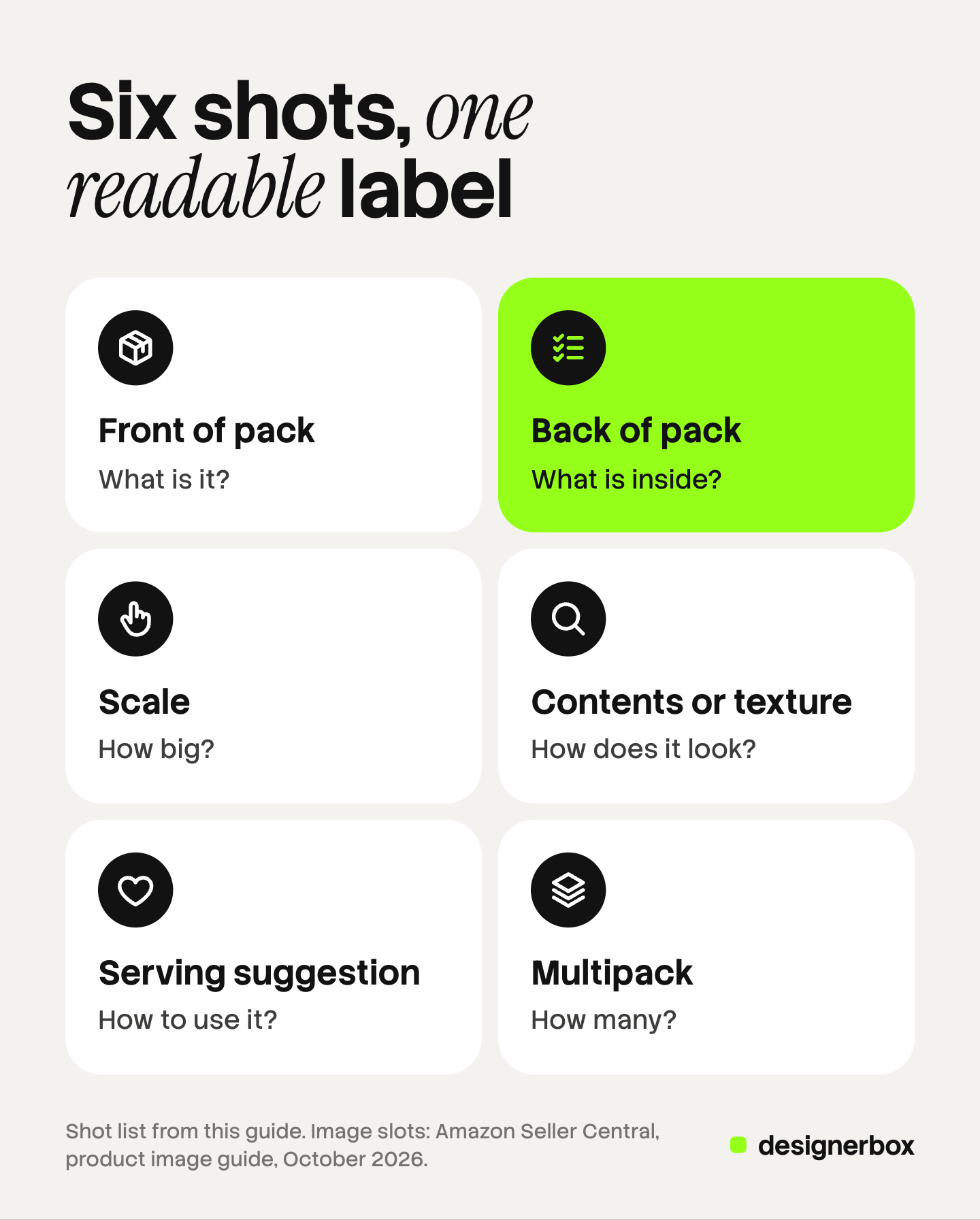
| Shot | The question it answers | The check before you publish |
|---|---|---|
| 1. Front of pack | What is it, and which flavor and size? | The whole pack is in the frame, and the color matches the real pack |
| 2. Back of pack | What is in it? | Every line of the nutrition panel and the ingredient list reads at full zoom |
| 3. Scale | How big is it? | The pack sits beside a hand or a common object at true size |
| 4. Contents or texture | What does the food look like? | The food in the frame came out of this pack, in a true amount |
| 5. Serving suggestion | How do I use it? | Extra food that is not in the pack is clearly extra |
| 6. Multipack | How many do I get? | The count in the image equals the count in the title |
Back of pack. Shoppers with an allergy read this panel before they buy. Amazon has named image slots for it: the variant code INGR is for ingredient information, and BACK is for the back angle (Amazon Seller Central, October 2026).
Scale. A 100 gram pouch and a 500 gram pouch look the same on white, so one frame needs a hand or a mug.
Multipack. Amazon’s multipack standard says the main image must show the total quantity that will be delivered, in its packaging, and the title must state the total quantity (Amazon Seller Central, multipack imaging standards, October 2026).
How to shoot the pack so the label reads
The back of pack is a reading test, because label type is small. US food label rules allow required text as small as one-sixteenth of an inch in height (eCFR, 21 CFR 101.2, October 2026). That is about 1.6 millimeters.
Here is an illustrative count. Suppose a pouch is 6 inches tall and fills 85% of a 2,000 pixel image. The pouch covers 1,700 pixels, or about 283 pixels for each inch. Type that is one-sixteenth of an inch tall is then about 18 pixels tall.
Export the same frame at 1,000 pixels and the type falls to about 9 pixels, which is hard to read on a phone. Give the panel its own frame, crop to the panel, and export at 2,000 pixels or more.
On the set, press a curved pouch flat, so the lines of text stay straight. Use one large, soft light from the side, because foil reflects a small light as a white spot over the text.
What does Amazon require for a food main image?
Amazon food photography starts with the main image, because it appears in search. Four rules shape a food shot (Amazon Seller Central, product image guide, October 2026).
- Pure white background. The RGB values are 255, 255, 255.
- 85% of the image. The whole pack is in the frame, and no part is cut off.
- One unit, shown once. Amazon’s example says to show the front only, and not the front and the back in one image.
- No props that are not included. A bowl, a spoon or a pile of raw nuts beside the pack breaks this rule.
The image must also represent the real scale, quantity and color of the product. Amazon accepts 500 to 10,000 pixels on the longest side, and 1,000 pixels or more turns on zoom. If no main image meets the rules, Amazon may remove the listing from search.
The bowl of granola belongs in the secondary slots. Our snack photoshoot ideas list the shots for those slots. Two limits still apply there. Every image must match the product title, and no image may show customer reviews, star ratings or claims such as free shipping. The complete list is in our guide to Amazon image requirements.
How to sell food on Amazon: what the policy adds
The question of how to sell food on Amazon has an image part. It is set by a separate page, Amazon’s food and beverages policy (Amazon Seller Central, food and beverages, October 2026). It adds four things.
- A complete label. Products must be labeled with the product name, manufacturer details, expiration date, net weight, ingredients, nutrition facts and allergen information.
- A shelf life greater than 90 days, and a label in English. Amazon asks for the entire compliant product label in English.
- No banned claims in the image. Product images must not include the FDA logo or the words “FDA approved”. They must not claim that the food treats or prevents a disease, or use the USDA organic seal without a valid certification.
- Unedited label photos for compliance. When Amazon asks for label and packaging images as compliance documents, they must be authentic and in their original unmodified format. Amazon states they must not be computer or AI-generated, and they must show all sides of the pack.
Keep the untouched camera files of every side of every pack. The policy excludes chilled and frozen food and fresh produce, and it is longer than this summary, so read it before you list.
What do Walmart and Google add?
Walmart and Google ask for much of what Amazon asks. Each adds a detail.
| Channel | Main image rule | What it adds for food |
|---|---|---|
| Walmart | Seamless white, 2200 x 2200 pixels, 1500 x 1500 for zoom, square | No claims or promotional language in any image, and at least four images recommended |
| Google Merchant Center | No promotional overlays, at least 500 x 500 pixels from 31 January 2027 | No product in the image that is not sold with the main product, and AI metadata kept |
Walmart’s rule covers a “high protein” badge added in editing (Walmart Marketplace Learn, image guidelines, October 2026).
Google requires that images created with generative AI keep the metadata that says so (Google Merchant Center Help, image link, October 2026).
Image specs for five channels sit side by side in our guide to ecommerce product photography.
What must a food image match by law?
Three sets of rules sit behind the marketplace pages. This section is general information, not legal advice.
The label law. In the US, a food is misbranded if its labeling is false or misleading in any particular (21 U.S.C. 343(a), Cornell Legal Information Institute, October 2026). The front panel must carry the statement of identity and the net quantity of contents (eCFR, 21 CFR 101.3 and 101.7, October 2026). The FDA names nine major food allergens: milk, eggs, fish, crustacean shellfish, tree nuts, peanuts, wheat, soybeans and sesame (FDA, food allergies, October 2026).
These rules govern the physical label, and a shopper reads that label through the photo. If editing changes a weight or drops an allergen line, the image shows a label that does not exist.
The advertising law. The FTC looks at an ad in context, and it lists “words, phrases, and pictures” as the things it reads. An ad is deceptive if it is likely to mislead consumers acting reasonably and the point is important to the decision to buy (FTC, advertising FAQs, October 2026). Its food advertising statement says the Commission judges the ad’s “overall net impression” (FTC, enforcement policy statement on food advertising, October 2026).
The UK and EU rule on pictures. The UK’s ASA considers the whole ad, including the imagery. Its example is a plate of stew with potatoes and rice. That picture is likely to mislead if the customer only receives the stew, unless the ad makes that explicitly clear (ASA, avoiding misleading imagery in ads, October 2026).
Article 7 of Regulation (EU) No 1169/2011 says food information must not mislead through “pictorial representations” that suggest an ingredient is present when it has been replaced. The article also applies to advertising and to the presentation of food (legislation.gov.uk, the UK’s assimilated version of Article 7, October 2026).
The ad side of these rules is in our guide to food advertising. The video version is in food commercial.
What may AI change in a food image?
AI image tools are useful in the area around the pack. They make a kitchen counter or morning light without a second shoot.
| May change | May not change |
|---|---|
| The scene: counter, table, shelf, outdoor setting | The pack: shape, size, color, closure |
| The surface under the pack | The label text: name, weight, ingredients, allergens, nutrition numbers |
| The light and the time of day | The amount of food shown from one pack |
| The crop and the format for each channel | The food itself, and seals the pack does not carry |
Three checks catch most failures.
- Read the label in the result. Image models can redraw small text. Compare every word on the pack with the source photo, at full zoom.
- Count the food. A model may add berries to a bowl or raise the level in a jar.
- Keep the main image real. Use the photographed pack on white for the main slot.
Amazon also requires a metadata tag on any image with photorealistic AI-generated people. Our guide to AI product photo accuracy lists the checks for print, logo and shape.
Food images, ads and video as one workflow
DesignerBox is AI creative production for brands and agencies. It makes images, ads and video, and a product photo is one of the inputs. Anyone can make an AI picture. Making hundreds that still look like your brand is the hard part.
For a food range, that means one look across every flavor and size. You save your logo, colors, fonts and rules as a brand once. You build a workflow once: the pack photo goes in, and the scene, the light and the crop come from your rules. A batch then runs that workflow over a sheet, one product per row, so row one and row two hundred follow the same rules. The cost is shown before the run.
The same pack photo then feeds the serving scene, the static ad and the short video. That is the full workflow from the first product photo to the finished ad, in one subscription. The product side is described on the AI product photography page.
The limits matter for food. DesignerBox does not check a label against the law. A person compares every result with the real pack, and the back of pack stays a camera file. DesignerBox does not send finished work to a store or a marketplace: you download the results, or send them with a webhook or an S3 step. Every plan below Ultra is one seat.
Uploading your own photos and the commercial license start on the Pro plan. AI video, virtual try-on, upscaling, the image editor and the video editor start on the Premium plan. Plans and credits are on the pricing page.
There is a free plan, and it runs on sample products. Get started free
FAQ
How many images does a food product need on Amazon?
Amazon requires at least one compliant main image and recommends at least six additional images and one video (Amazon Seller Central, October 2026). The main image is the front of pack on pure white. The other five shots go in the secondary slots.
Can I show a bowl of the food in my Amazon main image?
No. Amazon’s main image must not show props that are not included with the product, and a bowl or a spoon is a prop. Show the sealed pack alone on pure white. Put the bowl in a secondary image.
Can I use AI for food product photos?
You can use AI for the scene, the surface and the light around a real pack photo. Do not let it change the pack, the label text or the food in a way that misleads. Amazon will not accept computer or AI-generated images as label compliance documents, so keep the original camera files.
What does “serving suggestion” allow in a picture?
It allows you to show the food prepared or served with other food. The picture must still be clear. The UK’s ASA says a picture with extra items is likely to mislead if the customer receives only one of them, unless the ad makes that explicitly clear (asa.org.uk, October 2026).
Can DesignerBox make food product images?
It can make the scenes, ads and video around a pack photo you supply, with the same brand rules on every product. The cost is shown before the run. It does not check a label for legal errors, so a person reviews every result against the real pack.
Sources
- Amazon main image rules, recommended image count, pixel limits, variant codes and the AI-generated people tag: Amazon Seller Central, product image guide, accessed October 2026
- Amazon multipack main image and title rules: Amazon Seller Central, multipack imaging standards, accessed October 2026
- Amazon label, shelf life, claims and compliance image rules for food: Amazon Seller Central, food and beverages, accessed October 2026
- Walmart image size, background, image count and the rule against claims in images: Walmart Marketplace Learn, image guidelines and requirements, accessed October 2026
- Google main image rules, the 500 x 500 pixel minimum from 31 January 2027 and AI image metadata: Google Merchant Center Help, image link, accessed October 2026
- US label panels and minimum type height: eCFR, 21 CFR 101.2, 101.3 and 101.7, accessed October 2026
- Misbranded food, false or misleading labeling: 21 U.S.C. 343(a), Cornell Legal Information Institute, accessed October 2026
- The nine major food allergens: FDA, food allergies, accessed October 2026
- How the FTC reads an ad, and the test for deception: FTC, Advertising FAQs: A Guide for Small Business, accessed October 2026
- The net impression of a food ad: FTC, Enforcement Policy Statement on Food Advertising, May 1994, accessed October 2026
- Misleading imagery and the stew example: ASA, “A picture says a thousand words. Avoiding misleading imagery in ads”, accessed October 2026
- Pictorial representations of food and ingredients: Regulation (EU) No 1169/2011, Article 7, UK assimilated version, accessed October 2026
- DesignerBox brand, batch and plan gates: DesignerBox brand page, batch page and pricing page (designerbox.ai), October 2026
Amazon, Walmart, Google, FDA, FTC, ASA and legislation facts verified on each publisher’s own page, October 2026. Article 7 was read in the UK’s assimilated version. The label type example is illustrative arithmetic. DesignerBox features verified on designerbox.ai, October 2026.