

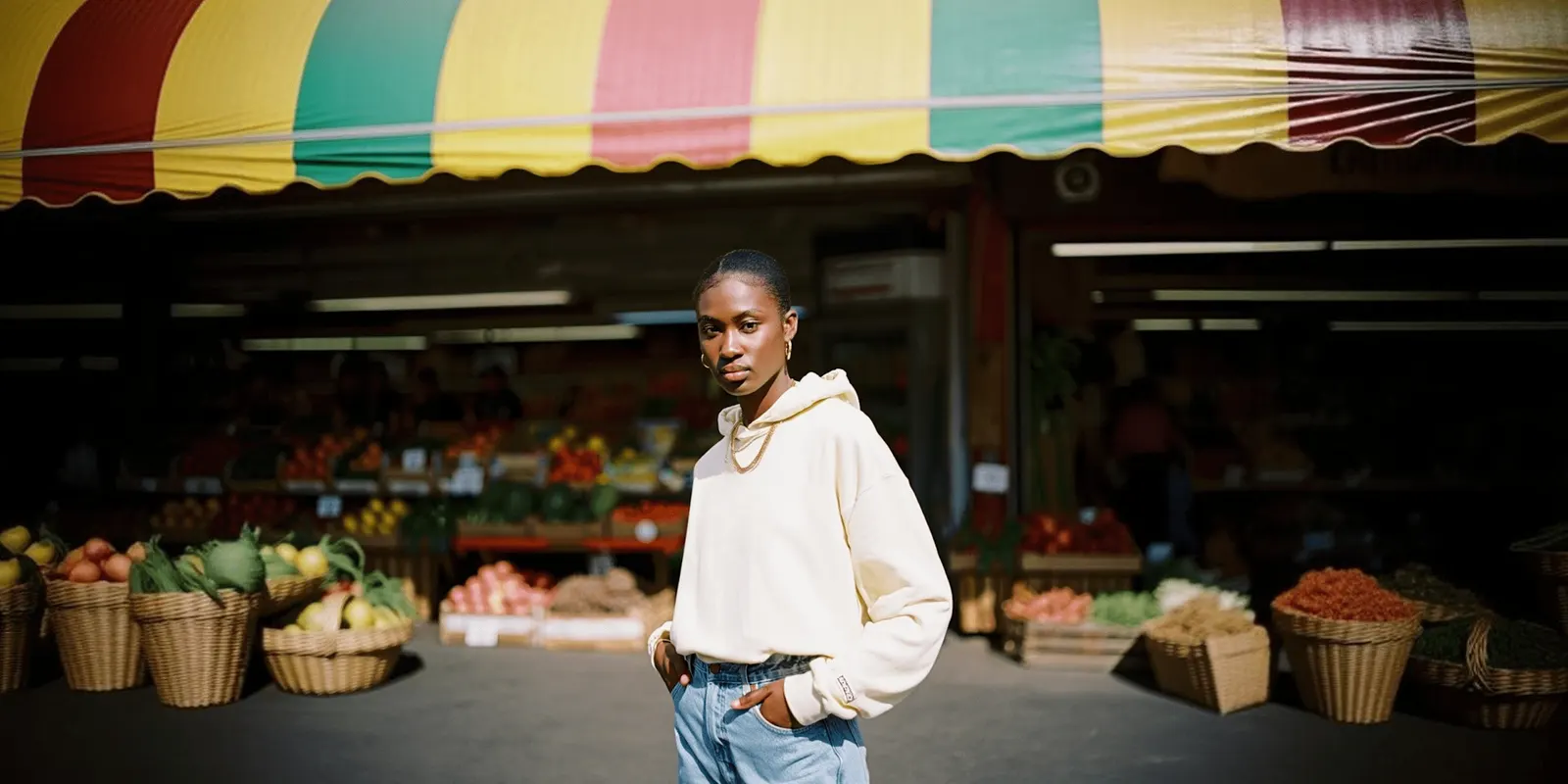
Food advertising is paid promotion for food and drink: packshots, recipe ads, pour shots, creator clips and TV spots. In the US, the FTC judges a food ad by its overall impression and applies FDA definitions to nutrient claims. In the UK, the CAP Code covers claims and styling, and since 5 January 2026, larger food companies cannot pay to show identifiable less healthy products online.
Picture a food brand with 80 products and one autumn campaign. The hero shot is a bowl of granola with berries on top. It has to run in the US, the UK and Germany, in six formats. The picture is the same in all three markets, and the rules under it change at each border. A “high fiber” line has to meet a legal definition in each market. And if the granola counts as less healthy under the UK model, a brand with 250 or more employees cannot pay to show it online in the UK.
This guide covers the rules first, then the line between styling and misleading, then six ad formats with the check each one needs. It is written for food and drink brands with 20 to 500 products, and for the agencies that make their ads. For the pictures themselves, see how food and drink product photography works from one pack shot.
Key Takeaways
-
The whole picture is the claim. The FTC judges a food ad by its overall net impression, words and images together.
-
Nutrient words have fixed meanings. The FTC applies FDA definitions to terms like “low fat” in ads. The UK and the EU allow only the claims on their official lists.
-
The UK restricts less healthy food ads. Since 5 January 2026, identifiable less healthy products cannot appear on UK TV between 5.30am and 9pm, or in paid online ads at any time. Food and drink businesses with fewer than 250 employees are exempt.
-
Styling is normal. Changing the product is the risk. A fresh garnish is fine. More toppings than the pack holds, or sides the buyer does not get, can mislead.
-
Pick the format by the claim. A packshot proves the pack. A pour shot proves the serve. A creator clip needs a clear paid label.
-
AI pictures follow the same rules. In 2024 the then FTC chair said “there is no AI exemption from the laws on the books”.
What is food advertising?
Food advertising is any paid message that promotes a food or drink product. It covers TV spots, print, shop displays, paid social ads, creator posts and search ads. The ad sells something people will eat or drink, so two promises carry extra weight: what the picture promises about the food, and what the words promise about health.

The category is large. The UConn Rudd Center reports that food, beverage and restaurant companies spend almost $14 billion a year on food advertising in the US, based on its 2017 analysis of Nielsen data (uconnruddcenter.org, accessed September 2026). It adds that more than 80% of that spend promotes fast food, sugary drinks, candy and unhealthy snacks.
Food ads also work on appetite. A 2023 meta-analysis in Advances in Nutrition pooled 13 experimental studies on food intake. It found a small but significant rise in how much people ate after they saw food ads, in both adults and children (pmc.ncbi.nlm.nih.gov, accessed September 2026).
For a brand, food advertising is a set of repeatable pictures that run in several markets and many sizes. The rules decide which of them can run where.
What rules apply to food advertising?
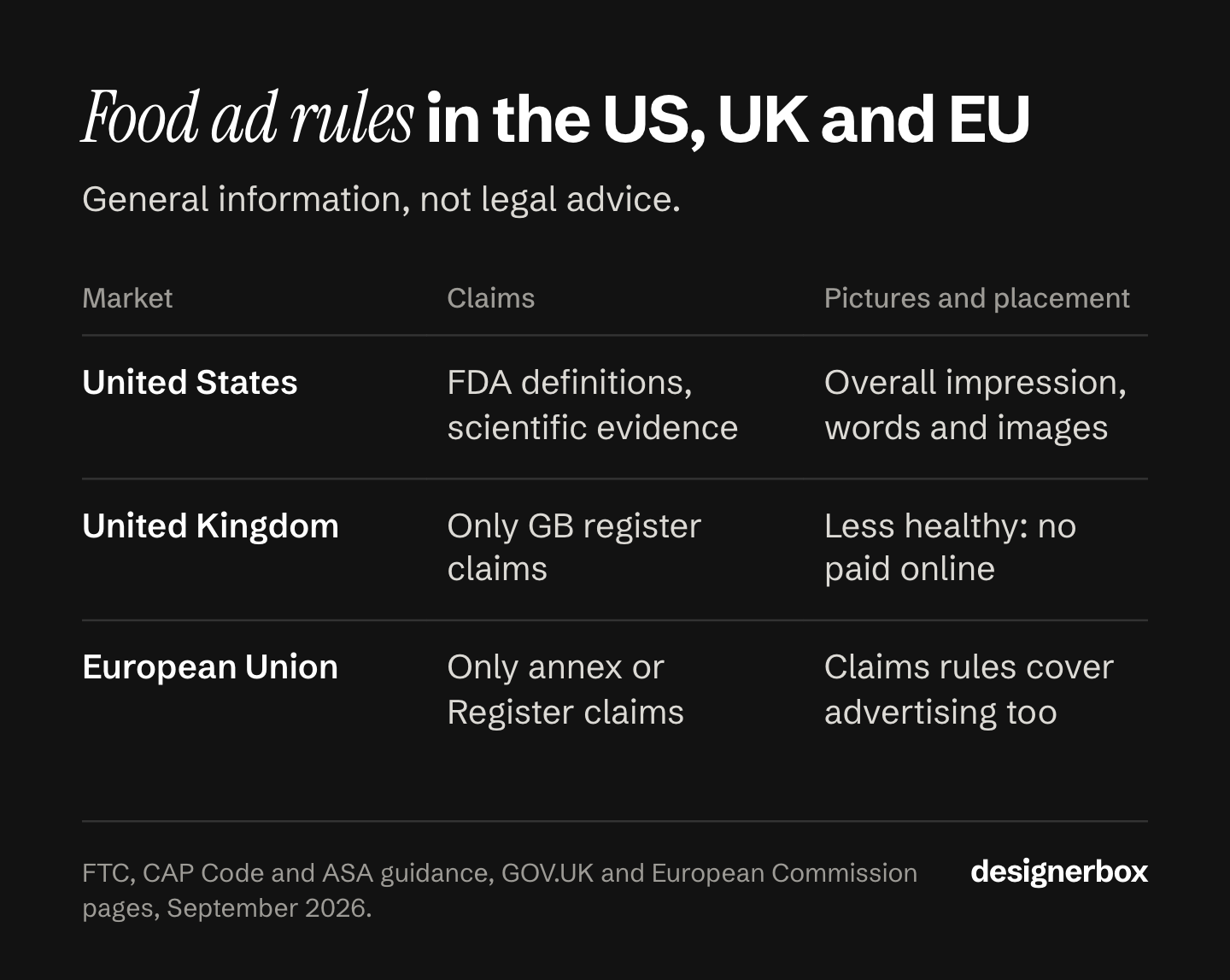
Three kinds of rules apply to most food ads. General advertising law says the ad must not mislead, in its words or its pictures. Claims law says what a nutrient or health claim may say. And some markets limit where ads for less healthy food may run. The US, the UK and the EU handle all three in different ways. This is general information, not legal advice.
In the United States
The FTC’s Enforcement Policy Statement on Food Advertising, issued on 13 May 1994, is still the base text (ftc.gov, accessed September 2026). It makes three points a brand needs to know:
- FDA definitions apply in ads. The FTC says it “will apply FDA’s definitions for absolute nutrient content terms when those terms are used in the same context in advertising.” So “low fat” in an ad means what it means on the label.
- Health claims need science. The FTC asks for “competent and reliable scientific evidence” behind a health claim. Supplement advertising uses the same test, with its own label rules.
- Leaving out a risk can deceive. A food can make a health claim and also contain a nutrient that raises a disease risk. The FTC says failing to disclose that nutrient is “likely to constitute an omission of a material fact”.
The statement also says the FTC will “focus on the ad’s overall net impression”, including “the juxtaposition of phrases, images, and the nature of the claim.” Its guide for small businesses puts it plainly: the FTC reads “words, phrases, and pictures” in context (ftc.gov, accessed September 2026). Fresh strawberries beside a strawberry-flavored drink can make a claim without a single word.
The definitions also change. The FDA announced an updated “healthy” claim in December 2024, with limits on added sugars, saturated fat and sodium (fda.gov, accessed September 2026). Companies that use the word must follow the new definition by 25 February 2028, the compliance date in the final rule (federalregister.gov, accessed September 2026).
For ads aimed at children, the main US framework is voluntary. Members of the Children’s Food and Beverage Advertising Initiative either do not advertise food to children or advertise only products that meet its nutrition criteria (bbbprograms.org, accessed September 2026).
In the United Kingdom
The CAP Code covers non-broadcast ads, and the ASA enforces it. Rule 3.11 says ads “must not mislead consumers by exaggerating the capability or performance of a product”. Rule 3.2 allows obvious exaggeration that the average consumer will not take literally (asa.org.uk, accessed September 2026).
Section 15 of the code covers food claims. Only nutrition claims listed in the applicable register may be used, and only health claims listed there as authorized (rule 15.1.1). Claims that a food prevents, treats or cures a disease are banned (rule 15.6.2) (asa.org.uk, accessed September 2026).
The newest rule restricts less healthy food. From 5 January 2026, ads for identifiable less healthy food and drink cannot run on UK TV or on-demand services between 5.30am and 9pm. Paid online ads for them are banned at any time (asa.org.uk, December 2025).
A product counts as less healthy when two things are true. It sits in one of 13 categories, such as soft drinks with added sugar, breakfast cereals, confectionery, pizza and complete meals. And it scores 4 or more for a food, or 1 or more for a drink, on the 2004 to 2005 nutrient profiling model (gov.uk, accessed September 2026).
Three details decide whether a given ad is in scope, according to the ASA’s guidance (asa.org.uk, updated April 2026):
- Company size. The rules do not apply when a food or drink SME pays for the ad. An SME here employs fewer than 250 people (legislation.gov.uk, accessed September 2026).
- An identifiable product. An ad is caught when people in the UK could reasonably identify it as an ad for that product. A brand ad that shows no specific less healthy product may qualify for the brand advertising exemption. If the ad shows one, the brand exemption does not apply.
- Paid space. The online rule covers paid-for ads only. A brand’s own website and its unpaid social posts are not paid-for ads. The other ad rules still apply there.
Alcohol has its own rules. In the UK, CAP rule 18.16 says people shown drinking must not be or seem to be under 25 (asa.org.uk, accessed September 2026). The US label rules for alcohol ads are in our guide to bottle product photography.
In the European Union
Regulation (EC) No 1924/2006 sets the EU rules for nutrition and health claims. The European Commission says they cover claims in labeling, presentation and advertising, and that each claim must be clear, accurate and based on science (food.ec.europa.eu, accessed September 2026). Nutrition claims must be on the annex list. Health claims must be authorized and listed in the EU Register.
| Market | Nutrient and health claims | Pictures and placement |
|---|---|---|
| United States | FDA definitions apply to nutrient words in ads. Health claims need scientific evidence | The FTC judges the overall impression of words and images. Ads to children follow voluntary pledges |
| United Kingdom | Only claims on the GB register (CAP section 15) | No misleading exaggeration (rule 3.11). Less healthy products: no TV from 5.30am to 9pm, no paid online ads, for companies with 250 or more employees |
| European Union | Only claims on the annex list or the EU Register | The claims rules cover advertising too. Check national ad rules for each country |
Where does food styling become misleading?
Food styling becomes misleading when the picture shows something the buyer will not get: more of the product, extras that are not included, or a quality the product does not have. Styling that shows the real product at its best is normal practice. The risk grows when a stand-in replaces the product itself, and the ad asks viewers to judge that product with their own eyes.
Food stylists have a long list of tricks. A 2025 trade article from the ad network Gourmet Ads lists 13, including mashed potato in place of ice cream, white glue in place of milk, and acrylic ice cubes (gourmetads.com, October 2025). Some change nothing the buyer pays for. Others replace the product itself.
The US line comes from a 1965 case about a shaving cream ad. In FTC v. Colgate-Palmolive, the Supreme Court held that “the undisclosed use of plexiglass in the present commercials was a material deceptive practice” (law.cornell.edu, accessed September 2026). The Court tied the problem to ads that ask viewers to trust their own eyes as proof of a claim. It said its order does not cover an ad where actors eat mashed potatoes that look like ice cream, because that prop is not used as proof.
The UK line comes from the ASA. Its guidance says a picture of stew with potatoes and rice “is likely to mislead if the customer will only receive the stew”, unless the ad makes clear that the sides cost extra (asa.org.uk, September 2025). In a 2019 ruling, the ASA looked at a ready-meal ad marked “serving suggestion”. It still found the ad misleading, because the rice and potatoes “appeared to be part of the respective meals” (asa.org.uk, November 2019).
The table below is a working test built from those sources, for a shoot or an AI run. It does not replace legal review.
| Styling that shows the real product | A change that can mislead |
|---|---|
| A fresh garnish and a clean plate | More toppings or pieces than the pack holds |
| Acrylic ice in a drink shot | A fill level or glass size the product does not have |
| Sides clearly marked as not included | Sides that look like part of the meal |
| Better light, with dust and crumbs removed | A color or texture the product does not have |
| A prop behind the product | A stand-in for the product, used as proof of a quality |
| The real label, with the glare removed | A label with words that differ from the real pack |
AI image tools make these changes easy to make by accident. A model can add prawns to a bowl, raise the level in a jar or shift the color of a drink. The same rules apply. In September 2024 the then FTC chair Lina Khan said “there is no AI exemption from the laws on the books” (ftc.gov, September 2024). What AI may change in a scene is set out in AI product ads. When an AI label is needed, AI disclosure in ads lists the rules now in force.
Six food and drink ad formats that work
This guide sorts food and drink ads into six formats: the packshot, the ingredient shot, the in-use shot, the recipe ad, the pour shot and the creator clip. Each one proves a different thing. Pick the format by the claim you can prove, then run the check that goes with it. The table lists all six.
| Format | What it shows | What it proves | Check before it runs |
|---|---|---|---|
| Packshot | The pack alone, on a plain or colored ground | This is the product on the shelf | Label words, pack size and color match the real pack |
| Ingredient shot | The product with its ingredients around it | What goes into it | Show only ingredients the product really contains |
| In-use shot | A person eating or drinking in a real moment | It fits a daily habit | The portion and the sides are what the buyer gets |
| Recipe ad | The product as one part of a finished dish | How to use it | Make clear which part of the dish is the product |
| Pour shot | A drink in motion, cold and fresh | Taste and freshness | The real color and fill level. For alcohol, the age rules on anyone shown |
| Creator clip | A real person filming with the product | Trust from a peer | A clear paid label, and real opinions only |
Drink ads and beverage ads often use the pour shot. Cold light, condensation and ice sell freshness. Acrylic ice is a prop around the product, and it stays clear under studio lights. The color of the drink and the level in the glass are the product, so they stay true. For a whole range, this guide to drinks range photos shows the set step by step.

Creator clips follow the endorsement rules. The FTC says “your company is ultimately responsible for what others do on your behalf”. It also says a creator who was paid, or who got the product free, should say so clearly (ftc.gov, accessed September 2026).
For more ad shapes, see the static ad examples and the product ad examples, with the platform rule each shape has to pass. The steps behind any single ad are in how to make an ad.
How to run one food campaign in every market
Run one food campaign in every market by fixing the claims first and the formats second. The picture can travel, but the words, the claims and some placements cannot. For example, 80 products in three markets and six formats make 1,440 ad files before any resizing.
- Write one claims sheet per market. Check every nutrient and health word against the FDA definitions, the GB register and the EU list. Remove a word from any market where it fails.
- Check each product against the UK rule. Is it in one of the 13 categories? Does it score 4 or more as a food, or 1 or more as a drink? Does your company employ 250 people or more? If all three answers are yes, the paid online version for the UK needs a brand ad with no identifiable product.
- Build all six formats from the same source photo. Use the real pack photo for every format, so the label stays the same everywhere.
- Translate and resize. Each market gets its own language, and each placement its own size. Longer words can break a layout. The size each platform asks for is listed in image ads.
- Compare every frame with the real product. Check the label text, the fill level, the color and the portion.
- Keep the evidence. File the source photo and the proof for each claim next to the ad. The FTC checks whether the advertiser has “sufficient evidence to support the claims in the ad”, and CAP rule 15.1 asks for documentary evidence behind nutrition and health claims.
Food and drink ads as a workflow
Anyone can make an AI picture. Making hundreds that still look like your brand is the hard part. A food campaign needs the same pack, the same light and the same brand rules on every product, in every market and every size.
DesignerBox is AI creative production for brands and agencies. You build the job once as a workflow: the real pack photo goes in, then the scene, the format, the brand rules and the sizes. You set your fonts, colors and logo once in Brand. The workflow reads them on every run. The AI ad generator starts from your own product photo. Food and drink product photography covers the pack shot, the pour and the condensation.
For the markets, one ad can be rebuilt in another language, with the layout redrawn. One ad can also be resized to the formats ad platforms need. Batch runs one workflow over a whole sheet of products. You review the results in one pass, keep or discard per row, and re-run one row on its own. The cost is shown before each run. The full workflow from the first product photo to the finished ad, in one subscription.
Three critic steps score the results, and best-of-N keeps the best one. You still check each frame against the real pack, because only you know the real fill level and label.
Here are the limits. DesignerBox does not publish into Meta, TikTok or Google. You download the results, or send them with a webhook or an S3 step. Uploading your own photos and the commercial license start on the Pro plan. Video starts on the Premium plan, and the free plan cannot make video. Team features, shared brand kits and white label are on the Ultra plan, and every plan below Ultra is one seat.
A free plan for your first run
There is a free plan, and it runs on sample products. Start from a template and see the cost before you run it. Get started free.
FAQ
What are the rules for food advertising in the US?
The FTC’s 1994 policy statement on food advertising is the base. The FTC applies FDA definitions to nutrient terms such as “low fat” in ads, and asks for scientific evidence behind health claims. It judges an ad by its overall net impression, pictures included.
Is food styling in ads legal?
Styling that shows the real product at its best is normal practice. The risk starts when the picture shows more than the buyer gets, such as extra toppings or sides that are not included, or when a stand-in replaces the product as proof. Compare every frame with the real product.
What is the UK ban on less healthy food ads?
Since 5 January 2026, ads for identifiable less healthy food and drink cannot run on UK TV between 5.30am and 9pm, or in paid online space at any time. The rule covers 13 product categories, scored by a nutrient model. Food and drink businesses with fewer than 250 employees are exempt.
Can a food ad use AI-generated images?
Yes, and the same advertising rules apply to them. Check that each AI frame shows the real label, fill level, color and portion. Some platforms and laws also ask for an AI label, so check the rules for each placement.
What makes a good drink ad?
A good drink ad shows the serve at its freshest: cold light, condensation, a clean pour and the real color of the drink. Props such as acrylic ice are common. Keep the drink itself true. For alcohol in the UK, never show anyone drinking who is or looks under 25.
What are some food ad examples?
This guide sorts food ad examples into six formats: the packshot, the ingredient shot, the in-use shot, the recipe ad, the pour shot and the creator clip. Each one proves a different claim, so pick the format by what you can prove.
Sources
- FTC, Enforcement Policy Statement on Food Advertising, May 1994: ftc.gov, accessed September 2026
- FTC, Advertising FAQs: A Guide for Small Business: ftc.gov, accessed September 2026
- FTC, “FTC Announces Crackdown on Deceptive AI Claims and Schemes”: ftc.gov, September 2024, accessed September 2026
- FTC, “FTC’s Endorsement Guides: What People Are Asking”: ftc.gov, accessed September 2026
- FDA, Use of the “Healthy” Claim on Food Labeling: fda.gov, accessed September 2026
- Federal Register, “Food Labeling: Nutrient Content Claims; Definition of Term ‘Healthy’”, final rule, 27 December 2024: federalregister.gov, accessed September 2026
- FTC v. Colgate-Palmolive Co., 380 U.S. 374 (1965), via Cornell LII: law.cornell.edu, accessed September 2026
- BBB National Programs, Children’s Food and Beverage Advertising Initiative: bbbprograms.org, accessed September 2026
- ASA and CAP, advice on exaggeration: asa.org.uk, accessed September 2026
- UK CAP Code, section 15, Food, food supplements and associated health or nutrition claims: asa.org.uk, accessed September 2026
- UK CAP Code, section 18, Alcohol: asa.org.uk, accessed September 2026
- ASA, “A picture says a thousand words. Avoiding misleading imagery in ads”: asa.org.uk, September 2025, accessed September 2026
- ASA ruling on a ready-meal ad and the words “serving suggestion”: asa.org.uk, November 2019, accessed September 2026
- ASA, “New rules and guidance for less healthy food and drink advertising”: asa.org.uk, December 2025, accessed September 2026
- ASA and CAP, advice on less healthy food products: asa.org.uk, updated April 2026, accessed September 2026
- GOV.UK, Restricting advertising of less healthy food or drink on TV and online: products in scope: gov.uk, accessed September 2026
- The Advertising (Less Healthy Food Definitions and Exemptions) Regulations 2024, regulation 4: legislation.gov.uk, accessed September 2026
- European Commission, Nutrition and health claims: food.ec.europa.eu, accessed September 2026
- UConn Rudd Center for Food Policy and Health, Food Marketing: uconnruddcenter.org, accessed September 2026
- Arrona-Cardoza P. and others, “The Effects of Food Advertisements on Food Intake and Neural Activity: A Systematic Review and Meta-Analysis of Recent Experimental Studies”, Advances in Nutrition, 2023: pmc.ncbi.nlm.nih.gov, accessed September 2026
- Gourmet Ads, “Food Advertising Tricks”: gourmetads.com/articles/food-advertising-tricks, October 2025
- DesignerBox food and drink product photography page (designerbox.ai/ai-product-photography/food-beverage), September 2026
Food advertising rules verified from the FTC, the FDA, the ASA, GOV.UK, legislation.gov.uk and the European Commission as of September 2026. Individual results vary.