


Social commerce is selling products inside social apps. For most brands that means three shops: TikTok Shop, Instagram Shop and Facebook Shop. They do not work the same way. On TikTok Shop the buyer pays inside the app. On Instagram and Facebook the shop shows the product, and since September 2025 the buyer pays on your website. All three show square product images.
Many guides still describe one model for all three. That was close to true until 2025. Then Meta moved checkout out of its apps, and the three shops split into two groups.
This guide covers how each shop works for a seller, what each one asks of your product images, and how to build one image set that fits all three. It is written for brands with 20 to 500 products and the agencies that list for them.
Key Takeaways
- Three shops, two checkout models. TikTok Shop completes the order in the app. Instagram Shop and Facebook Shop send the buyer to your website to pay.
- Meta changed in September 2025. Meta’s help page says “Shops on Facebook and Instagram now use website checkout” (Meta Business Help Center, October 2026).
- Meta’s shops need a website. Meta’s eligibility rules ask for product listings that are “available for direct purchase from your website”, and one domain you sell through.
- All three show square images. TikTok Shop takes up to 9 square images per listing. Meta displays shop images in a square format and asks for at least 500 x 500 pixels.
- One set covers all three. Nine square images at 1600 x 1600 pixels, with the main image on white and no text on any image, meet the published rules of all three shops.
- TikTok Shop is the strictest. Its listing policy does not allow placeholders or digital renderings of a product, so start from a real photo.
What is social commerce?
Social commerce is the sale of products inside a social media app. The buyer finds the product in a feed, a video or a shop page, and starts the purchase there. In some apps the buyer also pays there. In others the app sends the buyer to the seller’s website for the payment. Both count as social commerce.
It is a small part of online retail, and it grows each year. US social commerce was forecast to pass $87 billion in 2025 and to exceed $100 billion in 2026, according to Emarketer figures reported by Retail Dive (published December 2025, read October 2026). The same report put TikTok Shop at nearly 20% of US social commerce in 2025. It said most of the rest goes through Facebook Marketplace and Instagram.
These are forecasts, and they cover the United States only.
Three shops, two checkout models
The first question for a seller is where the buyer pays. It decides who handles orders, returns and disputes.
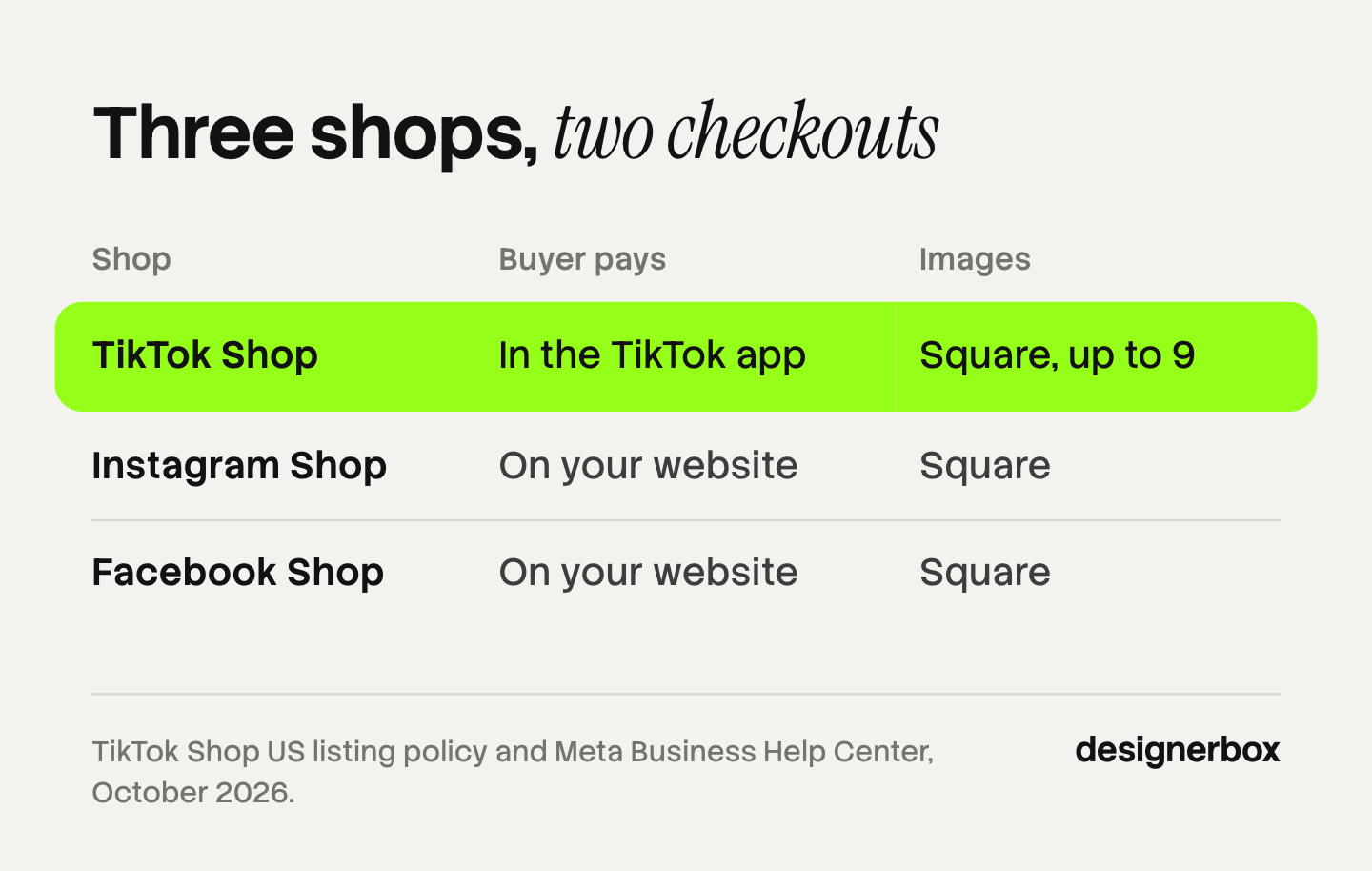
| Shop | Where the buyer pays | Who manages the order | Images shown as |
|---|---|---|---|
| TikTok Shop | Inside the TikTok app | TikTok Shop and the seller, in the app | Square, up to 9 per listing |
| Instagram Shop | On your website | You, on your website | Square |
| Facebook Shop | On your website | You, on your website | Square |
Sources: TikTok newsroom, TikTok Shop US Product Listing Policy and Meta Business Help Center, all read October 2026.
Instagram Shop and Facebook Shop are two views of one setup. Meta’s help pages treat them together as “Shops on Facebook and Instagram”, and both display the products in your Meta catalog. So for planning there are two systems to feed: TikTok Shop, and one Meta catalog.
How does TikTok Shop work for a seller?
TikTok Shop is a marketplace inside the TikTok app. A buyer can tap a product in a video or a live stream, or browse the Shop tab. TikTok’s launch post describes a “Secure Checkout” that uses third-party payment platforms, and a Shop tab where customers “manage orders, all within a single tab” (TikTok newsroom, read October 2026).

So the listing does the selling. The buyer may never see your website. That makes the listing images and the listing video more important here than on the other two shops.
TikTok publishes firm rules for those images. The US Product Listing Policy allows up to 9 square images and one video of 5MB or less. The main image needs a pure white background. The policy also says “Placeholders and digital renderings of a product are not allowed” (TikTok Shop US Product Listing Policy, October 2026). The full rule set, with the differences between the US and UK seller pages, is in TikTok Shop product images. The listing video has its own guide: TikTok Shop product videos.
How do Instagram Shop and Facebook Shop work now?
A shop on Instagram or Facebook is a storefront without a till. It has a home page, collections and product pages. When the buyer chooses to buy, Meta sends them to your website.
This is recent. Meta’s help page says: “As of September 2025, Shops on Facebook and Instagram now use website checkout.” It adds that customers “are now directed to your own website to complete the purchase” (Meta Business Help Center, October 2026).
Three things follow for a seller, all from the same page:
- Orders are yours. Meta ended payouts, order management, returns and dispute handling in Commerce Manager for new orders. You manage them on your own site.
- Your product page closes the sale. The shop shows the product. Your website has to match it in price, images and stock.
- Ads point to the website. Meta retired the “Website and shop” conversion location. Shops ads now use “Website”.
Meta also sets entry rules. Its commerce eligibility requirements (October 2026) list five. You follow Meta’s policies. Your profile has product listings “available for direct purchase from your website”, with one domain. You are in a supported country. Your profile shows “trustworthiness”, which Meta says may include “a sufficient follower base”. Your product information is accurate, with a clear refund and return policy.
If your store runs on Shopify, the product page that Meta sends buyers to is covered in Shopify product images.
Which social commerce platform fits your products?
Most brands do not choose one. The useful question is the order in which to set them up.
- Start with Meta’s shops if you already have a store with checkout. Meta requires the website, and the catalog also feeds your Facebook and Instagram ads. One catalog serves two shops and the ads.
- Start with TikTok Shop if short video already sells your product. The order completes in the app, so a viewer can buy without leaving the video. You accept TikTok’s listing rules and its checkout in return.
- Run both when the catalog is ready. The image rules overlap enough that one set of files serves both, as the next two sections show.
This is a difference of scope. TikTok Shop is a marketplace with its own checkout. Meta’s shops are a product display in front of your own store.
What product images does each shop need?
All three shops show square product images. The published rules differ in detail.
| Rule | TikTok Shop | Instagram Shop and Facebook Shop |
|---|---|---|
| Shape | Square | Displayed square (1:1) |
| Minimum size | 600 x 600 px on the US page, 800 x 800 px on the UK page | 500 x 500 px, 1024 x 1024 px recommended |
| Number of images | Up to 9 | At least 1, “4 or more” recommended |
| Main image | Pure white background | Clear, shows the entire product |
| Text and logos | No added logos, text, borders or watermarks | No text over the product, no calls to action, promo codes or watermarks |
| Renderings | Placeholders and digital renderings not allowed | Images “must accurately represent the specific product for sale” |
| File | Color only | JPEG or PNG, 8 MB maximum |
Sources: TikTok Shop US Product Listing Policy, TikTok Shop UK best practices and Meta’s product image specifications for catalogs, all read October 2026.
Meta’s page also recommends a white backdrop, close-ups of texture or details, and “the same product images that appear on your website”. It warns against a placeholder image, because a replaced image needs a new URL before the catalog refreshes it.
Read the two columns together and TikTok Shop is the stricter one on almost every row. An image set built to TikTok’s rules passes Meta’s rules too. The reverse is not always true.
One image set for three shops
Build the set once, to the stricter rule on each row. Then load the same files into both systems.
- Start from a real photo of the product. TikTok Shop’s listing policy does not allow digital renderings. Editing a real photo, such as a new background or better light, is a different thing from making the product up.
- Make the main image on pure white. It meets TikTok’s rule and Meta’s recommendation.
- Export every image square at 1600 x 1600 pixels. That is above every minimum in the table, and it leaves room to crop.
- Fill 9 slots with different views. Front, back, side, a detail close-up, the product in use, scale, and what is in the box. TikTok asks for different angles. Meta recommends four or more.
- Keep text off every image. No price flash, no promo code, no added logo. Both rule sets say so.
- Save as JPEG, in color. Meta prefers JPEG over PNG. TikTok rejects black and white.
Nine images for one product is a small job. Nine images for 200 products is 1,800 files that must share one white point, one crop and one look. That is where most catalogs drift. The feed side of each shop is a separate set of tall images and video, covered in Instagram product photos and AI images for paid social.

Do you have to label AI images in a social shop?
It depends on the shop and on how much AI did.
TikTok Shop’s AI content policy says creators must “proactively disclose content that is fully generated or significantly edited using AI”. It also says content “will not be restricted or penalized solely for using AI”. It lists edits such as changing a background or adjusting light and color as allowed, “as long as the product information is not altered” (TikTok Shop AI-generated content policy, October 2026).
Meta’s catalog page has no AI rule. It asks that an image accurately represents the product for sale. Meta’s rules for AI labels on posts and ads sit on other pages. They are set out, with the EU rules, in marketplace rules for AI product photos.
This is general information, not legal advice.
The same listing set for every product
Anyone can make an AI picture. Making hundreds that still look like your brand is the hard part. Three shops make that harder, because every product needs the same nine views to the same rules.
DesignerBox is AI creative production for brands and agencies. You build one workflow for the listing set: white main image, square crops, the views you chose. The workflow reads your brand rules on every run. Batch runs it over a sheet of products, and you keep or discard each row in one review pass. The standard on row one and row two hundred is the same. The page for TikTok Shop sellers shows the listing pictures and short product video in one look.
The full workflow from the first product photo to the finished ad, in one subscription. The cost is shown before each run. Uploading your own photos and the commercial license start on the Pro plan. AI video, virtual try-on, upscaling, the image editor and the video editor start on the Premium plan. Plans and credits are on the pricing page.
Here are three limits. DesignerBox does not post to TikTok Shop or to your Meta catalog: you download the results, or send them with a webhook or an S3 step. It works from the photo you give it, so the real product photo is still your job. Every plan below Ultra is one seat.
A free plan for your first run
There is a free plan, and it runs on sample products. Start from a template and see the cost before you run it.
FAQ
What is the difference between social commerce and ecommerce?
Ecommerce is any sale made online. Social commerce is the part of it that starts inside a social app, such as TikTok, Instagram or Facebook. In some apps the buyer also pays there. In others the app sends the buyer to the seller’s website to pay.
Can customers still check out on Instagram or Facebook?
No. Meta’s help page says that as of September 2025, Shops on Facebook and Instagram use website checkout. The shop still has a home page, collections and product pages. The buyer is sent to your website to complete the purchase, and you manage orders and returns there.
Do you need a website for an Instagram Shop or a Facebook Shop?
Yes. Meta’s commerce eligibility requirements ask for product listings that are available for direct purchase from your website. You give Meta the one domain you sell through, and Meta may ask you to verify that you own it.
What size are product images on Instagram Shop and Facebook Shop?
Meta displays shop images in a square format. Images must be at least 500 x 500 pixels, and Meta recommends 1024 x 1024 pixels. Files are JPEG or PNG and 8 MB at most (Meta Business Help Center, October 2026).
Can one set of product images work on TikTok Shop and Meta’s shops?
Yes, if you build to the stricter rule. Nine square images at 1600 x 1600 pixels, with the main image on pure white and no text or added logos, meet the published image rules of TikTok Shop, Instagram Shop and Facebook Shop as of October 2026.
Does TikTok Shop allow AI product images?
TikTok Shop’s listing policy does not allow placeholders or digital renderings of a product. Its separate AI content policy allows edits to a real photo, such as a new background or better light, when the product information is not altered. It asks creators to disclose content that is fully made or heavily edited with AI.
What does a listing image set cost to make with AI?
It depends on the tool and the number of images. In DesignerBox the cost is shown before the run, for one product or for a whole sheet. Plans are on the pricing page.
Sources
- Meta Business Help Center, About changes to Shops and checkout on Facebook and Instagram: website checkout since September 2025, discontinued order features, the Website conversion location, read October 2026
- Meta Business Help Center, Commerce eligibility requirements: the five requirements, read October 2026
- Meta Business Help Center, Product image specifications for catalogs: square display, pixel sizes, file types, text and placeholder guidance, read October 2026
- TikTok Shop US, Product Listing Policy: 9 square images, 600 x 600 minimum, pure white main image, no placeholders or digital renderings, one video of 5MB, read October 2026
- TikTok Shop UK, Best practices for product listings: 800 x 800 minimum, read October 2026
- TikTok Shop US, AI-generated content policy: disclosure and permitted edits, read October 2026
- TikTok newsroom, Introducing TikTok Shop: in-feed shopping, Shop tab and checkout, read October 2026
- Retail Dive, TikTok Shop is driving social commerce growth: Emarketer forecasts for US social commerce, published December 2025, read October 2026
- DesignerBox batch and plan gates: DesignerBox batch page (designerbox.ai/product/batch) and DesignerBox pricing page (designerbox.ai/pricing), October 2026
Shop rules verified on Meta’s and TikTok’s own pages, October 2026. TikTok Shop rules are from the US and UK seller pages and may differ in other regions. Market figures are forecasts for the United States. The 200-product count is an illustration. Individual results vary.