

Supplement advertising in the US follows the rules of two federal agencies and of every ad platform you use. The FTC judges the ad itself. Every stated or implied health claim needs competent and reliable scientific evidence, which usually means human clinical trials. The FDA sets the label rules: structure or function claims are allowed, and disease claims are not. Meta, Google, TikTok and Amazon then add their own limits.
Imagine a supplement brand with 60 products and one winning ad. The plan is to make 40 more versions of the winner. The risk sits in the versions. A new headline adds a benefit nobody tested. A new photo puts a model in a lab coat. Each small change can add a claim you cannot support to a legal ad.
This guide is for supplement and wellness brands with 20 to 500 products, and for their agencies. For the product photos under the ads, see AI supplement product photography. The guide covers the ad side of supplement marketing, rules first: the FDA claim line, how the FTC reads an ad, testimonials and before-and-after photos, and what each ad platform adds. Then it gives 8 ad formats that work inside those rules, and a method to make variants from a winner without changing the claim. This is general information, not legal advice.
Key Takeaways
-
The FTC judges the whole ad. Words, pictures and layout all count. A disclaimer cannot fix a claim that it contradicts.
-
Structure or function, never disease. “Calcium builds strong bones” is the FDA’s own example of a structure or function claim. A claim to treat, cure or prevent a disease is a drug claim.
-
Health claims need human trials. FTC staff guidance says a health benefit generally needs randomized, controlled human clinical testing.
-
A testimonial proves nothing on its own. The result must be typical, or the ad must say clearly what buyers can expect. “Results not typical” does not fix it.
-
Platform approval is not legal approval. Meta allows a weight loss result for adults when the ad shows the time it took. The FTC still asks whether that result is typical.
-
Keep the claim, change the frame. Make variants from a winner by changing the scene, the format, the size and the language. Keep the claim the same.
What can supplement advertising claim in the US?
A supplement ad can make structure or function claims. It can say how a nutrient or ingredient affects the normal structure or function of the body. It cannot claim to diagnose, treat, cure or prevent a disease, because only a drug may make that claim. Every claim, stated or implied, also needs evidence before the ad runs.
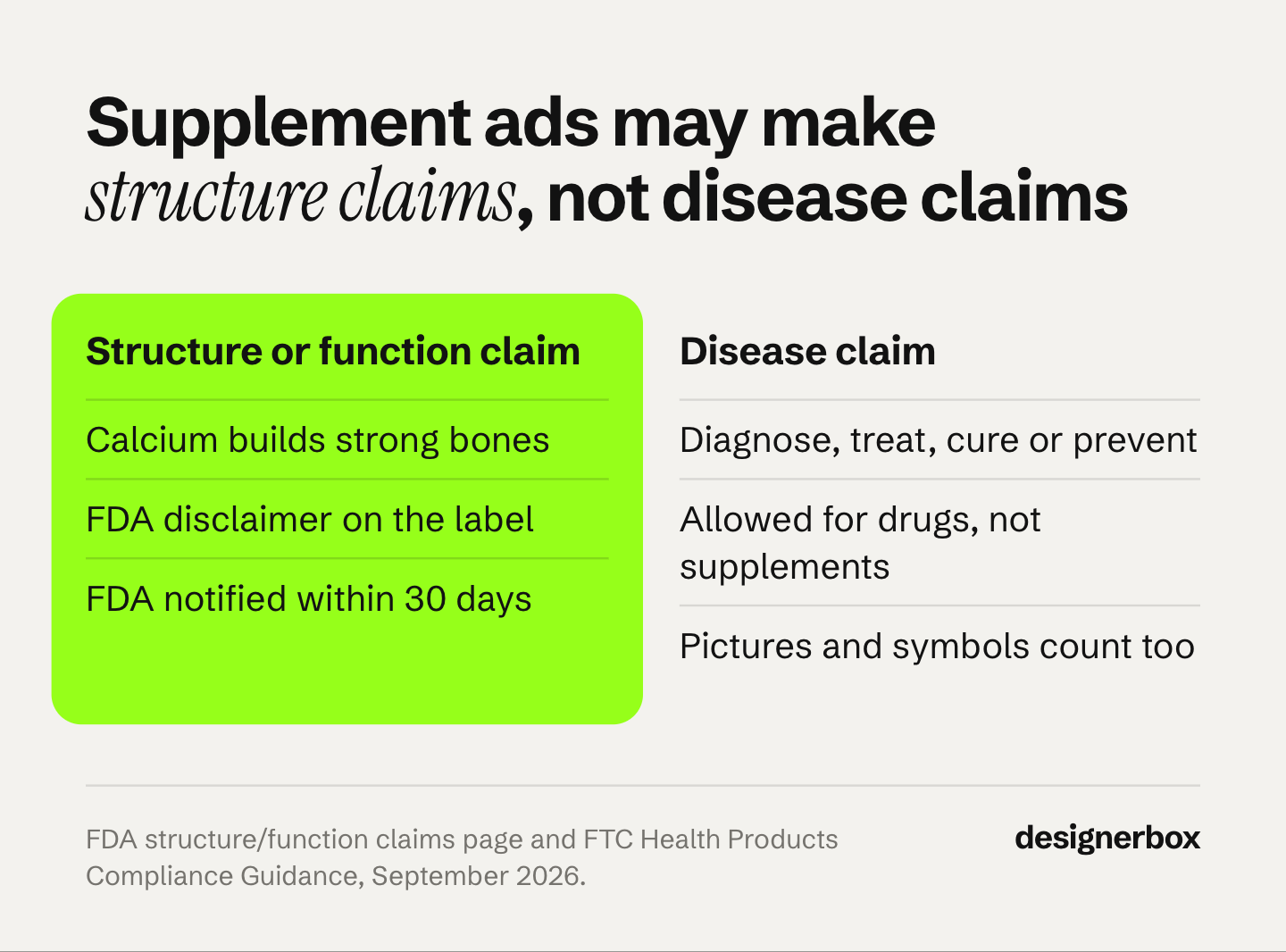
The FDA’s own example of a structure or function claim is “calcium builds strong bones” (fda.gov, September 2026). The Dietary Supplement Health and Education Act of 1994 (DSHEA) set special rules for these claims. The FDA does not approve them in advance. The maker must hold evidence that each claim is true. It must also notify the FDA no later than 30 days after it first sells the product with the claim.
On the label, a structure or function claim needs a disclaimer. The text is fixed in 21 CFR 101.93: “This statement has not been evaluated by the Food and Drug Administration. This product is not intended to diagnose, treat, cure, or prevent any disease.” (law.cornell.edu, 21 CFR 101.93, September 2026).
The same regulation lists the ways a statement becomes a disease claim. Two of them matter for ads: the product name, and “pictures, vignettes, symbols, or other means”. A legal sentence next to a picture of a hospital bed can read as a disease claim. The supplement product photography guide covers the images that carry this risk.
Two agencies share the work. In the FTC’s words, the FDA is responsible for claims “in labeling”, and “the FTC has primary responsibility for claims in all forms of advertising”. That includes social media and influencer marketing (ftc.gov, September 2026).
How does the FTC judge a supplement ad?
The FTC reads the ad as a whole. It asks what a reasonable viewer takes from the words, the pictures and the layout together. Then it asks whether you held evidence for that message before the ad ran. For a health benefit, FTC staff guidance says the evidence generally means randomized, controlled human clinical trials.
That guidance is the Health Products Compliance Guidance. FTC staff published it in December 2022 to replace the 1998 guide for supplement advertising (ftc.gov, December 2022). It “doesn’t have the force or effect of law”, but it explains how the FTC applies the law.
Four points from it shape every supplement ad:
- The net impression counts. Marketers should consider “each ad as a whole”, and they are “equally responsible” for claims the ad implies.
- Pictures make claims. In one FTC example, a weight loss brochure shows doctors in lab coats, microscopes and medical journals. The FTC says it likely implies the product is clinically proven. In another, a vitamin ad says 90% of cardiologists take the product, which likely implies a heart benefit. Food ads face the same picture test, as the food advertising guide shows.
- “Clinically tested” implies proof. In the FTC’s example, “clinically tested ingredient” implies that the test results prove a benefit. A test of one ingredient may not support a claim about the finished product.
- Fine print cannot contradict the ad. A clear disclosure can explain an unclear claim, but “it can’t directly contradict a claim”. The guidance adds that the DSHEA disclaimer “isn’t required in other forms of advertising”, and that it “won’t cure an otherwise deceptive ad.”
On 13 April 2023 the FTC sent notices of penalty offenses to about 670 companies. These notices are formal warning letters. The companies market over-the-counter drugs, homeopathic products, supplements or functional foods (ftc.gov, April 2023). One practice the notices list is “misrepresenting that a product claim has been scientifically or clinically proven”. The FTC said the companies could face civil penalties if they could not support their claims. It also said that a company on the list is not accused of breaking the law.
The maximum civil penalty is $53,088 per violation (ftc.gov, February 2025). That is the 2025 figure. The White House budget office canceled the 2026 inflation adjustment, so agencies keep the 2025 amounts (whitehouse.gov, April 2026).
What are the rules for testimonials and before-and-after photos?
A testimonial must come from a real user and reflect an honest experience. The FTC reads one customer’s result as a statement of what buyers will generally get. If the result is better than typical, the ad must say clearly what buyers can generally expect. A short “results not typical” line does not meet that test.

The FTC Endorsement Guides set the rules. “Consumer endorsements themselves are not competent and reliable scientific evidence” (law.cornell.edu, 16 CFR 255.2, September 2026). A hundred five-star reviews do not prove “supports immune health”. If a customer’s result is not typical, the ad “should clearly and conspicuously disclose the generally expected performance”.
The FTC’s guidance shows what that means for a before-and-after photo. In its example, a magazine ad shows a woman’s before-and-after photos and her words: she “lost 16 pounds in eight weeks while using the product.” An asterisk points to fine print: “These results are not typical. Your weight loss may not be the same.” A well-run trial showed an average loss of four pounds more than placebo over eight weeks. The FTC says the vague line fails. A better disclosure sits next to the quote: “In an 8-week study, subjects taking the supplement lost an average of 5 pounds. Subjects taking a placebo lost an average of 1 pound.” Beauty brands face a similar before-and-after test, and the makeup ads guide covers it.
Three more rules apply to people in supplement ads:
- Influencers cannot say what you cannot say. An endorsement “may not convey any express or implied representation that would be deceptive if made directly by the advertiser” (16 CFR 255.1, September 2026). The brand is liable for “misleading or unsubstantiated statements made through endorsements”. The same goes for affiliates, and affiliate creative assets covers the pack you give them.
- Actors must not appear as customers. An ad that presents “actual consumers” must use actual consumers, or “clearly and conspicuously disclose” that they are not. An AI-made person presented as a customer falls under the same rule.
- Experts need real credentials. FTC staff guidance says an expert endorser needs “appropriate qualifications” and must have examined or tested the product. Any paid tie between the expert and the brand should be disclosed.
The FTC’s rule on consumer reviews and testimonials adds one more point. It covers reviews by people who do not exist, “such as AI-generated fake reviews” (ftc.gov, August 2024). AI can design a review card. It cannot write the customer’s words.
What do Meta, Google, TikTok and Amazon add?
Each platform adds its own rules to the law. Meta and TikTok set age limits and ban body shaming. Google bans miracle cures, unrealistic weight loss and a list of unapproved ingredients. Amazon requires listing amounts to match the Supplement Facts panel. A platform can approve an ad that the FTC would still call deceptive.
| Platform | The rule | What it means for the creative |
|---|---|---|
| Meta | Dietary, health and weight loss or weight gain products must target people 18 or older. No “statements of inferiority about physical appearance”. No close-up of a body area with pinched fat in a weight loss ad | Adult audiences only. Show the product and the routine, never a body flaw |
| Meta | No “promises of specific outcomes within a set timeframe without disclaimers or qualifiers” | If a result appears, a qualifier appears next to it |
| Meta | Ads must not assert or imply a person’s health. “Do you have diabetes?” is one of Meta’s rejected examples | Describe the product’s buyer, never the viewer’s condition |
| No “miracle cures” and no unrealistic weight loss in a set time. Testimonials that claim specific results need a visible disclaimer that results can vary | Typical results only, with the disclaimer in view | |
| Ephedra, hCG for weight loss, and supplements with active pharmaceutical or dangerous ingredients are banned | Check every ingredient before you build the campaign | |
| TikTok | Weight loss or muscle gain claims only to people 18 or older. No claim that the product alone, without diet or exercise, causes weight loss or muscle gain | Show the product inside a routine with food and training |
| Amazon | No FDA logo, no “FDA approved”, no disease claims, no drug-like names such as “GLP-1”, no disease names in keywords. Ingredient amounts must match the Supplement Facts panel | State every amount per serving, as the panel states it |
Sources, all read in September 2026: Meta’s Health and Wellness and Personal Attributes policies, Google’s unreliable claims and unapproved substances policies, TikTok’s Weight Management and Body Image policy and Amazon’s dietary supplements policy.
For adults, Meta allows a weight loss supplement ad to show people using the product and its effect, when the ad will “clearly indicate the time taken to achieve noticeable results.” So a before-and-after result can pass Meta’s review. The FTC example above shows that the same ad can still be deceptive. Meta exempts “general food products, including protein products” from its 18+ rule.
Google asks for a “results can vary” disclaimer on testimonials that claim specific results. The FTC says a vague line of that kind does not fix a result that is better than typical. So use both: a typical result, and the disclaimer in view. If the ad uses AI-made images, the label rules in AI disclosure in ads apply too.
Which supplement ad formats work inside the rules?
Formats that prove a fact about the product carry the least risk, because the fact is easy to support. An ingredient shot, a label close-up and a daily routine carry structure or function claims. Testimonials, study cards and before-and-after results can work too. Each of them needs more evidence behind it.
| Format | What it shows | The claim it can carry | Check before it ships |
|---|---|---|---|
| 1. Ingredient still life | The capsule or powder next to its raw ingredients | What is inside, per serving | Every amount matches the Supplement Facts panel |
| 2. Label close-up | The Supplement Facts panel, readable | Dose and serving size | Every number is legible at phone size |
| 3. Daily routine | The product in a morning or training routine | One structure or function benefit | No sick person, no hospital, no doctor |
| 4. Founder or formulator note | The person who made the formula | Why the formula is built this way | Real qualifications for any expert, and any paid tie disclosed |
| 5. Real customer quote | One customer’s words and first name | A typical experience | Real customer, typical result, “results can vary” in view on Google |
| 6. Study card | One finding from a trial | The finding, word for word | The trial tested this product at this dose |
| 7. Before and after | A result over a stated time | A typical, measured result | Adults only on Meta, the time shown, typical results under FTC law |
| 8. Offer or bundle | Price per serving, a subscription or a bundle | No health claim at all | Still 18+ on Meta for dietary products |
The offer is the lowest-risk format, because it makes no health claim. The before-and-after is the highest-risk one, because it carries a weight or body claim, and the FTC, Meta and TikTok each limit those. The customer quote sits in between. UGC ads covers how to produce it with real customers.

A useful set for one product is three formats with three different jobs: one ingredient still life, one daily routine and one offer. Each proves a different thing, and none needs a new study. The ingredient and label shots start from clean range photos, and the supplement range photos guide shows how to make them. The formats also have to fit the brand: wellness branding covers how to set one promise and keep it on every touchpoint.
How do you make ad variants from a winning supplement ad?
Keep the claim and change the frame. Do not change the approved claim line, the evidence behind it or any disclaimer. Then change the scene, the model, the format, the size and the language. A new frame reaches new people. A new claim is a new ad, and it needs a new review.
Start with a claims sheet, before the first variant. Give each approved claim one row: the exact wording, the product it covers, the evidence file, and the platforms where it may run. Add a banned list under it: cure, treat, prevent, disease names, “FDA approved”, and “clinically proven” without a trial of the product itself.
| Safe to change in a variant | Needs a new review |
|---|---|
| The background and the scene | A new benefit, or a new number |
| A new model, shown as a model and not as a customer | A new person shown as a customer |
| The format: still, carousel or short video | An image that suggests a disease: a lab coat, a hospital, a doctor |
| The size for each placement | A new market with its own rules |
| The language, checked by a native speaker | A new before-and-after result |
This keeps the volume where it is safe. Twenty variants of one approved claim need one claim review, plus a check of each image. Twenty variants with twenty new benefits need twenty claim reviews. Ad variants at scale covers how many variants a month an account can test.
Supplement ad variants as a workflow
Anyone can make an AI picture. Making hundreds that still look like your brand is the hard part. For a supplement brand, each of those hundreds must also carry the same approved claim.
DesignerBox is AI creative production for brands and agencies. You set the brand once in Brand: logos, fonts, colors, voice and rules. Write your approved claim lines and your banned words into those rules. The workflow reads them on every run.
Start from your winning ad. The winning-ad variations template makes new versions of an ad that already works. The AI ad generator starts from your own product photo. The ads resizer makes one ad in every size the ad platforms need. The ad localizer rebuilds one ad in another language and redraws the layout.
Batch runs one workflow over a whole sheet of products. You keep or discard per row, and re-run one row on its own. Three critic steps score the results, and best-of-N keeps the best one. The critics score the picture. They do not check the law, so a person still reads every claim before an ad ships. The full workflow from the first product photo to the finished ad, in one subscription.
Here are the limits. DesignerBox does not publish into Meta, Google, TikTok or Amazon. You download the results, or send them with a webhook or an S3 step. Uploading your own photos and the commercial license start on the Pro plan. AI video starts on the Premium plan. The free plan cannot make video. Team features, shared brand kits and white label are on the Ultra plan, and every plan below Ultra is one seat. For the product photos behind the ads, see AI supplement product photography.
A free plan for your first run
There is a free plan, and it runs on sample products. Start from a template and see the cost before you run it. Get started free.
FAQ
What claims can a supplement ad make?
A supplement ad can make structure or function claims, such as the FDA’s example “calcium builds strong bones”. It cannot claim to diagnose, treat, cure or prevent a disease, because that is a drug claim. Every claim, stated or implied, needs evidence before the ad runs. For a health benefit, FTC staff guidance says that generally means human clinical trials.
Does a supplement ad need the FDA disclaimer?
The label needs it with any structure or function claim. FTC staff guidance says the DSHEA disclaimer is not required in other advertising, and that it “won’t cure an otherwise deceptive ad”. You can add it to an ad. It will not make an unsupported claim legal.
Are before-and-after photos allowed in supplement ads?
On Meta, a weight loss supplement ad for adults can show the result when it clearly shows the time the result took. TikTok bans any claim that the product alone causes weight loss. Under FTC law, the result must be typical, or the ad must say clearly what buyers generally get. A “results not typical” line is not enough.
Can I use customer reviews in supplement ads?
Yes, if the customer is real, used the product and wrote the words. The result must be typical, or the ad must show the result buyers generally get. Google also requires a visible disclaimer on testimonials that claim specific results. A review never proves a health claim.
Can supplement ads target people under 18?
Not on Meta. Meta requires ads for dietary, health, weight loss and weight gain products to target people 18 or older. General food products, including protein products, are exempt. TikTok limits weight loss and muscle gain claims to people 18 or older.
Can I use AI-generated images in supplement ads?
Yes, for products, scenes and models. An AI person must not appear as a real customer. The FTC rule on reviews covers “AI-generated fake reviews”. The Endorsement Guides require actual consumers, or a clear disclosure, when an ad presents people as consumers.
Sources
- FDA, Structure/Function Claims: fda.gov, page updated March 2024, accessed September 2026
- 21 CFR 101.93, the disclaimer text, the 30-day notice and the disease claim criteria, via Cornell LII: law.cornell.edu/cfr/text/21/101.93, accessed September 2026
- FTC staff, Health Products Compliance Guidance: ftc.gov, December 2022, accessed September 2026
- FTC, new business guidance for health products: ftc.gov, December 2022
- FTC, notices of penalty offenses to about 670 companies: ftc.gov, 13 April 2023
- FTC, inflation-adjusted civil penalty amounts for 2025: ftc.gov, 11 February 2025
- OMB memorandum M-26-11, cancellation of the 2026 penalty inflation adjustments: whitehouse.gov, 17 April 2026
- FTC, final rule banning fake reviews and testimonials: ftc.gov, 14 August 2024
- 16 CFR 255.1 and 16 CFR 255.2, the Endorsement Guides, via Cornell LII: law.cornell.edu/cfr/text/16/255.1 and law.cornell.edu/cfr/text/16/255.2, accessed September 2026
- Meta Advertising Standards, Health and Wellness: transparency.meta.com, changelog July 2026, accessed September 2026
- Meta Advertising Standards, Privacy Violations and Personal Attributes: transparency.meta.com, accessed September 2026
- Google Ads, Misrepresentation: Unreliable claims: support.google.com, accessed September 2026
- Google Ads, Healthcare and medicines: Unapproved substances: support.google.com, accessed September 2026
- TikTok Advertising Policies, Weight Management and Body Image: ads.tiktok.com, last updated September 2026
- Amazon Seller Central, Dietary supplements policy: sellercentral.amazon.com, accessed September 2026
Supplement ad rules verified from the FTC, the FDA, the Code of Federal Regulations, Meta, Google, TikTok and Amazon as of September 2026. Individual results vary.