

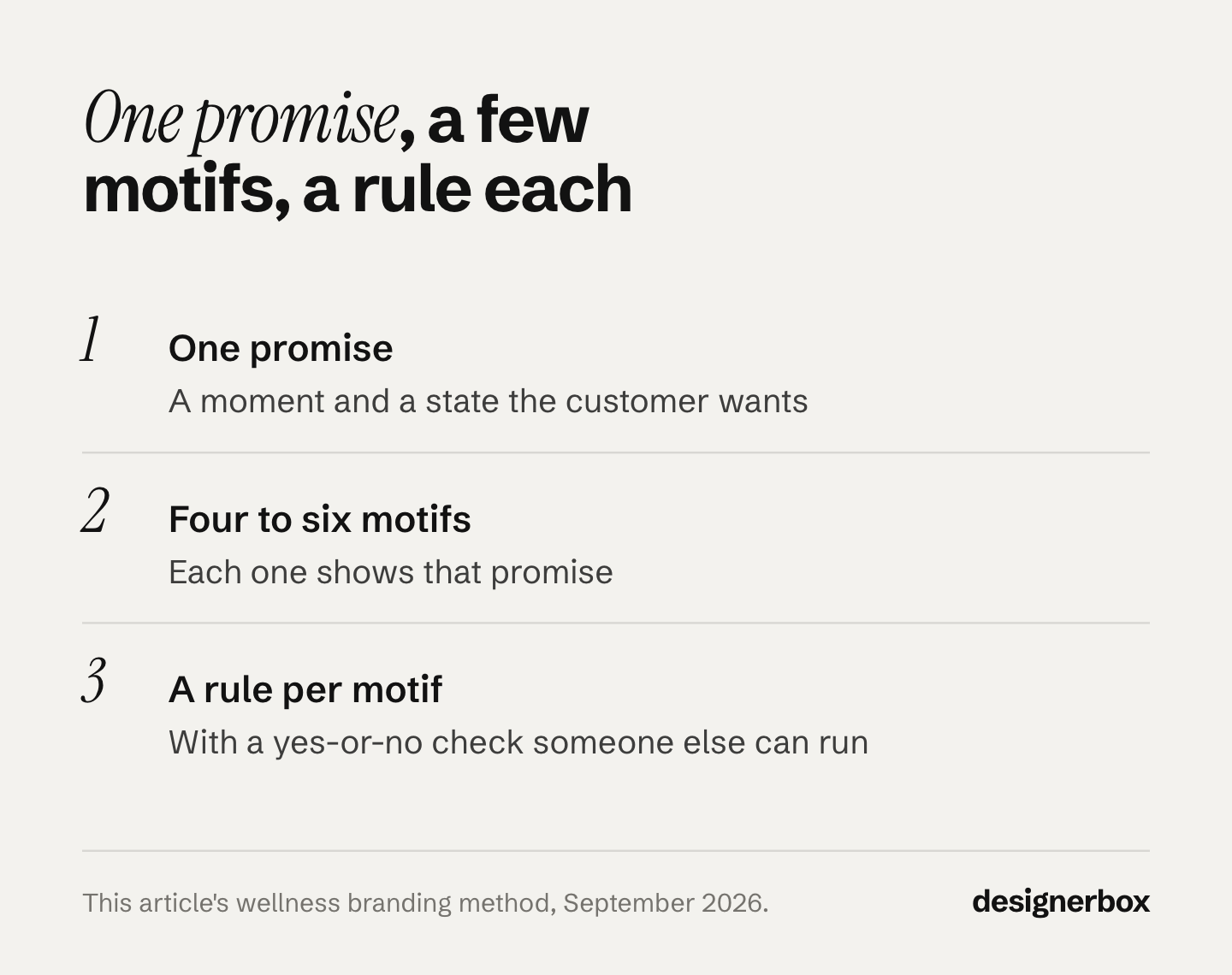
Wellness branding is the work of making a supplement, drink or skincare brand mean one thing everywhere a customer meets it. It runs in three stages. You write one promise about what the customer gets. You choose a short list of motifs that show that promise. Then you write a rule for each motif, so every pack, ad, email and support reply repeats it. The brand is the sum of those repeats.
Most wellness launches run in the other order. The pack comes from a mood board, the teaser posts come next, and the promise is written last, if at all. The launch looks good for a week. By the fortieth ad variant and the third flavor, nobody can say what the brand stands for, because nobody wrote it down.
This guide is for founders and brand leads at wellness product brands, and for the agencies that run their creative. It covers the three stages and what US rules let a wellness promise say. It also shows how to write motifs as rules someone else can check, and where the brand usually breaks. The brand rules page shows how DesignerBox holds those rules on every run.
Key Takeaways
-
The promise names an outcome, and the ingredient is only the proof. A tub holds creatine or magnesium. The customer buys a clearer morning or a slower evening. Write that result as one sentence.
-
A wellness promise has legal limits in the US. The FTC says health claims need “competent and reliable scientific evidence”, and it counts implied claims too (ftc.gov, September 2026). This is general information, not legal advice.
-
Motifs can make claims. The FTC gives an example where images create “an impression of scientific legitimacy”. A lab coat in your ad can promise more than your label does.
-
Shape beats color as a brand signal. A 2026 study of 1,162 brand assets found packaging and logos scored 40% fame and 71% uniqueness. Colors scored 12% and 39% (doi.org, March 2026).
-
Write each motif as a rule with a yes-or-no check. “Warm, calm light” is a mood. “One low side light, no lit screens in frame” is a rule a freelancer can follow.
-
The brand breaks in the tail. The hero shot is fine. The twelfth ad variant, the new flavor and the marketplace crop are where people stop following the rules.
What is wellness branding?
Wellness branding is the set of decisions that make a wellness product recognizable before anyone reads the name. It covers the promise, the visual motifs, the tone of voice and the rules that carry all three to every place a customer meets the brand. A logo is one item on that list. It is rarely the item that fails.
The category is large and crowded. McKinsey sizes the global wellness market at about $2 trillion in its 2025 Future of Wellness survey, which covered more than 9,000 consumers in four countries (NutraIngredients, June 2025). In a market that size, most shelves hold several products with the same ingredient. The brand is often the only thing that differs.
That is why the stages run in order. The promise decides the motifs. The motifs decide the rules. The rules decide what every photo, ad and email looks like. A pack designed first can only guess at the promise.
Why do so many wellness brands look the same?
They start from the same inputs. A founder collects the same reference images as every other founder in the category: soft neutrals, a matte pouch, a hand holding a capsule, a morning kitchen. The pack looks good. It also looks like forty other packs.
The second cause is the order of work. The visual system is built before anyone writes the promise. So the visuals cannot express a promise, because there is none yet. They express the category.
The third cause appears later, in production. A launch needs a product page, paid ads, emails, social posts, a marketplace listing and a subscription flow. Each one is made by a different person or tool. Without written rules, each person makes a reasonable choice, and the choices do not agree.
The research on brand consistency is thin. The number quoted most often is Lucidpress’s claim that consistent branding can lift revenue by up to 33% (PR Newswire, December 2019). It is a vendor-run survey, and the revenue lift is self-reported by the people answering it. Use it as a direction, not a forecast.
Stage one: the promise
The promise is one sentence about what changes for the customer. It never names the ingredient as the benefit. “Creatine gummies” describes the product. “A clear head for the first hour of the day” describes what the customer buys.
A good promise has three parts:
- A moment. When does the customer feel the result? Morning, after training, the last hour before sleep.
- A feeling or a state. Clear, calm, steady, rested. Pick one word, not four.
- A reason to believe. The ingredient, the dose or the test that supports it. This part goes on the label and the product page, and it is the part that needs evidence.
Here is an invented example that the rest of this guide uses. A brand sells a magnesium powder that customers mix into a warm drink at night.
The weak version of the promise is “premium magnesium for better sleep”. The stronger version is “a slower last hour of the day”. The first one names an ingredient and a medical-sounding result. The second one names a moment the customer already wants, and the brand can show it in every image.
Test the sentence before you build anything on it. Read it to three customers and ask what they expect the product to do. If their answers differ, the promise is too vague. If their answers include a health result you cannot prove, the promise is too strong.
What can a wellness brand promise?
In the US, two sets of rules apply to most wellness products. This is general information, not legal advice. Ask a regulatory lawyer before you print a health claim.
The FTC rules cover every place you advertise. The FTC’s Health Products Compliance Guidance says health claims for foods, dietary supplements and other health products “require substantiation in the form of competent and reliable scientific evidence” (ftc.gov, September 2026). It lists packaging, labels, websites, social media and influencer marketing as advertising. The FTC published this guidance on 20 December 2022, its first update in this area in nearly 25 years (ftc.gov, December 2022).
Implied claims count. The same guidance says “a marketer is equally responsible for the accuracy of claims suggested or reasonably implied in advertising.” So a brand line that never says “sleep” can still promise better sleep, if a reasonable reader takes it that way.
The FDA rules cover a supplement’s label. A structure/function claim, such as “supports restful sleep”, needs a disclaimer on the label: “This statement has not been evaluated by the Food and Drug Administration. This product is not intended to diagnose, treat, cure, or prevent any disease.” The company must also notify the FDA within 30 days after it first sells the supplement with that claim (fda.gov, content current as of February 2023).
What this means for the promise:
| Promise line | What it claims | What it needs |
|---|---|---|
| ”A slower last hour of the day” | A moment and a mood | Evidence only if readers take it as a health result |
| ”Supports restful sleep” | A structure/function claim | Scientific evidence, the FDA disclaimer and the 30-day notice |
| ”Fixes insomnia” | A disease claim | Not a structure/function claim. The FDA may object to it on a supplement |
The promise that is easiest to defend is also the easiest to brand. A moment can appear in a photo. A clinical result needs a study. How the same claim rules apply to each ad format is covered in supplement advertising.
Stage two: from motifs to rules
Motifs are the recurring things a customer learns to connect with the brand: an object, a light, a gesture, a shape, a word. The magnesium brand might choose a warm glass on a nightstand, a closed laptop, low evening light and lower-case type. Each one shows the slower last hour.

A motif on a mood board is not yet a rule. “Calm, warm light” means something different to every photographer and every AI model. A rule is a sentence that someone who never met you can follow, with a check that has a yes-or-no answer.
| Motif | The rule | The check |
|---|---|---|
| Evening light | One low warm light from the side. No overhead light | Is there a shadow on one side of the product? |
| The closed laptop | Screens appear closed or off. Never a lit phone | Is any screen lit in the frame? |
| The warm glass | The drink is in a clear glass, half full, on wood | Is the glass clear and on a wooden surface? |
| Lower-case type | Headlines in lower case, one line, no exclamation marks | Does any headline use capitals or an exclamation mark? |
Three findings from brand-asset research help you choose motifs.
- Shape carries more than color. A study of 1,162 distinctive assets across 21 categories and nine years found shape-based assets, such as logos and packaging, scored 40% fame and 71% uniqueness on average. Color assets scored 12% fame and 39% uniqueness (International Journal of Advertising, March 2026). A sage green that half the category uses will not identify you on its own.
- Your team is a poor judge of its own motifs. A study of 405 brand elements from 50 brands found that marketers’ judgments “are rarely accurate, typically overestimating fame and underestimating uniqueness” (Journal of Brand Management, June 2025). Test motifs with customers.
- Motifs can make health claims. The FTC guidance describes an ad whose images “give an impression of scientific legitimacy” and so “likely convey an implied claim” that the product is clinically proven. A lab coat, a microscope or a chart in your ads is a promise. Keep it out unless you have the study.
Keep the list short. Four to six motifs is enough for a customer to learn. Twenty motifs is a mood board again.
Written rules also belong in one shared place. A brand kit holds the files, and a product photography style guide holds the shot rules. A brand guidelines template sets out the sections for the rest of the written rules.
Stage three: carry it to every touchpoint
A touchpoint is any place a customer meets the brand. Wellness brands have more of them than most, because the product is used every day and bought again every month. Each touchpoint either repeats the promise or contradicts it.
| Touchpoint | What the promise looks like there | Where it usually fails |
|---|---|---|
| Pack and label | The moment in one line, the motif shape, the required disclaimer | A flavor extension designed by a new supplier |
| Product page | Photos that follow the motif rules on every flavor | The fourth flavor shot on a different day, in different light |
| Paid ads | The same moment, cut for each format | Variant twelve, made in a hurry for a test |
| Email and subscription | Plain, lower-case copy that matches the pack | The discount email that shouts |
| Customer support | The same calm tone, even in a refund reply | A template written by the support tool vendor |
| Marketplace listing | Motif rules inside the platform’s image rules | A white-background crop that drops every motif |
| Unboxing | Insert card and box that repeat one motif | A generic box from the 3PL |
Audit the touchpoints once a quarter. Put one example from each touchpoint side by side and read them as a customer would. Ask whether a customer who saw only this one example would know the promise.
Photography has its own category rules on top of the brand rules. The supplement product photography guide covers label legibility and marketplace specs. The skincare product photography guide covers texture shots and reflective packs.
Where the throughline breaks
The first ten assets are usually right. The founder made them, or checked each one. The brand breaks in the tail: the twelfth ad variant, the fourth flavor, the holiday bundle, the marketplace crop. Those are made quickly, by more people, and nobody checks them against the rules.
Ad testing makes the tail longer. A brand that tests creative every week makes more variants than it can review by eye. How to test ad creative covers how many variants a test needs. Every one of them is a touchpoint.
Brand building also takes years to repay, which makes it easy to cut. Binet and Field studied campaigns in the IPA effectiveness databank. They found the best average budget split was 60% brand building and 40% activation in 2013, and 62:38 in a 2018 update (IPA, September 2023). That is an average across categories, not a law. It still shows why a brand that spends everything on short-term ads loses the throughline first.
AI production adds a new kind of tail. A model makes a plausible wellness image for any prompt, and plausible means the category average. If the model does not read your rules, it repeats the forty packs you tried to leave. Why AI assets drift explains the mechanics.
Brand rules that hold at volume
Anyone can make an AI picture. Making hundreds that still look like your brand is the hard part.
In DesignerBox, the brand is a record. You set your logo, fonts, colors, product photos and written rules once on the brand page. The workflow reads them on every run. So the evening-light rule applies to the first flavor and to the fifth one.
One workflow, four ways to run it:
- Template. Start from a finished result, such as a product scene, and add your own product photo.
- Workflow. Save your steps with your brand rules inside them. A saved workflow runs the same way on the next product.
- App. Publish the workflow as a form. A colleague or an agency junior adds a photo and presses Run.
- Batch. Batch runs one workflow over a whole sheet of products. You keep or discard per row, and you re-run one row on its own.
Three critic steps score the results of a run, and best-of-N keeps the best one. You still review the results before you use them. The cost of a run is shown before the run.
The full workflow from the first product photo to the finished ad, in one subscription. The same place holds the image editor, the video editor, your brand rules and your assets. For wellness packs there are category pages for supplement product photos and skincare product photos. The AI ad generator makes the static ads from the same brand record.
There are two limits. You download the results, or send them with a webhook or an S3 step. You then add them to your store or ad account yourself. And the rules only work if you write them first. A brand record with no promise and no motif rules repeats nothing.
Uploading your own photos and the commercial license start on the Pro plan. AI video, virtual try-on, upscaling, the image editor and the video editor start on the Premium plan. Plans and credits are on the pricing page.
Agencies with several wellness clients need one more fact. Team features and shared brand kits are on the Ultra plan, and every plan below Ultra is one seat. The same three stages apply to clothing labels in apparel branding.
A free plan for your first run
Start from a template and see the cost before you run it. The free plan runs on sample products. Get started free.
FAQ
What is wellness branding?
Wellness branding is the set of decisions that make a wellness product recognizable before anyone reads its name. It covers one promise about what the customer gets, a short list of visual motifs and a tone of voice. It also covers the written rules that carry them to the pack, the ads, the emails and customer support.
What is a brand throughline?
A brand throughline is the one idea that appears at every touchpoint. For a wellness brand, it is usually the promise, shown through the same motifs on the pack, the product page, the ads and the support replies. A customer who sees any one of them should be able to name the promise.
How is supplement branding different from other branding?
Supplement branding sits under health-claim rules. In the US, the FTC requires competent and reliable scientific evidence for health claims, including implied ones. The FDA requires a disclaimer and a 30-day notice for structure/function claims on the label. So the promise and even the images need a legal check.
What should a wellness brand promise?
Promise a moment and a state the customer wants, such as a slower last hour of the day. Put the ingredient and dose in the reason to believe. Avoid disease claims, and treat any health result as a claim that needs evidence. This is general information, not legal advice.
How many brand motifs does a wellness brand need?
Four to six is enough. A customer can learn that many, and a freelancer can follow that many rules. Choose shapes and objects over colors, because research on 1,162 brand assets found packaging and logo shapes scored far higher on fame and uniqueness than colors.
Which brand touchpoints matter most for a wellness brand?
The pack, the product page and paid ads carry the most volume. Email, customer support, the marketplace listing and the unboxing are where the brand usually breaks, because different people or vendors make them. Audit one example of each touchpoint every quarter.
Can AI keep a wellness brand consistent?
Only if the model reads your rules. A model with no brand rules returns the category average. Start from your real product photo, write each motif as a rule with a yes-or-no check, and review the results before you use them.
Sources
- FTC, Health Products Compliance Guidance (read September 2026)
- FTC, press release on the new health products guidance, 20 December 2022 (read September 2026)
- FDA, Structure/function claims and dietary supplement labeling, content current as of 9 February 2023 (read September 2026)
- Phua, Bali, Anesbury and Sharp, International Journal of Advertising, on the fame and uniqueness of distinctive assets, 5 March 2026 (read September 2026)
- Brus, Hartnett, Faulkner and Driesener, Journal of Brand Management, on how marketers judge brand elements, 7 June 2025 (read September 2026)
- IPA, The next chapter for The Long and the Short of It, 13 September 2023 (read September 2026)
- NutraIngredients, report on McKinsey’s 2025 Future of Wellness survey, 12 June 2025 (read September 2026)
- Lucidpress, brand consistency study, vendor-run survey, 2 December 2019 (read September 2026)
Legal and research claims verified against their original publishers as of September 2026. The magnesium brand is an invented example. This is general information, not legal advice.