


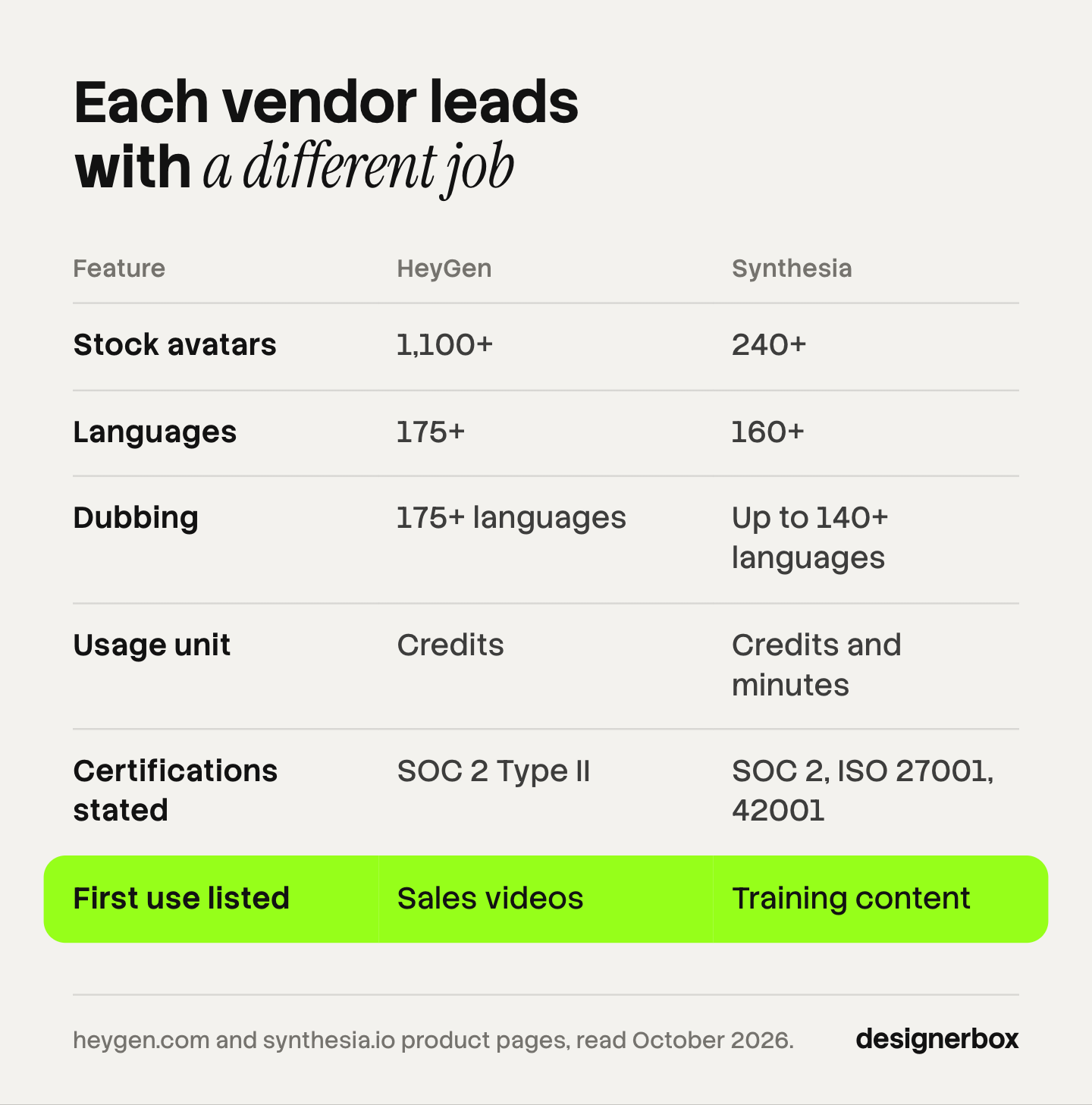
HeyGen vs Synthesia is a choice between two AI avatar video tools that turn a script into a presenter video. Both offer stock avatars, custom avatars with consent, translation with lip sync, an editor, an API and a free plan. HeyGen’s own pages lead with sales, marketing and social video. Synthesia’s pages lead with training and internal communication. The right one depends on the job.
This comparison is written for a brand or agency marketing team. It covers nine features, and every claim comes from the vendor’s own pages, read on 4 October 2026. It names no winner and prints no prices. It ends with which tool fits which job, and with the case where neither one fits.
Key Takeaways
- HeyGen lists more stock avatars and more languages. Its pages state more than 1,100 avatars and 175+ languages and dialects.
- Synthesia states more security certifications. It lists SOC 2 Type II, ISO 27001 and ISO 42001.
- Both require consent for a custom avatar. Synthesia asks for a live consent recording on camera.
- Both meter use in credits. Synthesia also counts minutes of video. Neither number prints here.
- A presenter tool is not a product ad tool. If the product has to carry the frame, look at a third route.
HeyGen vs Synthesia at a glance
Each cell is a short form of what the vendor states on its own site (heygen.com and synthesia.io, October 2026).
| Feature | HeyGen | Synthesia |
|---|---|---|
| Stock avatars | More than 1,100, cleared for commercial use | 240+, built from footage of paid, consenting actors |
| Custom avatars | From one photo or a short recording | From one photo or a short video, with live consent |
| Languages | 175+ languages and dialects | 160+ languages |
| Translation and dubbing | Uploaded video or a YouTube link, with lip sync | Dubbing into up to 140+ languages, with lip sync |
| Editor and templates | Script, PDF or link as a start, 75+ templates | Document, prompt or slides as a start, 60+ templates |
| API and integrations | API, MCP and automation tools | Video API, dubbing API and LMS embeds |
| Team and security | SOC 2 Type II, GDPR, SSO, SCIM | SOC 2 Type II, ISO 27001, ISO 42001, GDPR, SSO |
| Consent | Verified consent for custom avatars | Live consent video, adults only |
| AI labels and provenance | Member of the Content Authenticity Initiative | C2PA signals on videos, plus a visible label option |
The avatar and language counts depend on the plan at both vendors. Treat each number as the top of the range.

HeyGen: what it does well
HeyGen is built around speed from script to video. Its avatars page says HeyGen “is designed for videos that help grow a business: sales videos, client explainers, course lessons and social media content” (heygen.com/avatars, October 2026). Three things stand out on its pages.
Avatar range. HeyGen states more than 1,100 stock avatars, each “approved for commercial use”. A photo avatar starts from one front-facing photo. A custom avatar starts from a recording of about 30 seconds.
Translation. The video translator works on video you already have. You upload a file or paste a YouTube link, and HeyGen returns the video in another language with lip sync. The page says one video can go into up to 10 languages at once (heygen.com/translate, October 2026). A brand glossary protects product names.
Connections. HeyGen lists three ways to connect: an API, MCP for AI chats such as Claude, and skills for coding tools (heygen.com/integrations, October 2026).
The scope is the presenter, who is the main subject of the frame. HeyGen alternatives covers the tools teams shortlist when they need a different shape.
Synthesia: what it does well
Synthesia is built around company use at scale. Its avatars page lists training content first, then product explainers and internal communications (synthesia.io/features/avatars, October 2026). Three things stand out on its pages.
Consent and sourcing. Synthesia says its stock avatars “are built from footage of real actors who give their explicit consent and are paid each time their avatar is used”. A personal avatar needs “a live on-camera consent verification that cannot be uploaded or bypassed”. The person must be at least 18.
Security and provenance. Synthesia states SOC 2 Type II, ISO 27001, ISO 42001 and GDPR compliance. Its help center says videos made on Synthesia “carry C2PA-compliant provenance signals that mark them as AI-generated” (help.synthesia.io, October 2026). An editor option adds a visible AI label.
Learning features. The pricing page lists SCORM export, interactive quizzes, branching, live team collaboration and brand kits (synthesia.io/pricing, October 2026).
The scope is the presenter, and scripts must stay professional. Synthesia says political, sexual, personal, criminal and discriminatory content is not allowed.
Avatars, languages and lip sync compared
Both tools offer the same three avatar types. The differences are in how each one starts.
- Stock avatars. HeyGen lists more of them. Synthesia states how its actors are paid.
- Avatars from a photo. Both accept a single photo. This is the fastest custom route.
- Avatars from video. HeyGen asks for a short recording. Synthesia asks for a short video plus the live consent statement.
On languages, HeyGen states 175+ languages and dialects. Synthesia states 160+ languages for new videos and up to 140+ for dubbing, depending on the plan. Both vendors list more than 1,000 AI voices and offer voice cloning.
Both vendors sync lips on a new avatar video and again after translation. AI lip sync for video ads explains when a clip needs a separate lip sync step.
No vendor page tells you how natural a voice sounds in your language, so test your script with a native speaker. If you only need the voice, ElevenLabs alternatives sorts the voice tools by job.
Editor, API and team controls
Editor. Both editors are slide-style. HeyGen starts from a script, a PDF or a link, and imports PowerPoint files. Synthesia starts from a document, a prompt, a PowerPoint file or a blank canvas. Both include a screen recorder, templates and a brand kit.
API. HeyGen lists a direct API and an MCP route. Synthesia lists a video API and a separate dubbing API.
Team controls. Both list SAML single sign-on on their higher plans. HeyGen also lists SCIM, multi-factor authentication and an audit log. Synthesia lists live collaboration and workspaces.

For an agency, the question is seats and workspaces per client. Ask each vendor how client work is kept apart.
Pricing pages and usage units
HeyGen lists its plans on its own pricing page (heygen.com/pricing, October 2026). There is a free plan. Paid plans run on credits. HeyGen says the credits a video uses “can vary based on which AI model is used, video duration, and the complexity of the generation”.
Synthesia lists its plans on its own pricing page (synthesia.io/pricing, October 2026). There is a free plan. Synthesia calls credits “the shared currency across all AI usage-based features”. It also counts minutes of video and minutes of dubbing per month.
So the units differ. Before you compare plans, write down your videos per month, their average length and the languages per video.
Consent, likeness and AI labels
Both vendors put consent in the product. HeyGen says: “Custom avatars require verified consent from the person being recreated.” Its moderation policy lets the person ask for removal at any time (heygen.com/moderation-policy, October 2026). Synthesia requires the live consent video described above.
The law asks for consent too. New York requires written consent before a person’s likeness or voice appears in advertising (nysenate.gov, October 2026). California requires prior consent (leginfo.legislature.ca.gov, October 2026).
Labels are the second duty, and they fall on the company that publishes the video.
- European Union. Article 50 of the AI Act has applied since 2 August 2026. If you publish a deep fake, you must say it is AI-made, clearly, the first time people see it (digital-strategy.ec.europa.eu, October 2026). The Commission’s guidelines count realistic AI avatars as persons, so a realistic presenter is likely in scope.
- New York. Since 9 June 2026, an ad with a synthetic performer must disclose it in a way people will notice (nysenate.gov, October 2026).
- California. SB 1050 was signed on 16 September 2026 and takes effect on 1 January 2027. It requires a similar disclosure (leginfo.legislature.ca.gov, October 2026).
A machine-readable mark is not the visible label. Synthesia’s help center says its C2PA signals “do not, on their own, satisfy the EU visible-disclosure duty”. HeyGen’s ethics page states membership of the Content Authenticity Initiative (heygen.com/ethics, October 2026). The HeyGen pages read for this article do not say whether its videos carry C2PA signals, so ask the vendor in writing.
This is general information, not legal advice. AI disclosure in advertising covers the label rules in more detail, and AI spokesperson covers consent for each kind of presenter.
Which fits which job
Synthesia vs HeyGen has no general winner. Match the tool to the job.
| Job | Closer fit, by the vendor’s own pages |
|---|---|
| Training modules in a learning platform | Synthesia lists SCORM export and LMS embeds. HeyGen lists SCORM export on its team plan too |
| Internal company updates | Synthesia lists this use and live collaboration |
| Social clips with a presenter | HeyGen leads with this use and lists vertical formats |
| Translating video you already shot | Both dub with lip sync. HeyGen states more languages |
| Strict security review | Synthesia states more certifications. Both state SOC 2 Type II |
Run the same short script through both free plans. Then judge the voice in your language, the lip sync and the time one edit takes.
When neither tool fits
Both tools put a presenter in the frame. Some ads need the product in the frame.
A product-led ad shows the item itself: the bottle in a hand, the jacket on a model, the sofa in a room. The shopper has to see the real label, color and shape. A presenter who talks about the product does not show those things.
A campaign across markets adds a second need. One concept becomes many files: each language, each format, each product. If most of those files show the product, a presenter tool covers a small part of the work.
Product-led video as a saved workflow
DesignerBox is AI creative production for brands and agencies. It starts from the product photo, and the product stays the subject. Anyone can make an AI picture. Making hundreds that still look like your brand is the hard part.
You build a workflow once with your brand, your products and your rules. The workflow reads the brand profile on every run. The ad localizer rebuilds one ad in another language and redraws the layout. Batch runs the workflow over a whole sheet, so row one and row two hundred get the same standard. The AI video ads page shows the video workflows.
A presenter is available when the script needs one. There are six ready-made avatars and a talking avatar with lip sync. An avatar run returns nine fixed poses for 25 credits, and a text to speech step reads the script. AI avatars for brands explains how the nine-pose set keeps one face across a campaign. You cut the clips on a timeline in the video editor. The full workflow from the first product photo to the finished ad, in one subscription.
You see the cost of a run before you press Run. An 8-second clip costs 40 to 560 credits, depending on the model.
Here are the limits. DesignerBox is built for product creative. A long training video led by a presenter is outside its scope, and so are SCORM export and quizzes. You download the results, or send them with a webhook or an S3 step. Every plan below Ultra is one seat. Uploading your own photos and the commercial license start on the Pro plan. AI video, virtual try-on, upscaling, the image editor and the video editor start on the Premium plan. Plans and credits are on the pricing page.
One workflow for each client
An agency builds one workflow per brand and runs it on every new product. See DesignerBox for agencies
FAQ
Is HeyGen or Synthesia better?
Neither is better for every team. HeyGen’s pages lead with sales, marketing and social video, and state more avatars and languages. Synthesia’s pages lead with training and internal communication, and state more security certifications. Both have a free plan, so test one script in each.
Is HeyGen cheaper than Synthesia?
It depends on your volume, and this article prints no competitor prices. Both vendors list their plans on their own pricing pages (heygen.com/pricing and synthesia.io/pricing, October 2026). HeyGen meters credits. Synthesia meters credits and minutes of video. Count your videos, their length and your languages first.
Which one supports more languages?
HeyGen states 175+ languages and dialects for avatar video and for translation. Synthesia states 160+ languages for new videos and up to 140+ languages for dubbing, depending on the plan (heygen.com and synthesia.io, October 2026).
Do I need consent to make a custom avatar of a person?
Yes. Both vendors require it. HeyGen asks for verified consent from the person. Synthesia asks for a live consent video, and the person must be at least 18. Laws such as New York Civil Rights Law section 50 also require consent before a likeness appears in advertising.
Do I have to label an avatar video as AI?
In many cases, yes. The EU requires a clear label on deep fakes at first view, and a realistic avatar is likely in scope. New York requires a disclosure for synthetic performers in ads. California’s SB 1050 takes effect on 1 January 2027. The duty sits with the company that publishes the video.
Does DesignerBox make presenter video?
Only short clips. DesignerBox is built for product creative, and a long presenter-led training video is outside its scope. It has ready-made avatars and a talking avatar with lip sync for product clips.
Sources
- HeyGen, AI avatars page: stock, photo and custom avatars, consent and commercial use (heygen.com/avatars), October 2026
- HeyGen, pricing page: free plan, credits as the usage unit, plan feature list (heygen.com/pricing), October 2026
- HeyGen, AI video translator page: languages, lip sync, proofreading and glossary (heygen.com/translate), October 2026
- HeyGen, integrations page: API, MCP and skills (heygen.com/integrations), October 2026
- HeyGen, moderation policy and ethics statement (heygen.com/moderation-policy and heygen.com/ethics), October 2026
- Synthesia, AI avatars page: avatar types, consent, certifications and content rules (synthesia.io/features/avatars), October 2026
- Synthesia, pricing page: free plan, credits and minutes as usage units, plan feature list (synthesia.io/pricing), October 2026
- Synthesia, integrations list (synthesia.io/integrations), October 2026
- Synthesia help center, “What does the EU AI Act Article 50 mean for my Synthesia videos?” (help.synthesia.io), October 2026
- European Commission, FAQ on transparency obligations under Article 50 of the AI Act: digital-strategy.ec.europa.eu, October 2026
- AI Act Service Desk, Article 50: ai-act-service-desk.ec.europa.eu, October 2026
- New York General Business Law section 396-b, synthetic performers in ads: nysenate.gov, October 2026
- New York Civil Rights Law section 50: nysenate.gov, October 2026
- California SB 1050, synthetic performers in ads: leginfo.legislature.ca.gov, October 2026
- California Civil Code section 3344: leginfo.legislature.ca.gov, October 2026
- DesignerBox plans and feature gating: DesignerBox pricing page (designerbox.ai/pricing), October 2026
Vendor features checked on heygen.com and synthesia.io as of October 2026. This article prints no competitor prices; each vendor lists its plans on its own pricing page. Individual results vary.