
An advertising jingle is a short song that carries a brand name and one promise. With AI music you can make one in five steps: write the lyrics, generate the song and lock it, measure the word timings, build the pictures to the song, and add captions. Before you run it as an ad, check two things: the commercial rights your music tool grants, and the music rules of the ad platform.
The song is now the fast part. A music model sings your lyrics in a few minutes. The slow parts are the ones people skip. One music tool allows commercial use only on paid tiers. Another allows no commercial use at all. Meta and TikTok both keep their general music libraries out of ads. An ad built on the wrong track can be removed, however good the chorus is.
This guide is for a brand or an agency that wants a sung ad without a composer and a session singer. It covers what a jingle is, what each music model’s own terms say, who owns the result, the order of work, and the platform rules. Every fact comes from the vendor’s or regulator’s own page, read in October 2026.
Key Takeaways
- Lock the song before any picture. You can trim a voiceover. A song cut in the middle of a bar sounds broken, so every shot follows the song.
- Commercial rights differ by tool and by plan. Suno grants them on paid tiers. Udio’s current terms allow personal use only. ElevenLabs excludes film, TV and radio on its self-serve plans.
- Your lyrics are the part you can own. The US Copyright Office says purely AI-generated material is not protected by copyright. Human-written expression inside it is.
- Platform libraries are not ad libraries. Meta and TikTok both state that their general music libraries are not for commercial use. A track you made, with commercial rights, is a different case from a chart song.
- TikTok’s AI disclosure covers audio. Its ad setting applies to image, video or audio that is fully AI-generated or significantly modified by AI.
- Put the terms in a caption. A lyric rounds things. The caption carries the exact offer, and it works with the sound off.
What is an advertising jingle?
An advertising jingle is a short song or tune written for an ad. It contains a hook that names the brand or the product, and it repeats. A commercial jingle and a brand jingle are the same thing under other names. A sonic logo is shorter: a few notes with no words.
The reason to use one is memory. In an Ipsos analysis of 2,015 US video ads, ads with sonic brand cues were 8.53 times more likely to be in the top third for branded attention than in the bottom third (Ipsos, February 2020). Read that number with care. It is Ipsos’s own research, it is a correlation, it measures attention and not sales, and a sonic brand cue is a wider group than a sung jingle.
What changed in the last two years is the cost of a first draft. A jingle used to need a writer, a singer and a studio session. A music model now sings lyrics you typed. That moves the hard decisions away from the recording and toward the rights.
Can you use an AI song in an ad?
Sometimes. It depends on the tool, the plan, and where the ad runs. Each row below comes from that company’s own terms or documentation, read in October 2026.
| Tool | What it makes | What its own terms or docs say about use |
|---|---|---|
| Google Lyria 3.5 | Songs with vocals and timed lyrics, 44.1 kHz stereo. Accepts your own lyrics with section tags | All generated audio carries a SynthID audio watermark |
| Suno | Full songs from a prompt or lyrics | Paid tiers: Suno assigns its rights in the result to you. Free tier: personal, non-commercial use only |
| ElevenLabs Music | Music from 3 seconds to 5 minutes | Self-serve plans: commercial use online and offline, except film, TV, radio and studio games |
| MiniMax Music 3.0 | Songs of up to five minutes from lyrics with structure tags | Paid music API closed to new users from 20 August 2026. Open weights are published |
| Udio | Songs from a prompt | Current terms: personal, non-commercial use, and no downloads |
Google Lyria 3.5 is documented in the Gemini API. It generates vocals, timed lyrics and full arrangements, and the Clip model always returns 30 seconds (ai.google.dev, October 2026). Thirty seconds is a standard ad length, which makes the Clip model a natural fit for a jingle.
Suno makes complete songs quickly, and its terms are specific. On paid tiers Suno assigns to you its rights in what you generate. On the free tier you agree to personal, non-commercial use. Since the terms that took effect on 3 September 2026, you may not use a song commercially unless you downloaded it through an approved channel, and the number of downloads depends on your tier (suno.com/terms, October 2026). Those rights continue after you cancel. Suno also states that it does not promise any copyright will exist in the result.
ElevenLabs Music is strong for online ads and has one line that matters for a jingle. On every self-serve plan, commercial use is permitted online and offline except in film, TV, radio and studio games (elevenlabs.io/eleven-music-model-specific-terms, October 2026). A radio jingle is outside those plans. A Meta or TikTok ad is inside them.
Udio has signed licensing agreements with Universal Music Group and Warner Music Group, and it is moving to a licensed platform. During that move its terms limit results to personal, non-commercial use, and downloads are turned off (udio.com/terms-of-service, October 2026). That places a paid ad outside its current scope.
Two rules hold for every tool. Read the terms on the day you generate, because most of these five changed in 2026. And keep proof: the plan you were on, the date, and the download.
Who owns an AI jingle?
In the United States, a song that a model generated from a prompt is not protected by copyright on its own. The US Copyright Office states it directly: “Copyright does not extend to purely AI-generated material, or material where there is insufficient human control over the expressive elements” (copyright.gov, January 2025). It also concludes that prompts alone do not give enough control to make the user the author.
The same report protects what a person wrote. Human authors keep copyright in their own work where it is perceptible in the AI result. The report does not name lyrics. Read plainly, lyrics you wrote are your expression, and the melody and the voice a model made are not.
Two practical points follow.
- Write the lyrics yourself. They are the part of the jingle you can most clearly claim.
- A competitor copying the tune is hard to stop. A license from the music tool lets you use the song. It does not give you a monopoly over it.
This is general information, not legal advice. A jingle that will carry a brand for years is worth one hour with a lawyer.
How to make an advertising jingle with AI
The order matters more than the tools. Build the song first, then everything else to its timing.
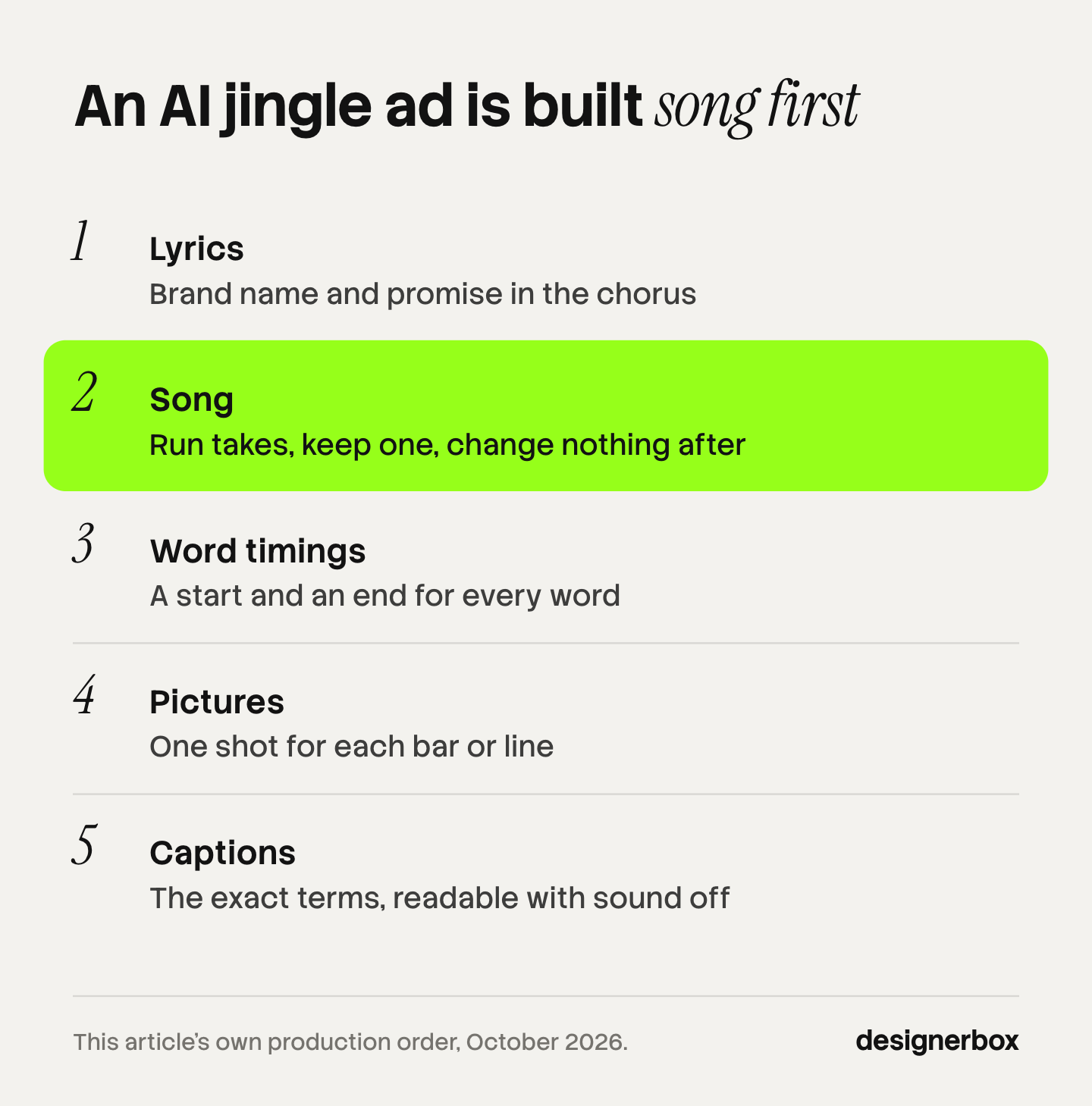
1. Write the lyrics
Put the brand name and the promise in the chorus, because the chorus repeats. Keep verses for the problem and the proof. Take every fact from the brand’s own offer page. A song is easy to remember, so a wrong number in a song is the number people repeat.
Write for a singer who is off screen. A narrator who sings about the product means nobody on screen has to sing. That removes lip sync from the job. AI lip sync for video ads covers the case where a character must sing or speak on camera.
2. Generate the song and lock it
Run a few takes with the same lyrics and keep one. Then stop. Do not edit the lyrics after this point, and do not ask for one more version when the pictures are half done. A changed song means every shot is the wrong length.
3. Measure the word timings
Run the finished song through a transcription model that returns a start and an end for each word. OpenAI documents this for its speech-to-text API: word and segment timestamps for captioning and video editing (developers.openai.com, October 2026). Sung words are harder to transcribe than spoken ones, so check the list against your lyrics by ear.
Measure the real length too. Models do not return the exact duration you asked for.
4. Build the pictures to the bars
One bar of music in 4/4 time lasts 240 divided by the tempo in beats per minute. Cut on the bar, and the picture feels like part of the song.
| Tempo | One bar | Eight bars |
|---|---|---|
| 100 BPM | 2.4 seconds | 19.2 seconds |
| 120 BPM | 2.0 seconds | 16.0 seconds |
| 128 BPM | 1.9 seconds | 15.0 seconds |
Approve each still before you animate it. A still is cheap to change, and a video clip is not. How to make AI ads covers the still-first method in full.
5. Add captions that carry the exact terms
Many people watch with the sound off. The captions must tell the whole story as a plain list. Where a lyric shortens the offer to fit the rhythm, the caption shows the exact line from the offer page.
Then check the result three ways before anyone else sees it: at phone width, with the sound off, and one cut at a time. Video hooks covers what the first three seconds need.
Platform rules for music and AI labels
A song you generated, with commercial rights from the tool, is your own track. That is a different case from picking a known song inside the app. The platforms state their rules like this.
| Platform | Music rule | AI label rule |
|---|---|---|
| Meta | The licensed music library is for personal, non-commercial use. Sound Collection can be used for ads | Meta labels ad images made or edited with AI. Ads about social issues, elections or politics must disclose AI image, video or audio |
| TikTok | Businesses use the Commercial Music Library for ads and organic posts, or a sound they hold a license for | The ad setting covers image, video or audio that is fully AI-generated or significantly modified by AI |
| YouTube | Not covered here | Creators must disclose AI-generated music that is the main focus of a video |
| Google Ads | Not covered here | Since July 2026 advertisers can add an AI label to image and video ads |
Meta’s music guidelines say that use of music for commercial purposes is prohibited unless you have the right licenses (Meta, October 2026). Its help center adds that Sound Collection content can be used for ads (Instagram Help Center, October 2026). Keep your license record for the jingle, because a rights check on an ad asks for it.
TikTok says businesses cannot use the general music library for commercial activity, and it tells them to confirm a proper license for any other sound (TikTok Business Help Center, October 2026). Its AI disclosure setting names audio (TikTok Business Help Center, October 2026). A sung AI track is fully AI-generated audio, so turn the setting on.
YouTube’s rule is written for creators who upload videos, and it lists AI-generated music as an example to disclose (YouTube Help, October 2026). Google Ads describes its AI label setting and notes that using it does not guarantee compliance with any regulation (Google Ads policy, July 2026).
We found no Meta or Google Ads page that requires a label for AI music in a non-political ad. That is not the same as permission. AI disclosure in advertising covers the wider rules, the EU AI Act included.
The picture side in DesignerBox
DesignerBox does not make the song. Bring a finished track that you hold commercial rights to. DesignerBox makes the pictures and the cut around it, for a brand or an agency that needs the same ad format for many products.
The stills and the clips come from a workflow that you build once with your brand, your products and your rules. Anyone can make an AI picture. Making hundreds that still look like your brand is the hard part. The video editor is a real timeline, with a lane for clips, a lane for words and a lane for sound. You place the music, set how loud it is, and add titles in your brand font. One of twenty voices can read a line over the track where the ad needs a spoken offer. That covers the full workflow from the first product photo to the finished ad, in one subscription.
The cost of a run is shown before you press Run. An 8-second clip costs 40 to 560 credits, depending on the model.
The limits, stated plainly. Uploading your own photos and the commercial license start on the Pro plan. AI video and the video editor start on the Premium plan. There is a free plan, and it runs on sample products. Nothing publishes to an ad account: you download one video file. Plans and credits are on the pricing page.
For the spoken version of the same job, AI voiceover for UGC ads compares three ways to add a voice. ElevenLabs alternatives compares the voice tools themselves.
Start from a template, add your brand and your products, and run it. See the templates.
FAQ
What is an advertising jingle?
An advertising jingle is a short song or tune made for an ad. It has a hook that names the brand or the product, and it repeats so people remember it. A sonic logo is the shorter form, a few notes with no words.
How long should an advertising jingle be?
Match the ad slot. Common video ad lengths are 6, 15 and 30 seconds. At 128 BPM, eight bars last 15 seconds, which fills a 15-second slot. A song ad that tells a story can run longer.
Can I use Suno music in an ad?
On a paid tier, yes, under Suno’s terms as of October 2026. Suno assigns its rights in the result to paid subscribers, and commercial use needs a download through an approved channel. The free tier is for personal, non-commercial use.
Do I own a jingle made with AI?
You hold the rights the tool’s terms give you. Copyright is a separate question. The US Copyright Office says purely AI-generated material is not protected, and that human-written work inside it is. Lyrics you wrote are the clearest part to claim.
Do I have to label an AI jingle in an ad?
On TikTok, turn on the AI-generated content setting, because it covers fully AI-generated audio. Meta requires disclosure of AI audio in ads about social issues, elections or politics. Check each platform’s current policy before launch.
Can I use a popular song in a business ad?
Not from the app’s general music library. Meta and TikTok both state that those libraries are not for commercial use. Use the platform’s commercial library, or a track you hold a license for.
Can an AI jingle run on radio?
Check the tool’s terms first. ElevenLabs excludes radio, TV and film from its self-serve plans. Other tools set other limits, and a broadcaster may ask for proof of your license.
Sources
- Ipsos, The Power of You: Why distinctive brand assets are a driving force of creative effectiveness, February 2020: https://www.ipsos.com/en/power-you-why-distinctive-brand-assets-are-driving-force-creative-effectiveness
- US Copyright Office, Copyright and Artificial Intelligence, Part 2: Copyrightability, January 2025: https://www.copyright.gov/ai/Copyright-and-Artificial-Intelligence-Part-2-Copyrightability-Report.pdf
- Google, Gemini API music generation (Lyria 3.5): https://ai.google.dev/gemini-api/docs/music-generation
- OpenAI, Speech to text guide: https://developers.openai.com/api/docs/guides/speech-to-text
- Meta, Music Guidelines: https://www.facebook.com/legal/music_guidelines
- Instagram Help Center, music in the licensed library and Sound Collection: https://help.instagram.com/402084904469945
- Meta, AI info labels on ads: https://www.meta.com/help/artificial-intelligence/355108217670024/
- TikTok Business Help Center, Commercial Music Library: https://ads.tiktok.com/help/article/commercial-music-library
- TikTok Business Help Center, Add disclaimers to ads: https://ads.tiktok.com/help/article/add-disclaimers-to-ads
- YouTube Help, Disclosing use of GenAI content: https://support.google.com/youtube/answer/14328491?hl=en
- Google Ads policy update, AI labels, 9 July 2026: https://support.google.com/adspolicy/answer/17257106?hl=en
- Suno Terms of Service, effective 3 September 2026 (suno.com/terms, October 2026)
- ElevenLabs, Eleven Music model-specific terms, updated 26 May 2026, and Music documentation (elevenlabs.io, October 2026)
- MiniMax, API overview and Music 3.0 announcement (platform.minimax.io and minimax.io, October 2026)
- Udio Terms of Service, revised 12 November 2025, and help center notes on its label partnerships (udio.com and help.udio.com, October 2026)
Music tool terms, platform music rules and AI label rules verified from each company’s own pages as of October 2026. Terms change often, so read them again on the day you generate. This article is general information, not legal advice. DesignerBox plans and credits are on the DesignerBox pricing page (designerbox.ai/pricing), October 2026.