

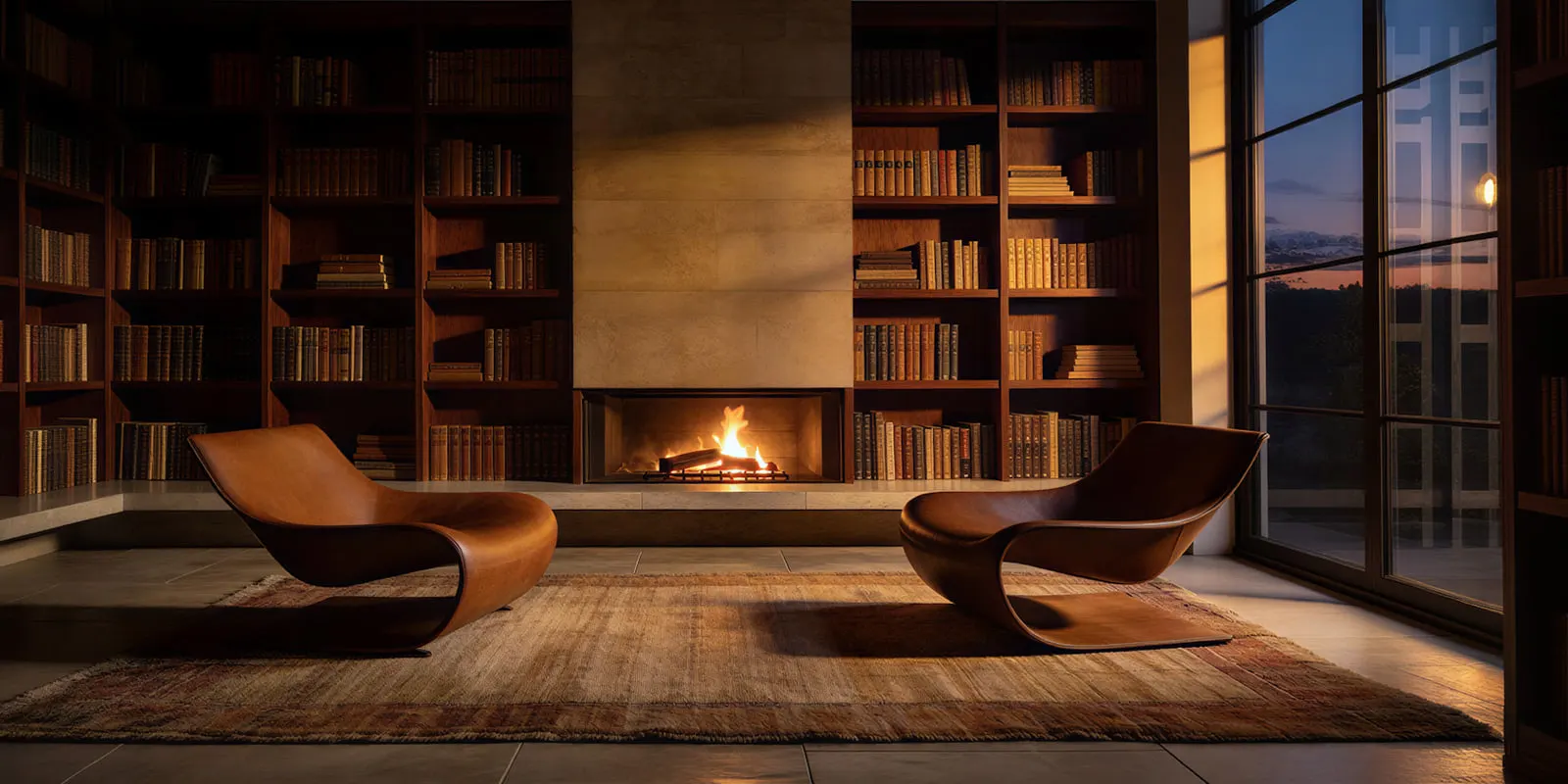
Candle photography is two jobs with two exposures. The unlit shot proves the vessel, the label and the wax color under clean, even light. The lit shot sells the room, and you expose it for the flame. Plan both for every candle, then place each one in the listing slot where it does its job: main image, proof, scale, lifestyle, gift set and scent cue.
A candle is one of the few products that is also a light source. The flame is far brighter than the label beside it, so one camera setting cannot hold both.
This guide sorts the shots by listing slot. It is written for candle and home fragrance brands with 20 to 500 products, and for the agencies that produce listing images for them. A range grows fast: every scent, in every size, in every vessel, is one more product to photograph.
Key Takeaways
- Two exposures, two jobs. The unlit shot is evidence of the product. The lit shot is mood. Do not ask one frame to do both.
- Six listing slots. Main image, vessel and label proof, scale, lit lifestyle, gift or set, and scent cue. Five are unlit and one is lit.
- The label is the hard part of a lit shot. Light the label with a soft lamp, or blend two exposures taken from a tripod.
- Size is easy to misread. Baymard Institute’s testing found that 42% of users try to judge a product’s size from its images.
- The main image is unlit and plain. Amazon asks for a pure white background and a product that shows as 85% of the image.
- AI scenes fit the room and miss the candle. Use generated backgrounds around one clean unlit photo. Check the label text, the wick, the flame and the vessel shape on every result.
What is candle photography?
Candle photography is the set of product images that sell a candle online. It includes a clean unlit photo of the vessel and label, close views of the wax and wick, a photo that shows size, and lit scenes that show the candle in a room. It is a branch of product photography with one extra problem, because the product makes its own light.
The category is large and varied. The National Candle Association estimates that more than 10,000 candle scents are available to US consumers, and it names container and jar candles as the most popular types (National Candle Association, October 2026). Most of the advice here is about container candles for that reason.
A shopper cannot smell a listing. The same association says fragrance is the most important factor in a candle purchase. So the photos have to carry two messages: what the object is, and what the scent feels like. Our guide to perfume photography covers the same problem for fragrance in a bottle.
Why a candle is harder than most products
Three things happen at once in a candle photo.
The product emits light. A flame is a small, intense light source. If you expose for the label, the flame becomes a white shape with no detail. If you expose for the flame, the label and the room go dark.
The vessel reflects and transmits light. Glass shows the windows, the lamp and the photographer. Wax is translucent, so light passes into it and changes its color. A front light flattens both. Our guide to home decor product photography explains why these materials need light from behind or from the side.
The flame changes the color of everything near it. Candle light is warm. A white wax looks cream and a pale blue vessel looks gray. That is pleasant in a lifestyle scene. It is a problem in a photo that has to show the real color.
The answer to all three is the same. Separate the shot that proves the product from the shot that sells the mood.
The lit shot and the unlit shot
The two shots have different lights, different settings and different rules.
| Unlit shot | Lit shot | |
|---|---|---|
| Job | Prove the vessel, the label and the wax color | Show the mood and the room |
| Light | Soft, even, neutral white balance | Low room light, plus the flame |
| Exposure | Set for the label and the wax | Set for the flame, then add light to the label |
| Wick | New, straight and centered | Trimmed, then burned until a thin wax pool forms |
| Color | Must match the real product | Warm on purpose |
| Listing slots | Main image, proof, scale, gift set | Lifestyle, ads, social posts |
Shoot the unlit set first. A burned wick and a melted surface cannot become new again, so every unlit photo has to happen before the first match. If you need both from one unit, the order is fixed.
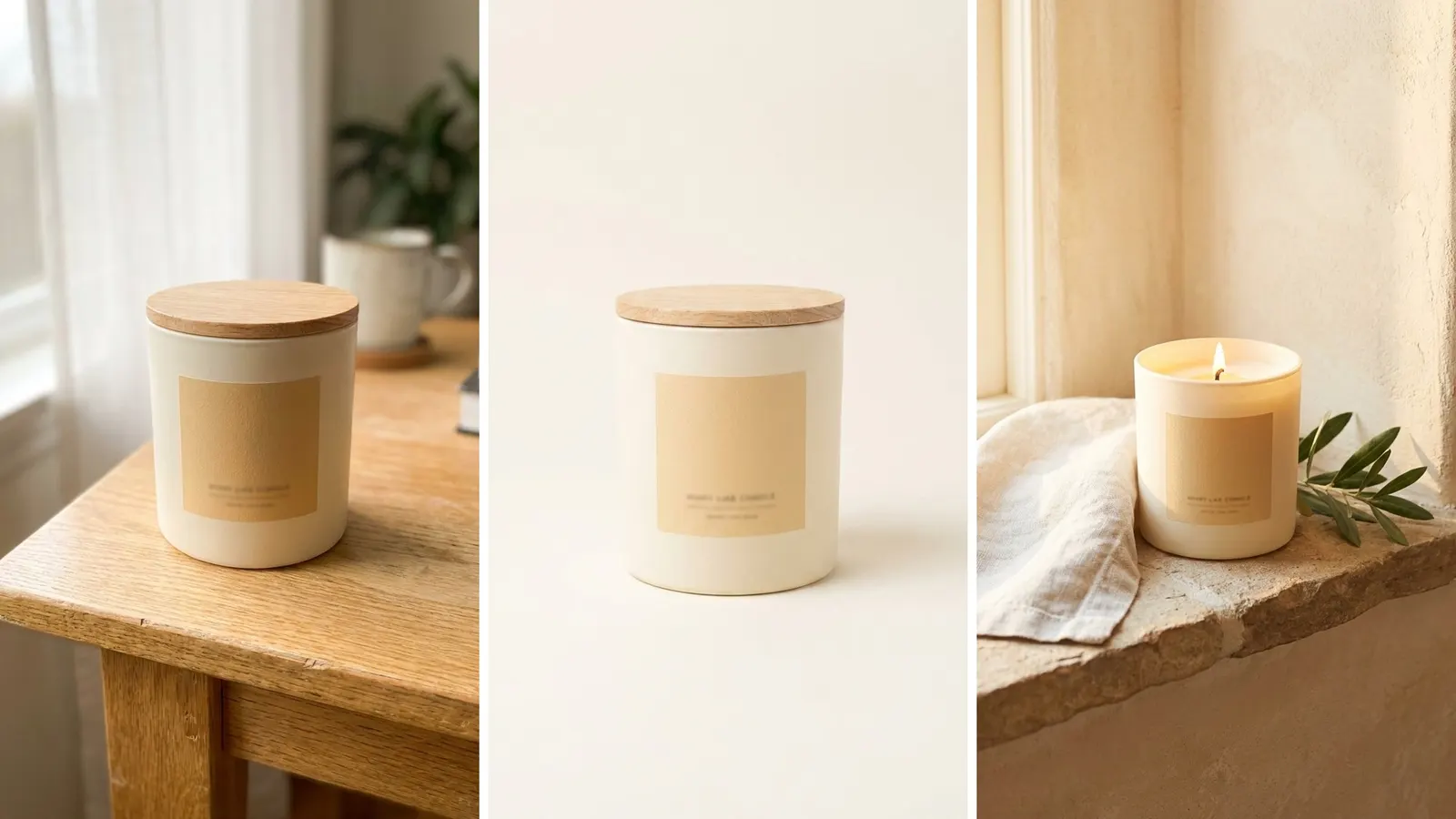
Candle photography shot list by listing slot
A listing has a fixed number of image slots, and each slot answers one question from the shopper. Sort the shots by slot, and the list is the same for every candle in the range.
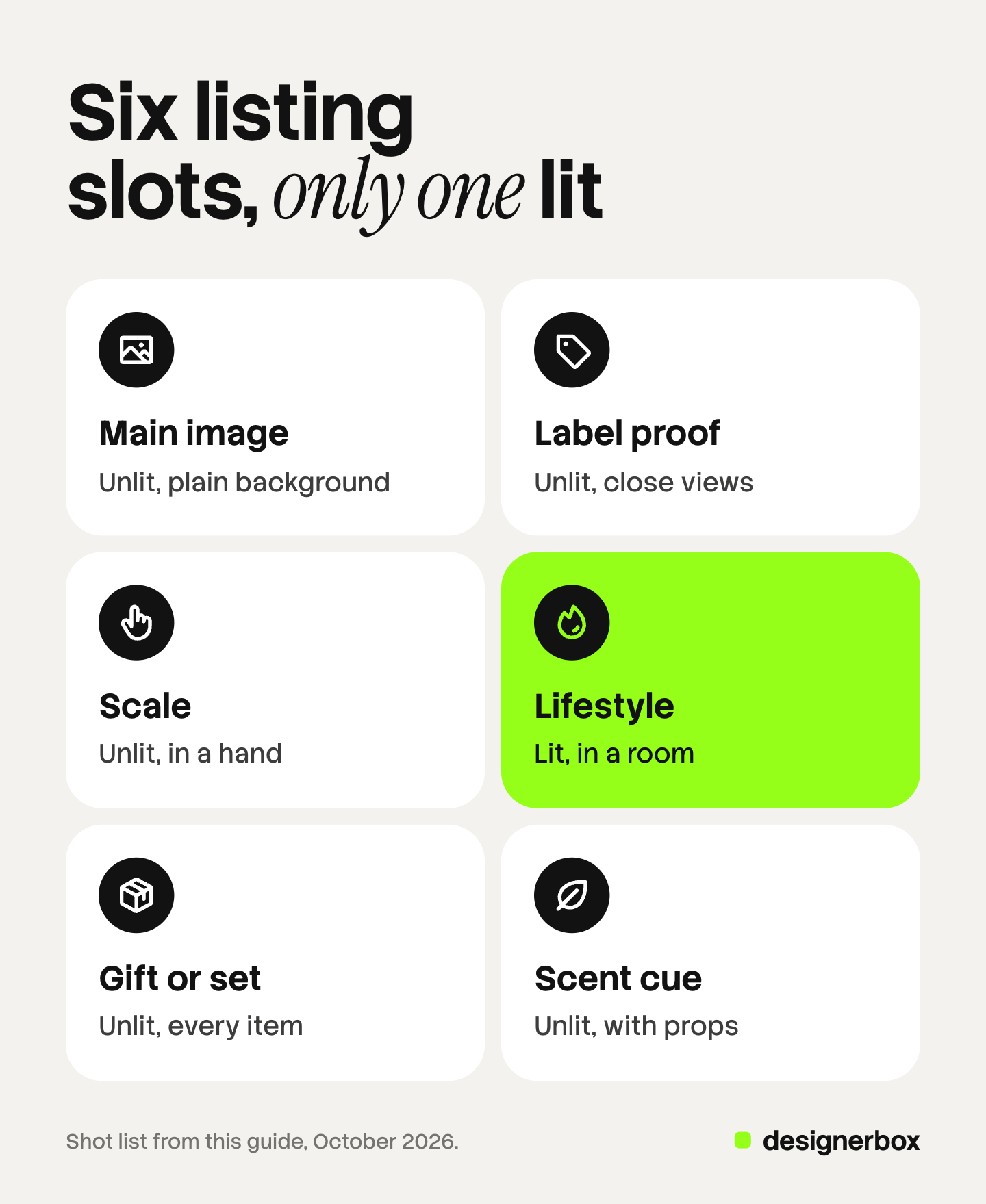
- Main image. Unlit, front view, plain background, lid as the buyer receives it. It answers “what is this?” in search results.
- Vessel and label proof. Unlit close views: the label straight on, the wax surface from above, the base with the caution label, and the lid.
- Scale. The candle in a hand, or beside one object of known size. It answers “how big is it?”
- Lit lifestyle. The candle burning in a real room, on a surface where a person would place it.
- Gift or set. The box, the wrapping and every item in the set, laid out so the buyer can count them.
- Scent cue. The unlit candle beside objects that suggest the fragrance.
Amazon recommends at least six additional images and one video beside the main image (Amazon Seller Central, October 2026). Etsy takes up to 20 photos and 2 videos for each listing (Etsy Help, October 2026). Six slots fit both, with room for a second lifestyle scene.
The same six slots work as candle photography ideas for a product page on your own store. Our guide to product photography ideas has a longer list sorted by the job each image does.
How to photograph a lit candle without losing the label
The lit shot fails in one of two ways. The flame is a white hole, or the label is unreadable. Four steps fix both.
Lower the room light, do not remove it. A flame in a black room gives a photo of a flame. Shoot at dusk, or with the room lights dimmed, so the surfaces around the candle still show.
Light the label separately. Place a small, soft lamp at the front and to one side of the candle, aimed at the label. Keep it weak. The label should read clearly, and the flame should still look like the brightest thing in the frame. A warm lamp matches the flame better than a cool one.
Use a tripod and take two frames. Take one frame exposed for the flame and one exposed for the label. The camera must not move between them. An editor can then combine the flame from the first frame with the label from the second. This is the most reliable method for dark vessels and dark labels.
Prepare the candle. The National Candle Association’s safety tips say to trim the wick to 1/4 inch before each use, to prevent high flames and soot (National Candle Association, October 2026). A trimmed wick also gives a small, steady flame that photographs well. The same page says to avoid drafts, and still air stops the flame from leaning or blurring during a long exposure.
A set with fire needs the same care as a living room. The association’s tips say never to leave a burning candle unattended. They also say to keep candles at least 12 inches from flammable items and at least 3 inches from each other. Dried flowers, paper and fabric are common props, and all three burn. Place them for the unlit shots, and move them away before you light the wick.
Glass, reflections and the wax surface
The unlit proof shots are close, and close shots show everything.
Control what the glass reflects. Glass shows whatever is in front of it. Put a large white card or a diffused light at each side of the vessel. The reflection becomes one clean vertical band on each edge, and that band describes the shape.
Light amber and colored glass from behind. A dark vessel looks black under front light. A light or a white card behind it passes through the glass and shows its real color. Our guide to product photography backdrops covers which surfaces work behind glass.
Keep the label flat to the camera. A label on a curved vessel bends away at both sides. Shoot it straight on, from the height of the label, so the brand name and the scent name are both readable. Soft light from the side shows embossing and foil.
Show the caution label. US candles carry a warning label with three rules: burn within sight, keep away from things that can catch fire, and keep away from children. The National Candle Association names ASTM F2058 as the labeling standard (National Candle Association, October 2026). One clear photo of the base shows a careful buyer that the label is there.
Check the wax before you shoot. A top view shows defects that nobody notices in the hand. Look for these four:
- Sinkholes or cracks near the wick
- White crystal patches on the surface of natural waxes, often called frosting
- Gaps between the wax and the glass, often called wet spots
- A wick that leans or sits away from the center
Choose the best unit from the batch for the photos. Wipe the glass with a lint-free cloth, and remove dust from the wax with a soft brush. Do not repair a defect in an editor if the buyer will receive it. Amazon asks that images accurately represent the product (Amazon Seller Central, October 2026), and a returned candle costs more than an honest photo.
Scale: the most common misread
A candle photo on a white background has no size. An 8-ounce jar and a 3-wick bowl can look the same in a cropped frame.
Baymard Institute’s product page testing found that 42% of users try to judge the size of a product from its images. In its benchmark, 28% of sites offered no in-scale image (Baymard Institute, published May 2017, read October 2026). The figures are old, so read them as a direction.
Three scale shots work for candles:
- In a hand. One hand holding the vessel is the clearest cue, because everybody knows the size of a hand.
- Beside one known object. A paperback book, a mug or a matchbox. Use one object, and keep it real size.
- The range in a row. Every size of the same scent, side by side, on one surface. This is the best single image for a listing with size variants.
Our guide to product staging has the rules for keeping props in true proportion.
Scent cue props that tell the truth
A scent cue is the object beside the candle that tells the shopper what it smells like: a cut orange, a cedar branch, a vanilla pod.
The prop is a claim. A shopper who sees fresh lavender beside a candle may believe the candle contains lavender. If the fragrance is a synthetic blend named “Lavender Field”, the photo says more than the label does.
Use this rule. A prop may show a note that is in the fragrance description. It should not suggest a raw material that is not in the product. If the label says “soy wax blend”, do not surround the candle with whole soybeans and a “100% natural” mood. If the label names essential oils, the plants behind those oils are fair props. Our guide to perfume photoshoot ideas by scent family lists props and surfaces for six scent families.
Keep props out of the main image. Amazon says not to show accessories or props that are not included with the product and could confuse the customer (Amazon Seller Central, October 2026). A cinnamon stick beside the jar looks like part of the order.
This is working practice and general information. It is not legal advice. Check the rules on ingredient claims in each market where you sell.
Marketplace main image rules for candles
The main image is the unlit shot, and each channel publishes rules for it.
| Channel | What its rules say | What it means for a candle |
|---|---|---|
| Amazon | Pure white background, RGB 255, 255, 255. The product shows as 85% of the image, whole and once. One unit, no props that are not included. No packaging unless it is an important product feature | Unlit candle, front view, lid as supplied. The gift box goes in a later slot unless it is part of the product |
| Google Merchant Center | No promotional overlays, no borders, no product that is not sold with the main product. At least 500 x 500 pixels for all products from January 31, 2027, with 1500 x 1500 recommended | One candle, no text badge. The lit room scene goes in the lifestyle image attribute |
| Etsy | Photos at least 2000 pixels wide and tall are recommended. The first photo should be at least 635 pixels and landscape or square | Leave space around the candle so the thumbnail crop does not cut the lid |
Amazon’s rules are on its product image requirements page, linked above. Google’s are on its image link specification, and Etsy’s are on its image requirements page, all read in October 2026. None of the three pages mentions flames. The unlit candle is still the safer main image, because Amazon asks for the real color of the product and a flame turns wax and glass warm.
Etsy has further rules about which images count as photos of the item. Read our guide to Etsy product photos before you use an edited or generated image there. For Walmart, TikTok Shop and your own store, our guide to ecommerce product photography specs for five channels lists the main image rules side by side.
Candle photoshoot ideas for seasons and sets
Candles are a seasonal product. The National Candle Association says approximately 35% of candle sales occur during the Christmas and holiday season (National Candle Association, October 2026). So the lifestyle and gift slots change through the year, and the proof slots do not.
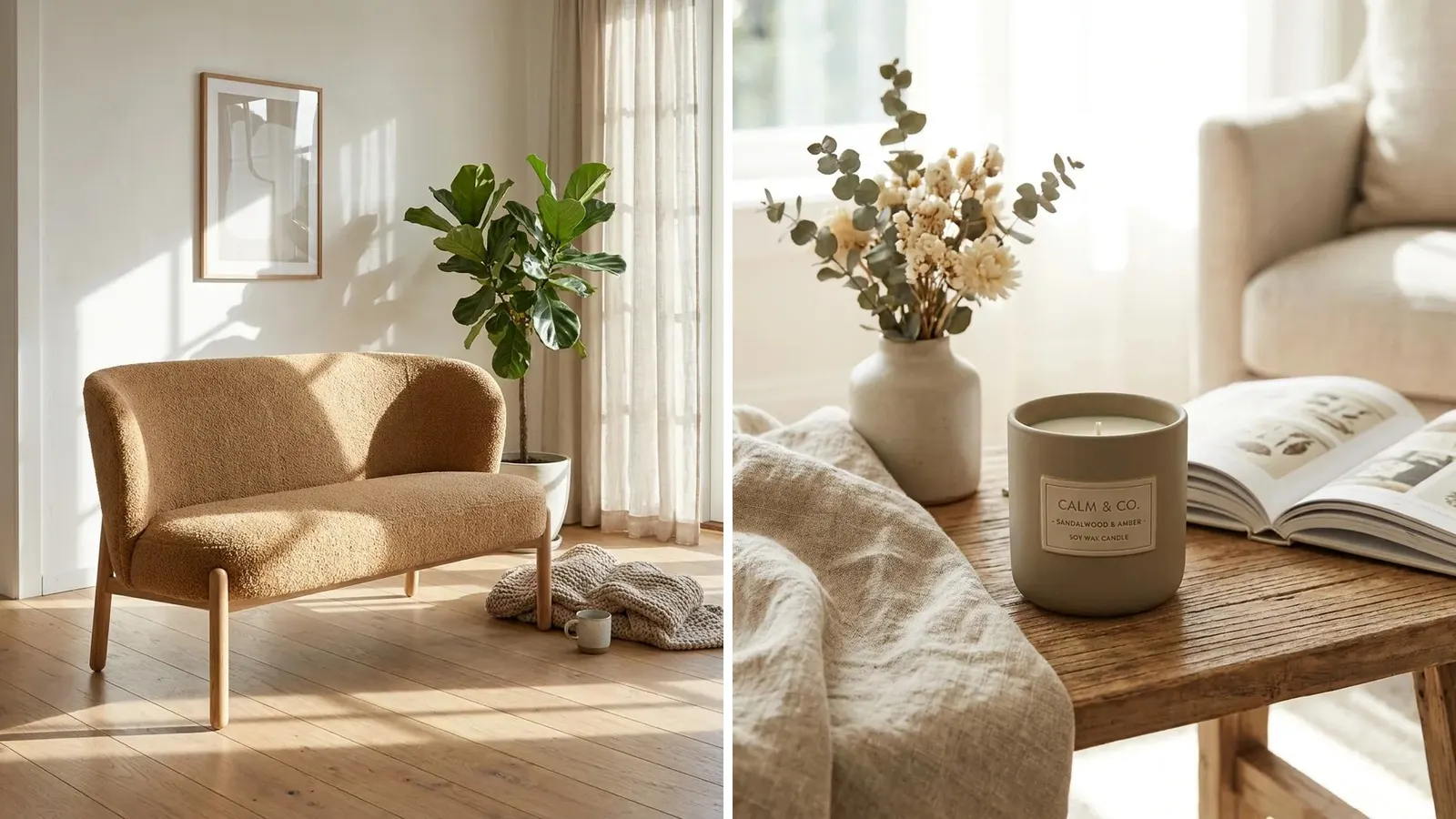
The same page says where people burn candles: the living room first at 42%, then the kitchen at 18% and the bedroom at 13%. Stage the lit scene in those rooms, in that order.
Five candle photoshoot ideas that reuse one unlit product photo plan:
- The coffee table at dusk. The lit candle on a tray with a book, shot at the level of the table.
- The kitchen counter. A citrus or herb scent beside a clean sink and one plant.
- The bedside. A small candle with a lamp turned off, so the flame is the only warm light.
- The gift flat lay. The unlit candle, its box, tissue paper and a ribbon, shot from above.
- The winter table. Three candles of one range on a set table. Keep them 3 inches apart, as the safety tips ask.
Our guide to holiday product photography has a calendar for when each seasonal set has to be ready.
Where AI scenes help and where they fail
AI image tools can build a room around a product photo. For candles, the split between what works and what fails is clear.
Where they help. Start from one clean unlit photo of the real candle. A generated scene can place it on a coffee table, a kitchen counter or a winter table without a location or a prop budget. Seasonal sets are the strongest case, because the product stays the same and only the room changes. A range of 40 scents needs the same six rooms 40 times, and that work repeats.
Where they fail. Four parts of a candle break often in generated images:
| Part | What goes wrong | How to check |
|---|---|---|
| Label text | Letters change, or the scent name becomes a different word | Read every word against the real label |
| Wick and flame | The flame floats, has no wick, or is too large for the vessel | Zoom to the wick. A flame starts at the wick tip |
| Wax pool | A lit candle shows solid wax, or an unlit one shows melted wax | Compare with a real burn photo |
| Vessel shape | The jar becomes taller, the lid changes, the glass thickness changes | Put the result beside the source photo |
A generated flame is a drawing of a flame. Use it for mood in a lifestyle slot, and check it. Use a real photo for every proof slot.
Our guide to lifestyle product photography explains which lifestyle images are worth a real shoot. For the checks on any generated image, see AI product photo accuracy.
One unlit photo, many rooms
DesignerBox is AI creative production for brands and agencies. It makes images, ads and video from a brand’s own material, and a product photo is one of the inputs. Anyone can make an AI picture. Making hundreds that still look like your brand is the hard part.
For a candle range, the job that repeats is the room. You photograph each candle once, unlit, and that photo is the source. A workflow holds your brand rules and the scene: the surface, the light and the season. A batch then runs that workflow over a sheet with one candle per row, up to 200 rows in one sheet. Row one and row two hundred read the same rules. The cost is shown before the run.
You keep or discard each result yourself. The page on AI product photography shows the product side of this job.
The same subscription covers the ads and the video made from those images. That is the second idea behind the product: the full workflow from the first product photo to the finished ad, in one subscription.
The limits are plain. The unlit proof photos and the real burn photo stay with your camera. DesignerBox does not send finished work to a store or a marketplace. You download the results, or send them with a webhook or an S3 step. Every plan below Ultra is one seat, and the free plan runs on sample products.
Uploading your own photos and the commercial license start on the Pro plan. AI video, virtual try-on, upscaling, the image editor and the video editor start on the Premium plan. Plans and credits are on the pricing page.
Start with one candle and one room, check the label and the flame, then run the range. Get started free
FAQ
How do you photograph a lit candle?
Dim the room without making it black, and put the camera on a tripod. Trim the wick to 1/4 inch and let a thin wax pool form. Expose for the flame, then add a weak, soft lamp on the label. For dark vessels, take a second frame exposed for the label and combine the two.
Should the main product image show the candle lit or unlit?
Unlit. The main image has to show the real color and shape of the product on a plain background. A flame turns the wax and the glass warm, and it hides the new wick. Keep the lit candle for the lifestyle slot, the ads and the social posts.
How do you stop reflections on a glass candle jar?
You cannot remove reflections from glass, so you choose them. Place a large white card or a diffused light at each side of the jar. The glass then reflects two clean bands and nothing else. Keep the camera and the photographer in the dark part of the room.
How many photos does a candle listing need?
Plan six kinds: a main image, vessel and label proof, scale, a lit lifestyle scene, the gift box or set, and a scent cue. Amazon recommends at least six additional images beside the main one. Etsy takes up to 20 photos for each listing.
Can AI make candle product photos?
AI tools can place a real, unlit candle photo into a generated room, and that works well for seasonal lifestyle scenes. They often change label text, flame shape, the wax pool and the vessel shape. Check each result against the source photo, and use real photos for the proof slots.
Can I make candle lifestyle images in DesignerBox?
Yes, from your own unlit product photo. A saved workflow places each candle in the same scene with your brand rules, and a batch runs it over a sheet of up to 200 products. You see the cost before you press Run. Uploading your own photos starts on the Pro plan.
Sources
- Amazon main image rules, the six additional images and accurate representation: Amazon Seller Central, product image requirements, accessed October 2026
- Google Merchant Center image rules, the 500 x 500 pixel minimum from January 31, 2027 and the lifestyle image attribute: Google Merchant Center Help, image link, accessed October 2026
- Etsy photo sizes and the first photo: Etsy Help, image requirements, accessed October 2026
- Etsy photo and video count for each listing: Etsy Help, how to create a listing, accessed October 2026
- Wick trimmed to 1/4 inch, drafts, the 12 inch and 3 inch distances, and never leaving a burning candle unattended: National Candle Association, candle safety tips, accessed October 2026
- Candle scents, popular candle types, fragrance as the main purchase factor, rooms where candles burn and the holiday season’s part of sales: National Candle Association, facts and figures, accessed October 2026
- The caution label and the ASTM F2058 candle fire safety labeling standard: National Candle Association, understanding safety standards, accessed October 2026
- 42% of users judge product size from images, and 28% of sites with no in-scale image: Baymard Institute, in-scale product images, published May 2017, accessed October 2026
- DesignerBox batch, one product per row, up to 200 rows and the cost shown before the run: DesignerBox batch page (designerbox.ai/product/batch), October 2026
- DesignerBox plan gates: DesignerBox pricing page (designerbox.ai/pricing), October 2026
Amazon, Google, Etsy, National Candle Association and Baymard facts verified on each publisher’s own page, October 2026. DesignerBox features verified on designerbox.ai, October 2026. The lighting steps and the prop rule are working practice. This is general information, not legal advice. Individual results vary.