
Hair product photography is the set of images that sells a hair care range: the pack, the formula and the hair. Plan it by pack type, because the pack decides the light and the angle. An opaque pump bottle, a clear bottle, a tube, a jar and an aerosol can each fail in a different way. Add one texture shot and one honest on-hair shot for each product.
A hair care range mixes pack types. A tall pump bottle sits beside a flat jar, a soft tube and a metal can, and all of them must look like one family. This guide is for a hair care brand with 20 to 500 products, and for the agency that produces its images.
Key Takeaways
- The pack decides the setup. Five pack types cover most hair care ranges, and each has one main problem.
- Texture is a product fact. Lather, cream and oil each need a different surface and a different light.
- The hair result is photographed. It comes from a camera and real use, never from an image model.
- A picture is a claim. The EU and UK rule on cosmetic claims names pictures, and the UK ad regulator names hair extensions.
- The main image has its own rules. Amazon asks for pure white and a product at 85% of the frame.
- One look needs written rules. A fixed camera height, scale rule and shadow keep every size in one family.
What is hair product photography?
Hair product photography covers every still image a hair care product needs. That includes shampoo, conditioner, mask, oil, styling products and tools such as brushes and dryers. The set has three subjects: the pack, the formula outside the pack, and the product on real hair.
Shampoo photography looks like bottle photography, and part of it is. Our guide to bottle product photography covers glass, liquid and label rules for drinks. Hair care adds a texture the buyer wants to see and a result that appears on a person.
The pack decides the light and the angle
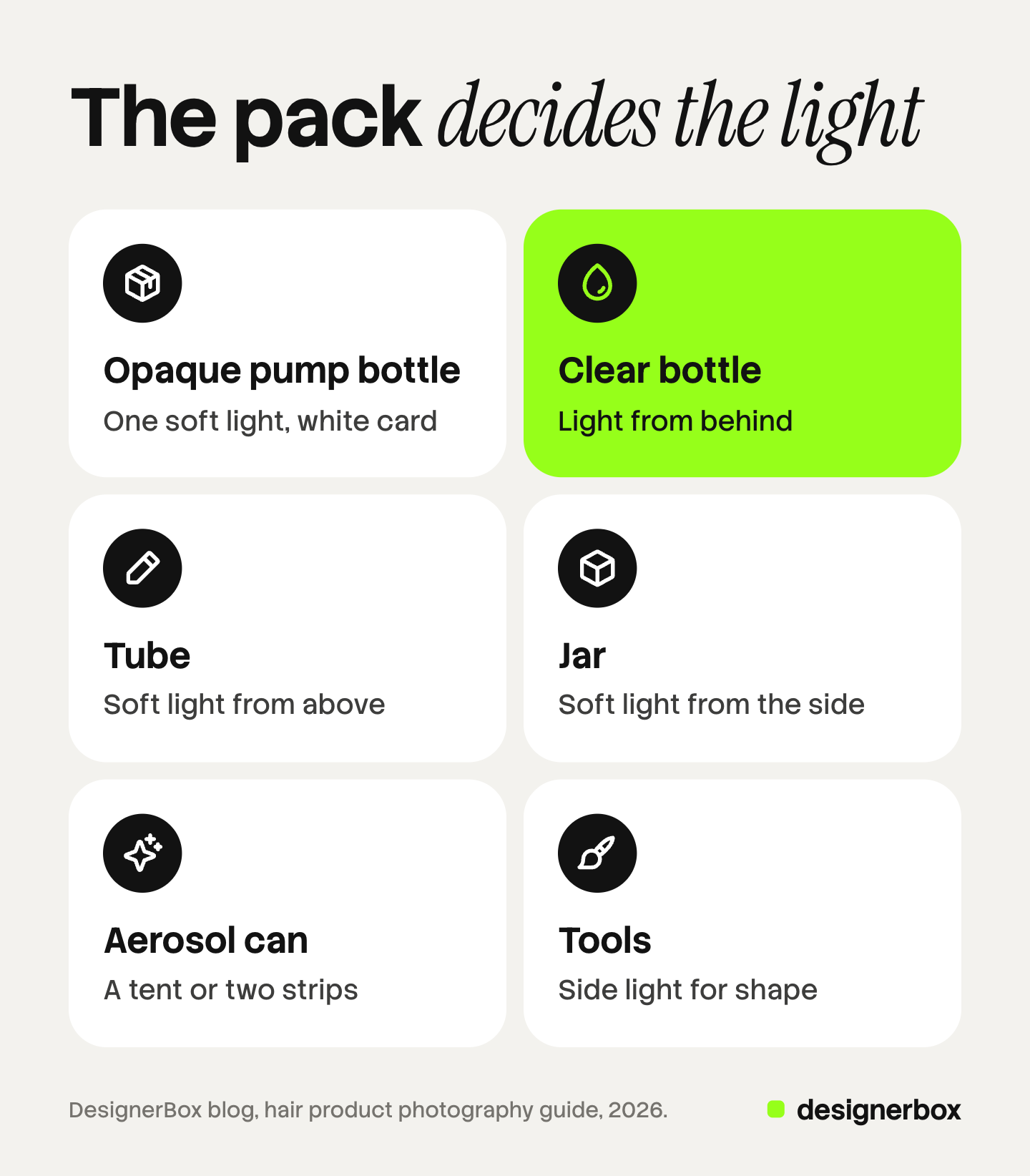
Sort the range by pack type before you plan a shot. Solve each pack’s main problem once, write the setup down, and reuse it.
| Pack type | Typical products | Main problem | Light | Camera angle |
|---|---|---|---|---|
| Opaque pump bottle | Shampoo, conditioner | A flat front and a dark pump | One large soft light, a white card on the other side | Level with the label center |
| Clear bottle | Oil, serum, clear shampoo | The liquid goes dark and the back label shows | Light from behind, black cards at the edges | Level, straight on |
| Tube | Styling cream, leave-in | Creases, and it cannot stand on a narrow cap | Soft light from above | Standing on the cap, or flat from above |
| Jar | Mask, pomade, butter | The label is short and the lid hides the formula | Soft light from the side | Slightly above, lid on and lid off |
| Aerosol can | Dry shampoo, hairspray, mousse | Metal reflects the whole room | A tent or two long strips of light | Level, with a clean highlight line |
Opaque pump bottle. This is the usual pack in shampoo bottle photography. The label is easy, and the dark pump is hard. A white card beside it gives the pump a soft edge of light. Turn every pump to the same side.
Clear bottle. A clear bottle lit from the front looks gray and empty. Light it from behind so the oil or serum shows its real color. Check the back label, because it shows through the liquid.
Tube. A tube creases the first time someone squeezes it. Photograph a full, unused tube, and decide once whether tubes stand on the cap or lie flat.
Jar. A jar has two faces: the label on the side and the formula under the lid. Take both. The open jar belongs with the texture shot below.
Aerosol can. A metal can is a curved mirror that shows the camera and the room. A light tent or two long strips of light give one clean highlight down the can.
Tools are a sixth group. A brush, a comb or a dryer has no label to protect, so a side light that shows its shape is enough.
The texture shot: lather, cream and oil
A hair mask and a conditioner can share one pack, and only the texture shot separates them. Match the surface and the light to the formula.
- Lather. Foam is white on white, so it needs a darker or colored surface and a light from the side. Foam collapses in minutes. Set the camera first, then make the foam.
- Cream. A swipe or a scoop shows thickness, and a low side light draws the ridges. Color cosmetics add a shade to this frame, covered in makeup product photography.
- Oil. Oil is clear, so it needs a light behind it or a bright surface under it. One drop on glass is clearer than a pool.
- Spray and mist. A mist only shows against a dark background with light from behind.
The texture must be the real formula. A richer cream from another jar makes a better picture and a false one. Amazon requires every product image to “accurately represent the product that you’re selling” (Amazon Seller Central, October 2026).
The on-hair shot and what it may claim
The on-hair shot shows hair after the product. A hair result on a person is photographed on real hair after real use. It is never made by an image model. This section is general information, not legal advice, and three sources set the limits.
The EU and UK claims rule. Commission Regulation (EU) No 655/2013 applies to cosmetic claims “in the form of texts, names, trademarks, pictures and figurative or other signs” (legislation.gov.uk, Article 1, October 2026). Its Annex says that “presentations of a product’s performance shall not go beyond the available supporting evidence” (legislation.gov.uk, Annex, October 2026).
The UK ad regulator. The ASA and CAP name hair extensions as a production technique in cosmetics ads. Their guidance describes past cases about “the excessive use of hair extensions or inserts that significantly added to hair volume in hair care advertisements”. It also says before and after images “are treated as objective claims just the same as written claims”. It adds that an after image “should be representative of what consumers can generally obtain from the product” (asa.org.uk, updated 18 August 2025, read October 2026).
The US agencies. The FDA says an antidandruff shampoo is both a cosmetic and a drug. It names claims that a product will “restore hair growth” as claims that can make a product a drug. Claims “in advertising, on the Internet, or in other promotional materials” count as well (fda.gov, October 2026). The FTC Endorsement Guides say a customer’s result in an ad will likely be read as “representative of what consumers will generally achieve” (law.cornell.edu, 16 CFR 255.2, October 2026).
The same logic covers generated images. The ASA says “it is likely to be materially misleading to include an AI generated image showing the effect of a cosmetic product that does not accurately reflect real-world results”. It adds that a disclosure that AI was used does not fix that (asa.org.uk, October 2026).
Three habits keep the on-hair shot honest:
- Photograph the before and the after with one light, one angle and one background.
- Use the model’s own hair. Add no extensions and no clip-in pieces for a volume, length or thickness claim.
- Do not retouch the thing the product claims to change: shine, frizz, volume or color.
Our guide to makeup ads covers the same rules for filters, lash inserts and paid reviews.
Marketplace main image rules for hair products
The main image is the pack alone. On Amazon it must have “a pure white background (RGB color values: 255, 255, 255)” and “show the product as 85% of the image”. It must show the entire product, only once, with one unit. Props that are not included with the product are not allowed (Amazon Seller Central, October 2026).
Two of those rules catch hair care often. A tall pump bottle is easy to crop at the top, and a shampoo and conditioner pair is two units. Amazon also asks that the image “accurately represent the real scale, quantity, and color of the product”, which matters for a purple toning shampoo.
Amazon also recommends at least six more images for each product. That is where the texture shot, the on-hair shot and the size comparison go. Google Merchant Center has a rule of its own for product images. It says not to “use an image that contains promotional elements or overlays” (Google Merchant Center Help, October 2026).
Amazon also asks for a metadata tag on images with photorealistic AI-generated people. Our guides to ecommerce product photography and AI product photos and marketplace rules compare the channels.
Which shots do hair product ads need?
An ad does a different job from a listing, so it needs different frames from the same shoot.
- The pack with space. The pack sits off center with clean space for a headline.
- The texture in motion or close. Lather, a cream swipe or an oil drop shows the formula faster than a label does.
- The real result. The on-hair shot, made under the rules above. This is the frame regulators read most closely.
One look across sizes and variants
A hair care range repeats one product in many forms: a travel size, a retail size and a salon size, then a version for curls and one for color. As an example, 12 products in 2 sizes is 24 packs, and 5 images for each pack is 120 images.
Four written rules keep those images in one family:
- Camera height. Set the camera level with the center of the label, for every pack.
- One scale rule. Every pack fills the same share of the frame, or packs keep their true relative size. Write the choice down.
- One shadow. Decide the direction, the softness and the length of the shadow once.
- Color against the pack. Check each variant color against the real pack under one light.
Write the four rules into a product photography style guide, with one approved reference image for each pack type. Our guide to consistent product images lists the layers such a standard has to cover. A shot list then turns the standard into one row for each image.
Hair care images as a repeatable workflow
DesignerBox is AI creative production for brands and agencies. It makes images, ads and video from a brand’s own inputs, and a product photo is one of those inputs. Anyone can make an AI picture. Making hundreds that still look like your brand is the hard part.
You build a workflow once with your brand, your pack photos and your rules. A brand holds the logo, colors, fonts, rules and reference pictures, and the workflow reads it on every run. A batch then runs that workflow over a sheet, one pack on each row, from row one to row two hundred. The cost is shown before the run.
Use it for the frame around the pack: the surface, the scene, the crop for each channel and the ad layout. The approved image then becomes the ad and the short video. The full workflow from the first product photo to the finished ad, in one subscription. For the product side of the job, see AI product photography.
Do not use DesignerBox, or any image model, to make a hair result, a before and after, or a texture that is not the real formula. Those are photographed. Check every label on every result against the real pack before you keep it. DesignerBox does not send finished work to a store or a marketplace. You download the results, or send them with a webhook or an S3 step. Every plan below Ultra is one seat.
Uploading your own photos and the commercial license start on the Pro plan. AI video, virtual try-on, upscaling, the image editor and the video editor start on the Premium plan. Plans and credits are on the pricing page.
There is a free plan, and it runs on sample products. Get started free
FAQ
How do you photograph shampoo bottles?
Sort them by pack type first. Light an opaque pump bottle with one large soft light and a white card on the other side. Light a clear bottle from behind so the liquid shows its color. Set the camera level with the center of the label, and keep the whole pump inside the frame.
What background is best for hair product photography?
Use pure white for a marketplace main image. Amazon requires RGB 255, 255, 255 for it. For texture shots, pick a surface that contrasts with the formula: darker for white foam, bright or backlit for clear oil. Keep one background family for the whole range.
Can I use AI images for hair care products?
Yes, for the frame around the pack: the surface, the scene, the crop and the ad layout. Check the label on every result. Do not use an image model for the result on hair. The UK ASA says an AI image of a cosmetic’s effect that does not reflect real results is likely to be materially misleading.
Are hair extensions allowed in a hair care ad?
The claim decides it. UK guidance from the ASA and CAP describes past cases about hair extensions that significantly added to hair volume in hair care ads. If the ad claims volume, thickness or length, show the model’s own hair.
How do you keep a hair care range consistent across sizes?
Write four rules and apply them to every pack: camera height at the label center, one scale rule, one shadow, and a color check against the real pack. Keep one approved reference image for each pack type, and compare every new image with it.
Sources
- Amazon product image requirements: pure white background, 85% fill, the entire product shown once, one unit, no props, accurate scale and color, six additional images recommended, and the AI-generated people tag: Amazon Seller Central, product image guide, accessed October 2026
- Google Merchant Center image rule on promotional elements and overlays: Google Merchant Center Help, image link, accessed October 2026
- Commission Regulation (EU) No 655/2013, UK retained text: scope including pictures at legislation.gov.uk, Article 1, and the honesty criterion at legislation.gov.uk, Annex, accessed October 2026
- ASA and CAP, “Beauty and Cosmetics: The use of production techniques”: hair extensions, before and after images as objective claims: asa.org.uk, updated 18 August 2025, accessed October 2026
- ASA, “Disclosure of AI in advertising”: AI images of a cosmetic’s effect: asa.org.uk, accessed October 2026
- FDA, “Is It a Cosmetic, a Drug, or Both? (Or Is It Soap?)”: cleansing shampoos, antidandruff shampoo, hair growth claims and intended use: fda.gov, content current as of 11 September 2024, accessed October 2026
- FTC Endorsement Guides, 16 CFR 255.2, via Cornell LII: law.cornell.edu, accessed October 2026
- DesignerBox brand, batch and plan gates: DesignerBox brand page (designerbox.ai/product/brand), batch page (designerbox.ai/product/batch) and pricing page (designerbox.ai/pricing), October 2026
Amazon, Google, ASA, FDA, FTC and legislation.gov.uk facts verified on each publisher’s own page, October 2026. DesignerBox features verified on designerbox.ai, October 2026. The range count is an example. Individual results vary.