A realistic AI video prompt names seven things the model cannot guess: the subject, the camera and lens, the light direction, the motion, what stays consistent, the colour grade, and the delivery format. Weak prompts give only the subject, so the model fills the rest with its average, and the average looks generic. Specify all seven and the clip reads like footage.
Most people blame the model. They type “woman drinking coffee”, get a plastic-looking clip, and conclude AI video is not ready. The clip is not the model’s fault. It is a three-word brief handed to a system that will invent every decision you did not make.
The fix is not a secret keyword or a better tool. It is structure. The same model that returns a generic clip from “woman drinking coffee” returns a usable one from a prompt that names the lens, the light, the motion, and the frame.
This guide breaks a realistic AI video prompt into seven layers, shows the weak and strong version of the same shot, maps which model holds which look, and does the part every other guide skips: what it costs in credits to iterate until the take is right.
Key Takeaways
-
A prompt has seven layers. Subject, camera, light, motion, continuity, grade, delivery. Name all seven or the model chooses for you, and its choice is the generic average.
-
Weak prompts are two or three words. Strong prompts run 80 to 200 words and read like a shot brief, not a wish.
-
Your product photo is frame one. OpenAI documents that an input image “acts as the first frame of your video” for Sora 2 Pro (developers.openai.com, July 2026). The motion grows out of your real product, so nothing comes out looking generic AI.
-
Iteration is the real cost. Video is priced per second, and audio is the expensive layer. Draft on a cheap model, finish on the expensive one. A Veo 3 clip with audio at 8 seconds costs 6,400 credits.
-
AI video needs Premium ($75/month) or higher. It is not on Basic or Pro. There is a free plan for everything else. Check DesignerBox pricing before you plan a campaign.
What makes an AI video prompt realistic
Realism is not a style you request. It is the sum of decisions the model would otherwise guess.
A camera in the real world has a focal length, an aperture, a position, and a move. Light comes from a direction and has a quality. A subject behaves according to physics. When your prompt states those, the model reproduces footage. When it omits them, the model averages every video it has seen that matches your three words, and an average of everything reads as generic.
So a realistic AI video prompt is a specification, not a description. “Someone using a blender” is a description. “Medium shot, 35mm lens at f/2.8, soft window light from camera-left, hands pressing the blender button with real resistance, steam rising, slow push-in, warm grade, 9:16, 6 seconds” is a specification. Same subject. Different result.
Why most AI video prompts return generic clips
The failure is almost always the same: the prompt names the subject and stops.
“Woman drinking coffee” leaves the model to invent the lens, the light, the framing, the motion, the grade, and the pacing. It will pick the most probable option for each, and the most probable option is the one it has seen most often, which is the one everyone else already generated. That is where the plastic, over-lit, weightless look comes from. When the weightlessness is in the body rather than the frame, it is a separate failure with its own fixes, covered in realistic AI human movement.
Three habits cause most weak prompts:
- Subject-only briefs. No camera, no light, no motion rules. The single biggest cause.
- Adjectives instead of specs. “Cinematic”, “beautiful”, and “high quality” are not instructions. “50mm at f/2.0, hard rim light from behind” is.
- No continuity constraints. Nothing tells the model to hold the face, the hands, or the logo steady, so they drift frame to frame and the eye catches it instantly.
The rest of this guide replaces each habit with a layer.
The seven layers of a realistic AI video prompt
Think of a prompt as seven decisions, made in order. You do not need a paragraph for each. One precise clause per layer is enough.
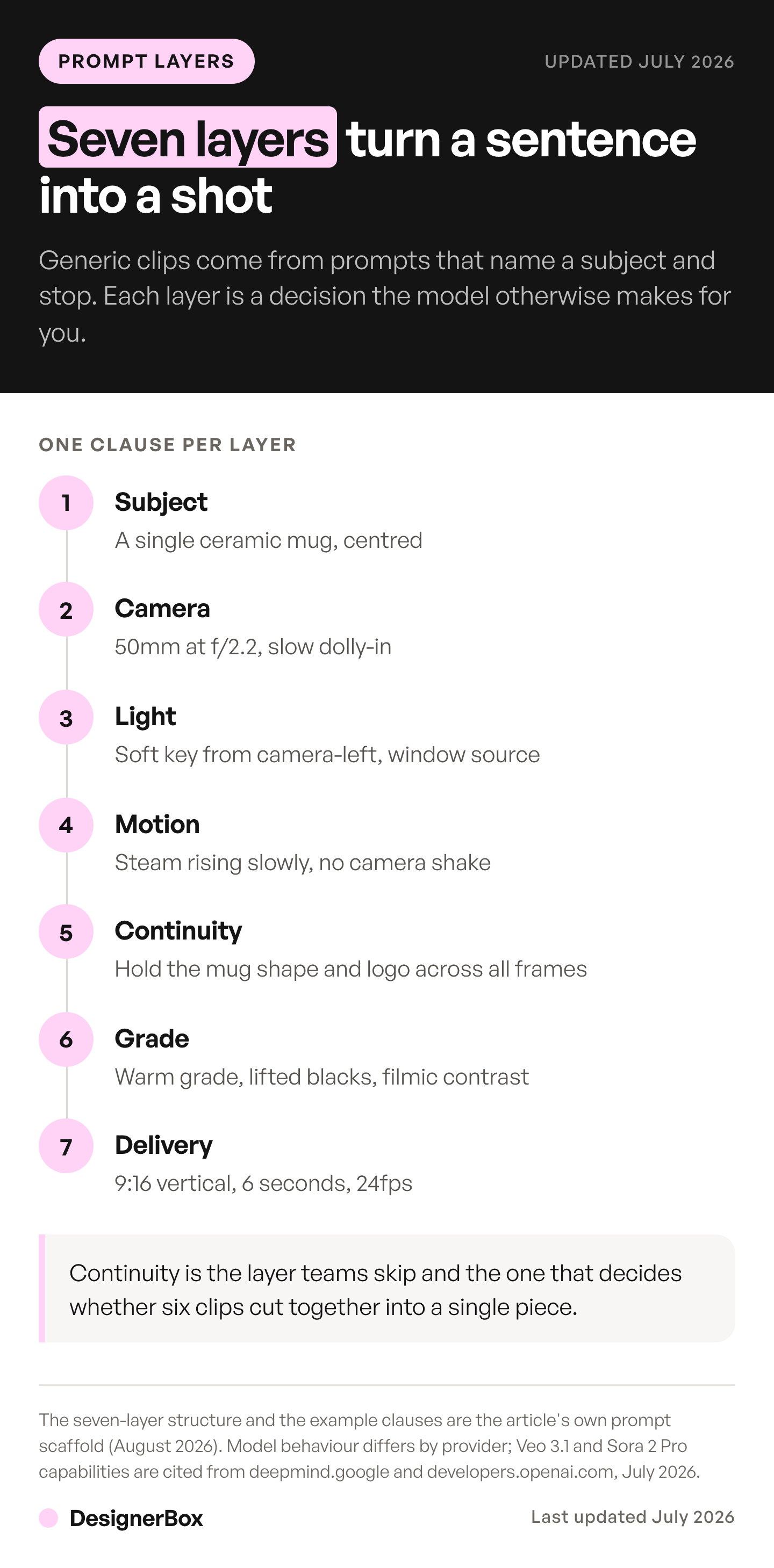
| Layer | The decision | Example clause |
|---|---|---|
| 1. Subject | The one hero of the frame | A single ceramic mug, centred |
| 2. Camera | Lens, aperture, position, move | 50mm at f/2.2, slow dolly-in |
| 3. Light | Direction, quality, source | Soft key from camera-left, window source |
| 4. Motion | What moves, how fast, physics | Steam rising slowly, no camera shake |
| 5. Continuity | What must not change | Hold the mug shape and logo across all frames |
| 6. Grade | Colour and era | Warm grade, lifted blacks, filmic contrast |
| 7. Delivery | Ratio, duration, frame rate | 9:16 vertical, 6 seconds, 24fps |
1. Subject
Name one hero and its hierarchy. If everything is important, nothing is. State what is in focus and what is background so the model does not split attention across the frame.
2. Camera
This is the layer that separates footage from render. State the focal length, the aperture, and the move. A 35mm lens at f/2.8 gives a natural, slightly wide look with soft background separation. An 85mm at f/2.0 flattens and isolates a face. A whip pan is urgent, a slow dolly is premium, a locked-off frame is editorial. Name the lens and the move or the model picks a nervous default.
3. Light
Light direction carries more realism than any other single word. Say where it comes from and what it is. “Soft key from camera-left” reads honest and commercial. “Single hard source from behind with a rim light” reads premium. “Overhead flat light” reads like a render, so avoid it unless you want that.
4. Motion
Describe what moves and how it obeys physics. Real objects have weight. Steam rises slowly, fabric settles, a hand meets resistance when it presses a button. Also state what does not move: “no camera shake” or “stable handheld drift” tells the model how much energy to add.
5. Continuity
This is the layer weak prompts always miss. Tell the model what must stay identical across every frame: the face, the hands, the product shape, the logo, the label text. Without it, those elements morph second to second and the clip screams AI. A single clause fixes most of it: “hold the product shape, label, and logo consistent across all frames.” Continuity within a clip is a prompt job. Continuity across clips is not, and once a second shot exists the room needs a reference plate rather than a better sentence. Physics is neither, because no clause makes a model render a collision it cannot predict, which is why distortion is worth diagnosing by mode before you rewrite anything.
6. Grade
Colour sets the era and the mood. Cool and neutral reads modern tech. Warm with lifted blacks reads film. Name the grade so the model does not default to an over-saturated, high-contrast look that ages the clip immediately.
7. Delivery
State the aspect ratio, the duration, and the frame rate up front, because they change how you should brief everything above. A 4-second 9:16 clip for a feed needs a one-second hook and minimal camera movement so captions stay readable. A 12-second 16:9 talking-head clip can afford a slow, locked frame. Deciding delivery last means re-shooting.
Weak vs strong: the same shot, two prompts
The gap between a generic clip and a usable one is visible in the prompt before you ever render.
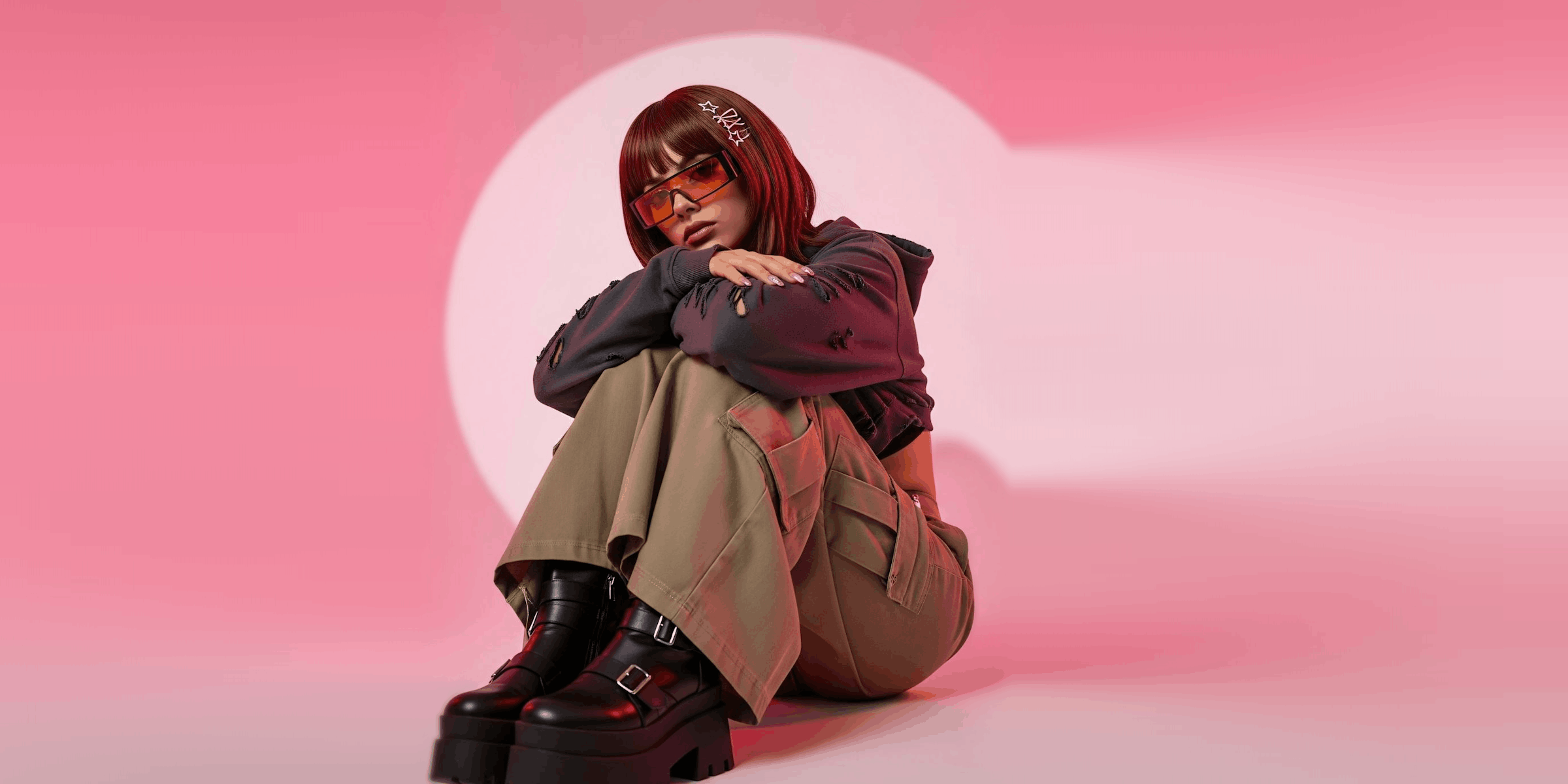
Hero product shot
- Weak: “Bottle on a table.”
- Strong: “A single matte glass serum bottle centred on dark stone. 50mm lens at f/2.2, slow dolly-in. Studio softbox key from the front, hard rim light from behind for edge separation, controlled reflections. Hold the bottle shape and label text consistent across all frames. Cool neutral grade. 9:16 vertical, 4 seconds, 24fps.”
UGC handheld clip
- Weak: “Someone using a skincare product.”
- Strong: “Smartphone-style vertical clip of a hand applying serum, imperfect framing, slight micro-shake. Soft daylight from a window camera-right. Realistic skin texture and hand anatomy, phone-camera compression look. Hold the face and hands consistent. Natural grade. 9:16 vertical, 7 seconds, 30fps.”
Lifestyle micro-story
- Weak: “Woman drinking coffee in the morning.”
- Strong: “Medium shot of a woman lifting a coffee mug, warm golden light through a window camera-left. 35mm lens at f/2.8, slow push-in. Steam rising, natural hand movement with weight. Hold facial features consistent across frames. Warm filmic grade, lifted blacks. 16:9, 8 seconds, 24fps.”
The strong versions are not longer for the sake of it. Every added clause removes one decision the model was about to guess.
Prompt patterns worth reusing
Once the seven layers are habit, a few patterns cover most B2C footage. Treat these as templates, then swap the subject.
- Hero product. Centred subject, slow dolly-in, softbox key plus rim light, tight continuity on the label, cool grade. Best for launches and PDP video.
- UGC handheld. Imperfect framing, micro-shake, window light, phone-compression look, natural grade. Best for paid social that needs to read as real.
- Lifestyle micro-story. Product in use, warm window light, 35mm at f/2.8, slow push-in. Best for feed ads that play silent.
- Talking-head authority. Medium close-up at eye level, 85mm at f/2.0, soft key from one side, locked camera, hard continuity on the face. Best for founder and testimonial clips.
- Macro detail. 100mm macro at f/3.2, shallow focus, a slow lateral slide, one controlled rim highlight. Best for texture and craft.
For the lighting, camera, and grade side of these looks in more depth, see AI cinematic ad styles. For turning a still into motion specifically, AI image to video for ecommerce compares the video models on animating a product photo.
Which model holds which prompt
A prompt is only as realistic as the model rendering it, and the models differ. One decision sits above all seven layers: which input mode the shot starts from, because a text prompt and a first-frame photo constrain the model very differently. DesignerBox includes six video models on one bill: Veo 3.1, Veo 3.1 Fast, Sora 2 Pro, Seedance 2.0, Kling 2.6 Pro, and Runway Gen-4.5. You switch between them without switching tools. Two of them publish specs precise enough to decide a shot on.
| Your prompt needs | Model | What the provider documents |
|---|---|---|
| Native audio in the render | Veo 3.1 | Generates video with native audio, dialogue and ambient (deepmind.google, July 2026) |
| A 4K master | Veo 3.1 | Outputs “in 1080p and 4K” (deepmind.google, July 2026) |
| An object or character reference | Veo 3.1 | Takes up to three reference images “of a scene, a character, or an object” (deepmind.google, July 2026) |
| Your product photo as literal frame one | Sora 2 Pro | An input image “acts as the first frame of your video” (developers.openai.com, July 2026) |
| A single clip longer than 8 seconds | Sora 2 Pro | Supports “16- and 20-second generations” (developers.openai.com, July 2026) |
That first-frame behaviour is why the workflow starts from your product photo. Your packshot is not a loose mood reference. It is frame one, and the seven layers describe how it should move.
The seven layers stay the same on every model. The order you brief them in does not, because each provider publishes its own prompt shape: Veo 3.1 opens with cinematography, Seedance 2.0 puts camera fourth of six, and Sora 2 Pro wants labelled blocks. The five documented prompt structures, side by side covers the conversion routine.
For Seedance 2.0, Kling 2.6 Pro, and Runway Gen-4.5, check the current spec on the model pages before you commit a shot. This category changes monthly, and a capability that was true in January is routinely wrong by July. How completely each provider documents its limits is itself a selection criterion, and which models publish enough spec to plan a shot list against scores all six on it.
What it costs to iterate
No prompt is right on the first render. The honest cost of realistic AI video is the cost of iterating until it is, and video is the most expensive operation in the product.
Video is priced as credits per second multiplied by duration. These are DesignerBox’s own examples, and the spread between them decides your workflow.
| Example clip | Credits | Credits per second |
|---|---|---|
| Seedance Pro Fast, 720p, 5s | 150 | 30 |
| Kling Standard, 720p, 5s | 225 | 45 |
| Sora 2, 720p, 8s | 1,600 | 200 |
| Veo 3 + Audio, 8s | 6,400 | 800 |
Read the last row against the plans. Premium is $75/month and includes 2,500 credits. One 8-second Veo 3 clip with audio costs 6,400, more than double the entire monthly allocation. Ultra includes 8,000 credits, so the same clip leaves 1,600 behind.
That produces one rule: draft cheap, finish expensive. Block the shot on Seedance Pro Fast while you get the framing, light, and motion clauses right. The same 2,500 credits buy roughly 16 Seedance clips at 5 seconds, which is plenty of takes to lock a prompt. Spend the Veo audio budget once, on the take you already know works. For the full per-second breakdown, see AI video generation cost. One step earlier than that, a storyboard settles the framing for 25 credits before any prompt gets a video budget.
If a look needs no dialogue, it needs no native audio. Music laid under a silent render costs nothing in credits, and most paid social plays silent anyway.
Put the prompt to work
Once a prompt is dialled, save it so the team reruns it for the next product rather than rediscovering the clauses. Start from one product photo in the Ad Studio, or from a garment in the Fashion Video Creator. If you would rather brief a shot from a chat window, the DesignerBox MCP server drives the same models from Claude, Cursor, or ChatGPT.
For the delivery layer applied to a specific platform, how to create TikTok video ads with AI covers the hook timing and format rules that decide whether a feed clip lands.
Model-specific starting points sit in the Veo prompts, Sora prompts and Seedance prompts libraries.
FAQ
What makes a realistic AI video prompt?
A realistic AI video prompt specifies the seven decisions a model would otherwise guess: subject, camera and lens, light direction, motion and physics, continuity constraints, colour grade, and delivery format. Weak prompts name the subject only, so the model averages everything else and the average reads as generic. The more of the seven layers you state, the closer the output gets to footage.
How long should an AI video prompt be?
Long enough to cover the seven layers. A simple B-roll clip needs 80 to 100 words. A complex product or talking-head shot with tight continuity runs 150 to 200 words. The count is a symptom, not a target. If a prompt is under 20 words, it is missing layers, and the model is filling them for you.
Why does my AI video look generic?
Almost always because the prompt named the subject and stopped. With no lens, light direction, motion rule, or continuity constraint, the model picks the most probable option for each, which is the look it has generated most often. Add the camera, light, and continuity layers first. They remove the plastic, weightless look faster than any other change, and they are the cheapest way to cut the re-roll count that drives AI video turnaround.
Can I reuse the same prompt across different products?
Yes, and that is the point of treating prompts as patterns. Keep the camera, light, motion, grade, and delivery layers fixed, then swap the subject clause. A hero-product template built for a serum bottle works for a sneaker or a mug with one line changed. Saving the working prompt as a reusable workflow is how teams keep output on brand across a catalogue.
Which AI video model gives the most realistic result?
It depends on the shot, not on a single winner. Veo 3.1 outputs “in 1080p and 4K” with native audio and accepts reference images of an object (deepmind.google, July 2026), so it fits a polished 4K hero. Sora 2 Pro takes your product photo as the first frame and supports “16- and 20-second generations” (developers.openai.com, July 2026), so it fits longer single clips. DesignerBox includes both, plus Seedance 2.0, Kling 2.6 Pro, and Runway Gen-4.5, on one subscription.
Do I need to name the camera and lens in the prompt?
Yes. The camera layer is the one that most separates footage from render. A focal length and aperture tell the model how to handle depth, separation, and perspective, and a named move (“slow dolly-in”, “whip pan”, “locked off”) sets the energy. Without them the model defaults to a nervous, over-wide look that reads as AI.
Sources
All accessed July 2026.
- Veo 3.1 native audio, 1080p and 4K output, and the three-reference-image limit for a scene, character or object: (deepmind.google, July 2026)
- Sora 2 Pro input image acting as the first frame of the video, and 16- and 20-second generations: (developers.openai.com, July 2026)
- DesignerBox credit costs, plan allocations, video model catalogue and feature gating verified against live product configuration, July 2026
Model capabilities verified from deepmind.google and developers.openai.com as of July 2026. DesignerBox pricing and credit costs from the product’s own plans. Individual results vary.