


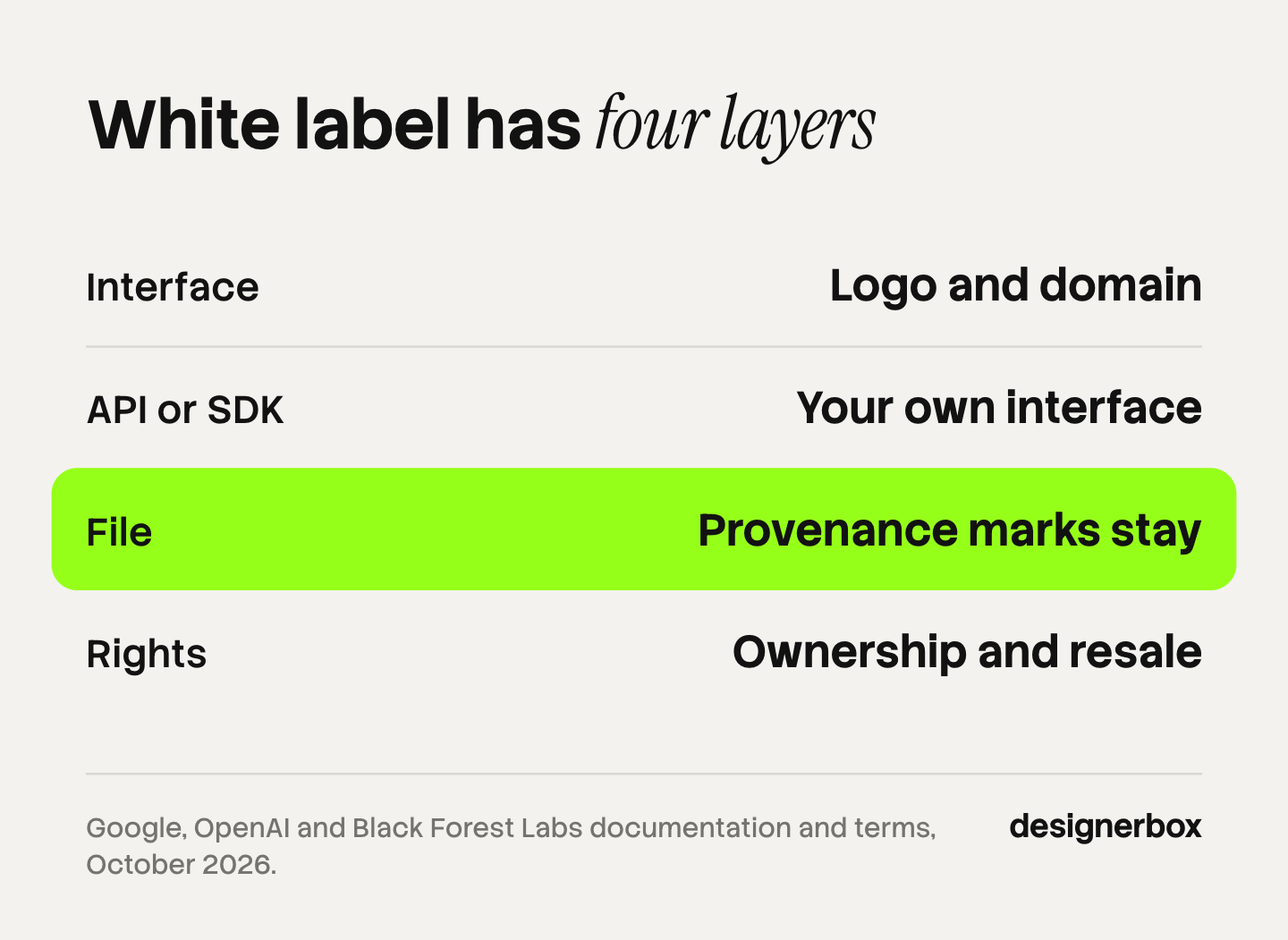
A white label AI image generator is image software that you sell or use under your own brand. The vendor’s name does not appear to your client. White label has four layers: the interface, the API, the file and the rights. A tool can pass one layer and fail the next. Check all four before you put your name on the result.
The usual first question is whether you can change the logo. A client’s lawyer asks two others first: what is inside the file, and who owns it.
This guide is for agencies and operators who sell images under their own name. It covers the four layers, what six vendors state on their own pages, the provenance marks that no reseller can remove, and the rights checks to run before you sign. It prints no vendor prices. A note on bias: DesignerBox makes AI creative production software, and this guide says where other tools are the better choice.
Key Takeaways
- White label has four layers. Interface, API, file and rights. Ask about each one separately.
- Two different buyers use the same phrase. One sells an image tool under its own brand. The other sells finished image sets under its own brand. They need different software.
- You can remove a logo. You cannot promise an unmarked file. Google says every image from its Gemini image models carries a SynthID watermark. OpenAI says images from its API carry C2PA metadata and SynthID.
- In the EU, marking is the law. Article 50 of the AI Act has applied since 2 August 2026, and it requires machine-readable marks on AI-generated content.
- Ownership depends on the plan and on human input. The US Copyright Office says prompts alone do not make a person the author.
- Few vendors use the words “white label”. Of the six vendors checked for this guide, one states it on its own site.
What is a white label AI image generator?
A white label AI image generator is an image tool, or an image service, that carries your brand and not the maker’s. The maker builds and runs the models. You set the price, own the client relationship and answer for the result. This is the same idea as white label content, applied to the software that makes the pictures. White label AI video covers the same question for video.
Two different buyers use this phrase, and they need different things.
- The product builder. A software company or an agency wants to sell an image tool under its own name. Clients log in to the builder’s domain and make images there. This buyer needs an API or an embeddable editor.
- The service seller. An agency or an operator makes the images and delivers finished sets. The client never logs in to anything. This buyer needs clean files, clear rights and the same standard on every set.
Decide which one you are before you compare tools. A product builder who buys a tool with no API has nothing to build on. A service seller who buys an API has bought engineering work it does not need.
The four layers of white label
Each layer answers one question. A vendor can say yes to the first and no to the third.
| Layer | The question | What to ask the vendor |
|---|---|---|
| Interface | Does the client see the vendor’s name on screen? | Can I use my own logo, colors and domain? |
| API or SDK | Can I build my own front end? | Is there an API or an embeddable editor, and on which plan? |
| File | Does the file carry the vendor’s mark? | Is there a visible watermark? Is there an invisible mark or metadata? |
| Rights | Who owns the result, and can I pass it on? | Do I own results on my plan? Can I deliver them to clients? Is there an indemnity? |
The first two layers are about software. The last two are about the picture itself, and they matter to both kinds of buyer.

What six vendors state about white label
These six tools appear often in white label lists. Each fact below was read on the vendor’s own page on 4 October 2026. Where a page does not use the words “white label”, this guide says so. That is a note about wording, and the tool may still fit your build.
| Vendor | Strong at | API | States “white label” on its own site |
|---|---|---|---|
| Bria | Licensed training data and indemnity | Yes | Not found |
| Scenario | Custom models trained on your assets | Yes, on paid plans | Not found |
| Leonardo | Paid-plan ownership of results | Yes, sold as separate plans | Not found |
| Picsart | Embeddable editor | Yes | Yes |
| Photoroom | Product image editing at volume | Yes | Not found |
| Segmind | A workflow published as an endpoint | Yes | Not found |
Bria
Bria leads on the rights layer. It states that its models are trained only on licensed data from Getty Images, Alamy and Envato, and that results are covered by IP indemnification. The level of cover depends on the plan. Bria also runs on its own cloud, on your cloud or on your own servers (bria.ai, October 2026). It is the natural choice when a client’s legal team reads the contract first.
Scenario
Scenario is built for custom models. You train a model on your own images, and Scenario states that it never uses your training data to improve other models. Paid plans include a commercial license that covers delivery to clients, and the API needs a paid plan (scenario.com/pricing, October 2026). It fits a team that needs one consistent style across many images.
Leonardo
Leonardo states that on paid plans you keep full ownership of the images you make (leonardo.ai/pricing, October 2026). Its terms say that on the free plan, ownership of results goes to Leonardo. Its API plans are separate from its web app plans (docs.leonardo.ai, October 2026). Read the terms for your plan before you resell anything.
Picsart
Picsart is the one vendor of the six that uses the phrase. Its developer site says its tools can be integrated “branded or white label”. It offers image APIs for jobs such as background removal and upscaling, and an editor SDK that puts a full web editor inside your own application (picsart.io, October 2026). It fits the product builder best.
Photoroom
Photoroom’s API edits product images at volume: background removal, AI backgrounds, AI shadows and ghost mannequin. Results from its free sandbox carry a watermark, and paid calls do not (photoroom.com/api, October 2026). It fits a product builder whose users sell physical products.
Segmind
Segmind offers image models through one serverless API. Its workflow builder turns a saved workflow into a REST endpoint, and it shows a cost estimate for each step as you build (segmind.com/pixelflow, October 2026). It fits a developer who wants several models behind one endpoint.
The model’s own API
A product builder can also skip the middle layer and call a model vendor directly. OpenAI’s image generation API, Google’s Gemini API and the Black Forest Labs FLUX API all sell image generation by the call. You then build the queue, the storage, the billing and the review yourself. Build vs buy for AI creative work lists the seven parts around the model, and the GPT Image 2 API guide covers one model in detail.
Marks inside the file
You can remove a vendor’s logo from the screen. You cannot promise your client an unmarked file. The model vendors put provenance signals into the image itself, and those signals stay when the file moves from tool to tool.
- Google. Its documentation says: “All generated images include a SynthID watermark” (Gemini API docs, October 2026). SynthID is invisible and sits in the pixels.
- OpenAI. It says supported images made with the OpenAI API carry both C2PA metadata and a SynthID watermark. If the metadata is removed, the watermark may still give a signal (OpenAI Help Center, October 2026).
- Black Forest Labs. Its developer terms say it may embed Content Credentials or other provenance data in results (BFL developer terms, October 2026).
So “no vendor branding” can only mean no visible branding. A white label tool that runs on these models passes the marks through. Tell your client this before they find it. It is a normal property of AI images in 2026, and hiding it creates the problem.
In the EU, marking is also a legal duty. Article 50 of the AI Act has applied since 2 August 2026. Providers of AI systems must mark generated content in a machine-readable format. Systems that were on the market before that date have until 2 December 2026 to add the marks. Deployers must disclose deep fakes, and the European Commission says they cannot rely on the provider’s mark alone (European Commission, October 2026). This is general information, not legal advice. AI disclosure in advertising covers the platform rules that sit on top.
Who owns a white label AI image?
Ownership has two parts: what the vendor’s terms give you, and what copyright law protects.

The vendor’s terms. They differ by vendor and by plan, as the Leonardo example shows. Google’s Gemini API terms say Google will not claim ownership of generated content (Gemini API terms, October 2026). Black Forest Labs says that, between you and it, you own the results (BFL developer terms, October 2026). Check three things in any vendor’s terms: who owns results on your plan, whether you may deliver them to a client, and whether the vendor gives an indemnity.
Copyright law. In the United States, the Copyright Office concluded in January 2025 that AI results can be protected only where a human author has determined sufficient expressive elements, and that prompts alone do not meet that test (US Copyright Office, October 2026). A product photo you took, a layout you arranged and edits you made by hand count toward human authorship. A picture made from a prompt alone may have no copyright owner at all.
For a white label seller, this changes the contract. You can transfer the rights you have. You cannot promise a client exclusive copyright in a file that the law may not protect. Say what you transfer, and say what you do not warrant. This is general information, not legal advice.
How to choose a white label AI image tool
Start from which buyer you are, then run the four layers.
- Name your model. Product builder or service seller. Write it down.
- Product builders: test the API first. Ask which plan carries it, what the rate limits are and whether the vendor changes models without notice. Picsart, Segmind, Scenario and the model vendors lead here.
- Service sellers: test the file and the rights first. Ask whether paid plans remove the visible watermark and whether the license covers client delivery. Bria leads where indemnity decides the deal.
- Ask about the marks. Find out which models the tool runs, and read each model vendor’s provenance page.
- Price one finished set. Count the cost per accepted image, and include the ones you discard. Agency creative pricing shows four ways to charge for it.
- Write the client contract last. State the rights you pass on, the AI disclosure you make and who answers for an error.
White label sets in DesignerBox
DesignerBox is AI creative production for brands and agencies. It serves the second buyer: the agency or operator that sells finished sets. Anyone can make an AI picture. Making hundreds that still look like your client’s brand is the hard part.
You save one workflow for each client, with that client’s logos, fonts, palette, light and framing. A colleague runs it through an app, which is a workflow with a form. Batch runs one workflow over a sheet of up to 200 products, so row one and row two hundred get the same standard. Three critic steps score the results, and best-of-N keeps the best one. You see the cost before each run. The full workflow from the first product photo to the finished ad, in one subscription.
Here is how DesignerBox answers the four layers.
- Interface. White label options are on the Ultra plan. Your client does not log in to DesignerBox to see work in progress.
- API. DesignerBox does not have a public API. It has 68 tools over MCP, so an AI chat such as Claude, ChatGPT or Cursor can run it. A product builder who needs an API should choose one of the tools above.
- File. Every paid plan removes the DesignerBox mark from your results. Provenance signals from the model vendors are a property of the models, as described above.
- Rights. Uploading your own photos and the commercial license start on the Pro plan.
Team features and shared brand kits are on the Ultra plan, and every plan below Ultra is one seat. There is a free plan, and it runs on sample products. You download the results, or send them with a webhook or an S3 step. Plans are on the pricing page. Agencies with many client brands can apply to the agency partner program.
Bring one client product and the set you sell for it. Book a demo.
FAQ
What is a white label AI image generator?
It is an AI image tool or service that carries your brand in place of the maker’s. The maker runs the models. You sell the tool, or the images, under your own name and set your own price.
Can I resell AI images under my own brand?
Usually yes on a paid plan, but the vendor’s terms decide. Check that your plan gives you ownership or a commercial license, and that the license covers delivery to clients. Scenario, for example, states that its paid plans cover client delivery (scenario.com/pricing, October 2026).
Do white label AI images have a watermark?
Paid plans on most tools remove the visible watermark. Invisible marks stay. Google states that all images from its Gemini image models include a SynthID watermark, and OpenAI states that API images carry C2PA metadata and SynthID (vendor documentation, October 2026).
Do I need an API for white label AI image generation?
Only if clients will log in to a tool under your brand. If you deliver finished image sets, you need clean files and clear rights, and an API adds work you do not need.
Who owns the copyright in AI-generated images?
It depends on human input. The US Copyright Office says AI results can be protected only where a human author determined sufficient expressive elements, and prompts alone do not qualify (copyright.gov, January 2025). This is general information, not legal advice.
Is DesignerBox a white label AI image generator?
For finished sets, yes: paid plans remove the DesignerBox mark, and white label options are on the Ultra plan. For building your own image product, no. DesignerBox does not have a public API. It has 68 tools over MCP.
Which white label AI tools state it on their own site?
Of the six vendors checked on 4 October 2026, Picsart states that its tools can be integrated “branded or white label” (picsart.io). The other five describe APIs, licenses or indemnity without that phrase.
Sources
- Bria licensed training data, indemnification by plan and where it runs: (bria.ai and bria.ai/pricing, October 2026)
- Scenario custom model training, data use, commercial license and API plans: (scenario.com, scenario.com/pricing and scenario.com/api, October 2026)
- Leonardo paid-plan ownership, free-plan ownership terms and separate API plans: (leonardo.ai/pricing, leonardo.ai/terms-of-service and docs.leonardo.ai, October 2026)
- Picsart image APIs, editor SDK and “branded or white label” wording: (picsart.io and docs.picsart.io, October 2026)
- Photoroom API features and sandbox watermark: (photoroom.com/api, October 2026)
- Segmind serverless API, workflow endpoints and cost estimate: (segmind.com/pixelflow and docs.segmind.com, October 2026)
- SynthID watermark on generated images: Google, Gemini API image generation, October 2026
- Ownership of generated content: Google, Gemini API additional terms, October 2026
- C2PA metadata and SynthID on API images: OpenAI Help Center, C2PA in ChatGPT images, October 2026
- Image generation by API: OpenAI, image generation guide, October 2026
- Ownership of results and provenance data: Black Forest Labs, developer terms of service, October 2026
- Copyrightability of AI results: US Copyright Office, Copyright and Artificial Intelligence, Part 2, January 2025
- Article 50 duties, the 2 August 2026 date and the 2 December 2026 grace period for marking: European Commission, transparency obligations under Article 50, October 2026
- DesignerBox plan gates, batch and MCP tools: (DesignerBox pricing and product pages, October 2026)
Vendor facts verified from each vendor’s own pages as of October 2026. Individual results vary.