


A white label AI platform is AI software that another company builds and runs, and that you sell under your own brand. Your client sees your name, your domain and your invoice. There are five kinds: agency platforms resold whole, chat agents, voice agents, tool builders with a paywall, and image or video generation. Each kind lets you rebrand different things, so check the kind first.
Search for the phrase and you get a voice receptionist, a chatbot builder, an agency CRM and an image API on one page. An agency that picks from one vendor’s list can buy the wrong kind of product.
This guide is for agencies and operators who want to sell AI under their own name. It sorts the platforms into five kinds, says what you rebrand in each, and gives six checks that hold for all of them. It prints no vendor prices. DesignerBox makes AI creative production software, and this guide says where it does not fit.
Key Takeaways
-
The phrase covers five kinds of product. Agency platforms, chat agents, voice agents, tool builders and image or video generation.
-
A logo change is the small part. Check the domain, the login, the system emails, the billing and the name of the model.
-
Branding and resale are two separate rights. A plan can let you add your logo and still not let you resell.
-
Someone has to bill and support the end customer. Find out whether that is you or the vendor before you set a price.
-
Flat fees and metered costs move margin in opposite ways. A flat fee rewards more clients. With a metered cost, one heavy client can remove your margin.
-
AI disclosure duties do not move to the vendor. Article 50 of the EU AI Act has applied since 2 August 2026.
What is a white label AI platform?
A white label AI platform is software with AI features that one company builds and hosts, and that a second company sells as its own. The maker runs the models, the servers and the updates. The seller sets the price, owns the client relationship and answers for the result. It is white label SaaS with a model inside it.
Every one of these products calls a model from a model vendor such as OpenAI, Anthropic or Google. You rebrand the layer around the model. The model vendor’s terms still apply to you.
The five kinds of white label AI platform
Sort a platform by what the client receives. The table shows what you rebrand in each kind. The agency platform rebrands the most.
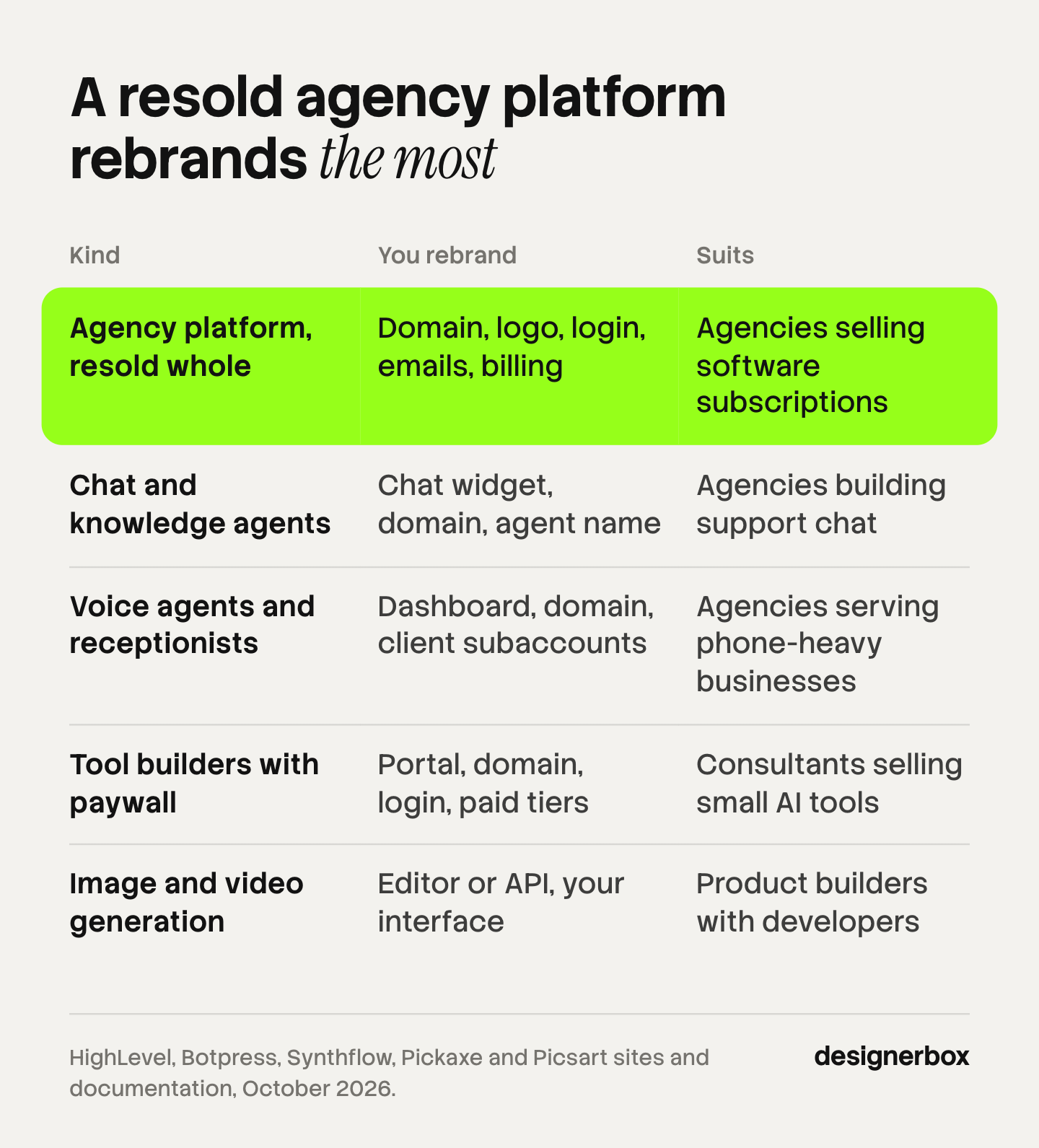
| Kind | What you rebrand | Who it suits | Example vendors |
|---|---|---|---|
| Agency platform, resold whole | Domain, logo, login, emails, billing | Agencies selling software subscriptions | HighLevel, Vendasta |
| Chat and knowledge agents | Chat widget, domain, agent name | Agencies building support chat | Botpress, CustomGPT.ai, Voiceflow |
| Voice agents and receptionists | Dashboard, domain, client subaccounts | Agencies serving phone-heavy businesses | Synthflow, Retell AI partner apps |
| Tool builders with a paywall | Portal, domain, login, paid tiers | Consultants selling small AI tools | Pickaxe, Stack AI |
| Image and video generation | Editor or API, your interface | Product builders with developers | Picsart |
Each fact below was read on the vendor’s own site or documentation on 4 October 2026. The vendors are examples of a kind, in no ranked order.

Agency platforms, resold whole
The client logs in to a full system: CRM, messaging, automations and AI features. You sell the subscription. HighLevel calls this SaaS mode, and its support pages describe a platform that agencies resell under their own brand, with a white label domain and the agency’s logo on the login screen and in system emails (help.gohighlevel.com, October 2026). Its terms grant a “limited, non-exclusive, non-transferable and revocable license” for “re-branding and reselling access to the Platform under your own white-label brand” (gohighlevel.com/terms-of-service, October 2026).
Vendasta’s partner page describes the same model in one line: “Custom domain, custom branding, your billing” (vendasta.com/partners, October 2026). Both vendors target agencies that serve small local businesses.
Chat and knowledge agents
The client receives a chat agent that answers from the client’s own content. You rebrand the chat widget, the domain it runs on and the agent’s name. Botpress says its white-labeling covers a custom interface, domain, branding and API access, and removes the Botpress watermark from the webchat on its paid plans (botpress.com, October 2026).
Voiceflow lists a plan track for agencies and partners. It includes white-labeling, client handoff tools and usage-based billing (voiceflow.com/pricing, October 2026). CustomGPT.ai separates branding from resale. Its white label page says a logo, colors and a domain do not by themselves give you the right to resell, and that resale rights come from a partner or reseller agreement (customgpt.ai, October 2026).
Voice agents and receptionists
The client receives an agent that answers and makes phone calls. Synthflow’s documentation has a partner section for subaccounts, permissions, branding, a custom domain and usage limits. The same documentation says in-product reselling through Stripe was removed on 15 September 2026, so a partner now bills its customers from its own billing system (docs.synthflow.ai, October 2026).
Retell AI is built for developers. Its own partner directory lists separate white label services that run on Retell, such as branded client dashboards for voice agencies (retellai.com, October 2026). In that case you sign with two vendors: the voice platform and the dashboard on top of it.
Tool builders with a paywall
The client receives small AI tools behind a login, and often pays for them through your own checkout. Pickaxe describes a no-code portal with white labeling, a custom domain, custom logins and paid tiers that run through Stripe. Its pricing page also says that when an end user runs your tool, the use counts against your credits (pickaxe.co, October 2026). Check 4 shows why that matters for margin.
Stack AI builds agents that you can publish as a chat widget, a form or an API endpoint. It says the interfaces can be white labeled with your branding (stackai.com, October 2026). Its site addresses enterprise teams.
Image and video generation
The client makes pictures or clips inside your product. You rebrand an embedded editor, or you build your own interface on an API. Picsart’s developer site says its tools “can be integrated to your platform: branded or white label” (picsart.io, October 2026). This kind needs developers on your side. White label AI image generators covers this kind in detail, including the provenance marks that stay inside every file. White label AI video covers the same question for clips.
What you can rebrand
“White label” means different surfaces to different vendors. Ask about each one by name.
- Domain. The client logs in at your address. Ask whether links in emails also use it.
- Logo and colors. The usual first step, and the smallest.
- Login. Each client gets its own login under your brand.
- System emails. Password resets and alerts come from your name.
- Billing. The client’s invoice and card statement show your company.
- Model name. Some tools show which model answered. Ask whether your client sees it.
CustomGPT.ai states the limit in plain words: branded “does not mean every vendor trace can be removed from every surface” (customgpt.ai, October 2026). Test each surface with a client account before you sign.
Six checks before you sign
These six checks apply to every kind in the table. The first two can end the deal before you compare features.

1. Resale rights in the terms
Read the vendor’s terms for the words “resell”, “sublicense” and “white label”. Branding is a feature, and resale is a right in a contract. The HighLevel license quoted above is revocable and non-transferable. Find out which plan carries the right, and what happens to your clients if the vendor ends it.
2. Merchant of record and support
The merchant of record is the company that charges the end customer’s card. It handles refunds, chargebacks and sales tax. On a white label platform that company is often you. Vendasta’s partner page says “your billing”, and Synthflow partners now bill from their own system. Ask who collects the money and who answers the client when the product stops working. If the answer is you, add your support hours to the price.
3. Client separation
Each client’s data, settings and logins must stay apart from every other client’s. Ask how the vendor separates clients, and whether you can export or delete one client alone. Agencies that run creative for multiple clients know the same problem from brand files.
4. Flat fee or metered cost
Your cost is either a flat fee or a metered cost per use. The two move margin in opposite ways. The numbers below are illustrative and are not any vendor’s price.
Flat fee. You pay 400 dollars a month and charge each client 120 dollars. With three clients you collect 360 dollars and lose 40. With ten clients you collect 1,200 dollars and keep 800, a 67% margin. A flat fee rewards more clients.
Metered cost. You pay for every call, minute or credit your clients use. An average client costs you 30 dollars a month, so you keep 90 of the 120 dollars, a 75% margin. One heavy client who uses 150 dollars of capacity costs you 30 dollars that month. Set a usage cap, or meter your own price.
Agency creative pricing compares four ways to charge clients once you know your cost.
5. Data and model terms
The vendor’s terms sit on top of a model vendor’s terms. Both reach your client. OpenAI’s Services Agreement defines a “Customer Application” as a product that integrates with an OpenAI API, and it says end users may include that customer’s own customers (OpenAI Services Agreement, October 2026).
Ask the vendor three questions. Which models does the platform call? Does anyone in the chain train on your clients’ content? Which usage rules pass through to your clients?
6. AI disclosure
Your brand on the product does not move the disclosure duty to the vendor. Article 50 of the EU AI Act has applied since 2 August 2026 (European Commission, October 2026). Article 50(1) says AI systems that interact directly with people must be designed so that people “are informed that they are interacting with an AI system”, unless that is obvious. Article 50(2) requires providers to mark generated content in a machine-readable format. Article 50(4) requires deployers to disclose deep fakes (AI Act Service Desk, October 2026).
For a chat or voice agent, ask the vendor in writing whether the disclosure is built in and whether a reseller can turn it off. In the United States, the FTC’s position is short. In September 2024 its then Chair said “there is no AI exemption from the laws on the books” (FTC, October 2026).
This is general information, not legal advice. Ask your lawyer which role your company holds under each rule when your name is on the product. AI disclosure in advertising covers the rules for ads.
White label the software, or white label the work?
There are two ways to put your name on AI. You can sell access to software, or you can sell the finished work that software makes.
| White label the software | White label the work | |
|---|---|---|
| What the client buys | A login and a subscription | Finished files or a running service |
| What you support | The product, for every user | Your own delivery |
| Where margin comes from | Seats and usage | Price per set minus your cost |
| Main risk | Support load and vendor changes | Review time and revision rounds |
Sell the software if your clients want to run it themselves and you can support it. Sell the work if your clients want results. For creative agencies, white label content covers the second model: finished image and video sets, priced per set, with the rights checks. An AI UGC agency runs the same model for video ads.
Client work in DesignerBox
DesignerBox is not a platform that you resell as software. It serves the second model: the agency or operator that sells the work.
DesignerBox is AI creative production for brands and agencies. Scale your images, ads and video with AI and keep your brand on every piece: build the workflow once with your brand rules, run it on every product, see the cost before each run, and keep everything from the first product photo to the finished ad in one place.
Anyone can make an AI picture. Making hundreds that still look like your brand is the hard part. For an agency, the brand belongs to the client. You build one workflow for each client with that client’s logos, fonts, palette and rules. You publish it as an app, which is a workflow with a form, and a colleague runs it. Batch runs one workflow over a whole sheet of products, so row one and row two hundred get the same standard. You download the results, or send them with a webhook or an S3 step.
An AI chat such as Claude, ChatGPT or Cursor can run the same workflows, because DesignerBox has 68 tools over MCP. Skills vs MCP explains the connection. DesignerBox does not have a public API, so a product builder who needs one should choose a tool from the fifth kind above.
Here are the limits. White label options, team features and shared brand kits are on the Ultra plan, and every plan below Ultra is one seat. Uploading your own photos and the commercial license start on the Pro plan. AI video, virtual try-on, upscaling, the image editor and the video editor start on the Premium plan. Plans and credits are on the pricing page.
The full workflow from the first product photo to the finished ad, in one subscription.
A demo for your agency
Bring one client brand and the set you sell for it. DesignerBox for agencies shows how one workflow per client runs.
FAQ
What is a white label AI platform?
A white label AI platform is AI software that one company builds and hosts, and that another company sells under its own brand. The seller sets the price and owns the client relationship. The phrase covers five kinds of product: agency platforms, chat agents, voice agents, tool builders and image or video generation.
Can I resell any AI tool under my own brand?
No. Adding your logo and reselling are two separate rights. A plan can allow branding and still forbid resale. Read the vendor’s terms for the words “resell” and “sublicense”, and get the right in writing before you quote a client.
What is a white label AI agency?
A white label AI agency sells AI software or AI services that carry the agency’s own name. Some agencies resell a full platform as a subscription. Others build chat or voice agents for each client. Others sell finished creative work and keep the software in-house.
How do white label AI agents differ from white label SaaS?
White label SaaS is a whole product that the client logs in to. White label AI agents are single chat or voice agents that you build for a client and place on the client’s website or phone line.
Is DesignerBox a white label AI platform?
No. DesignerBox is not resold as software, and it does not have a public API. It has 68 tools over MCP. Agencies use it to make client work: one workflow per client, published as an app, with the cost shown before each run. White label options are on the Ultra plan.
Sources
- HighLevel Support Portal, SaaS mode guide and agency company settings (help.gohighlevel.com), accessed October 2026: reselling under the agency’s brand, white label domain, logo and system emails
- HighLevel, Terms of Service (gohighlevel.com/terms-of-service), accessed October 2026: license to white label
- Vendasta, partner program page (vendasta.com/partners), accessed October 2026
- Botpress, white label chatbot platform guide (botpress.com/blog/white-label-chatbot-platform), accessed October 2026
- Voiceflow, pricing page, agencies and partners track (voiceflow.com/pricing), accessed October 2026
- CustomGPT.ai, white label page (customgpt.ai/white-label), accessed October 2026: branding and resale rights
- Synthflow documentation, admin dashboard, Stripe and subscriber terms pages (docs.synthflow.ai), accessed October 2026
- Retell AI, app partner directory (retellai.com/app-partner), accessed October 2026
- Pickaxe, pricing page and product posts (pickaxe.co), accessed October 2026
- Stack AI, product comparison post (stackai.com/blog/stackai-vs-writer), accessed October 2026
- Picsart for developers (picsart.io), accessed October 2026
- OpenAI, Services Agreement: openai.com/policies/services-agreement, accessed October 2026
- EU AI Act, Article 50, via the AI Act Service Desk: ai-act-service-desk.ec.europa.eu, accessed October 2026
- European Commission, Transparency obligations under Article 50 of the AI Act, FAQ: digital-strategy.ec.europa.eu, accessed October 2026
- US Federal Trade Commission, press release on Operation AI Comply, 25 September 2024: ftc.gov, accessed October 2026
- DesignerBox pricing (designerbox.ai/pricing), October 2026: plan gates and white label options
- DesignerBox MCP (designerbox.ai/mcp), October 2026
Vendor white label and resale facts verified from each vendor’s own site or documentation on 4 October 2026. EU AI Act and FTC statements verified from the AI Act Service Desk, the European Commission and the FTC as of October 2026. Individual results vary.