


UGC platforms are services that supply brands with user-generated content for ads, product pages and social posts. They come in three kinds. Creator marketplaces pay a real person to film your product. Customer content platforms collect posts and reviews your buyers already made. AI generators produce a creator-style video with a generated presenter. The kind decides who is on camera, which ad formats you can run and what the ad may claim.
Most lists of UGC platforms mix all three kinds in one ranking. A marketplace with 10,000 creators sits next to a review widget and an AI avatar tool, and the ranking tells you nothing. The three kinds do different jobs. A brand that picks the wrong kind pays for content it cannot run in the format it planned.
This guide sorts 15 UGC platforms into the three kinds. Each fact comes from the vendor’s own site, read in October 2026. The guide is for brands and agencies that buy creator-style content every month. It lists no vendor prices, because plans change often. Check each vendor’s own pricing page.
Key Takeaways
- There are three kinds of UGC platform. A marketplace hires a creator, a customer content platform collects real posts, and an AI generator makes a presenter.
- Only a real creator has a handle. Meta partnership ads and TikTok Spark Ads run from a creator’s account, so they need a marketplace or a real customer.
- Usage rights differ by vendor. Some marketplaces state full or lifetime rights. Others leave rights to each order.
- A generated presenter cannot be a customer. The FTC rule on fake testimonials covers a testimonial from a person who does not exist.
- A paid creator must disclose the payment. FTC guidance says a material connection “must be disclosed clearly and conspicuously”.
- A third of the search results are for creators looking for work. This guide is for the buyer of the content.
- Start from the ad format. Choose the format first, then the kind of platform that can supply it.
What is a UGC platform?
A UGC platform is software or a service that gets user-generated content to a brand in a form it can publish. “User-generated” first meant content that customers made without being asked: a review, a photo, a tagged post. Today it also means a paid video filmed to look that way, made by a UGC creator. Vendors use one name for both, which is why the lists are confusing.
The search results show the same split. We read the first page of Google for “ugc platforms” in October 2026. Most results were ranked lists, and many were written by a vendor that placed itself first. About a third were written for creators who want paid work. If you are a creator, those lists are for you. This guide is for the brand or agency that pays for the content.
Three questions sort any UGC platform:
- Who is on camera? A paid creator, a real customer or a generated presenter.
- Whose account can the ad run from? Your brand’s account only, or a creator’s handle too.
- What may the person claim? A personal experience, or product facts only.
The three kinds of UGC platforms
The three kinds of UGC platforms are creator marketplaces, customer content platforms and AI UGC generators. Each answers the three questions differently. The table shows the split before the vendor lists.
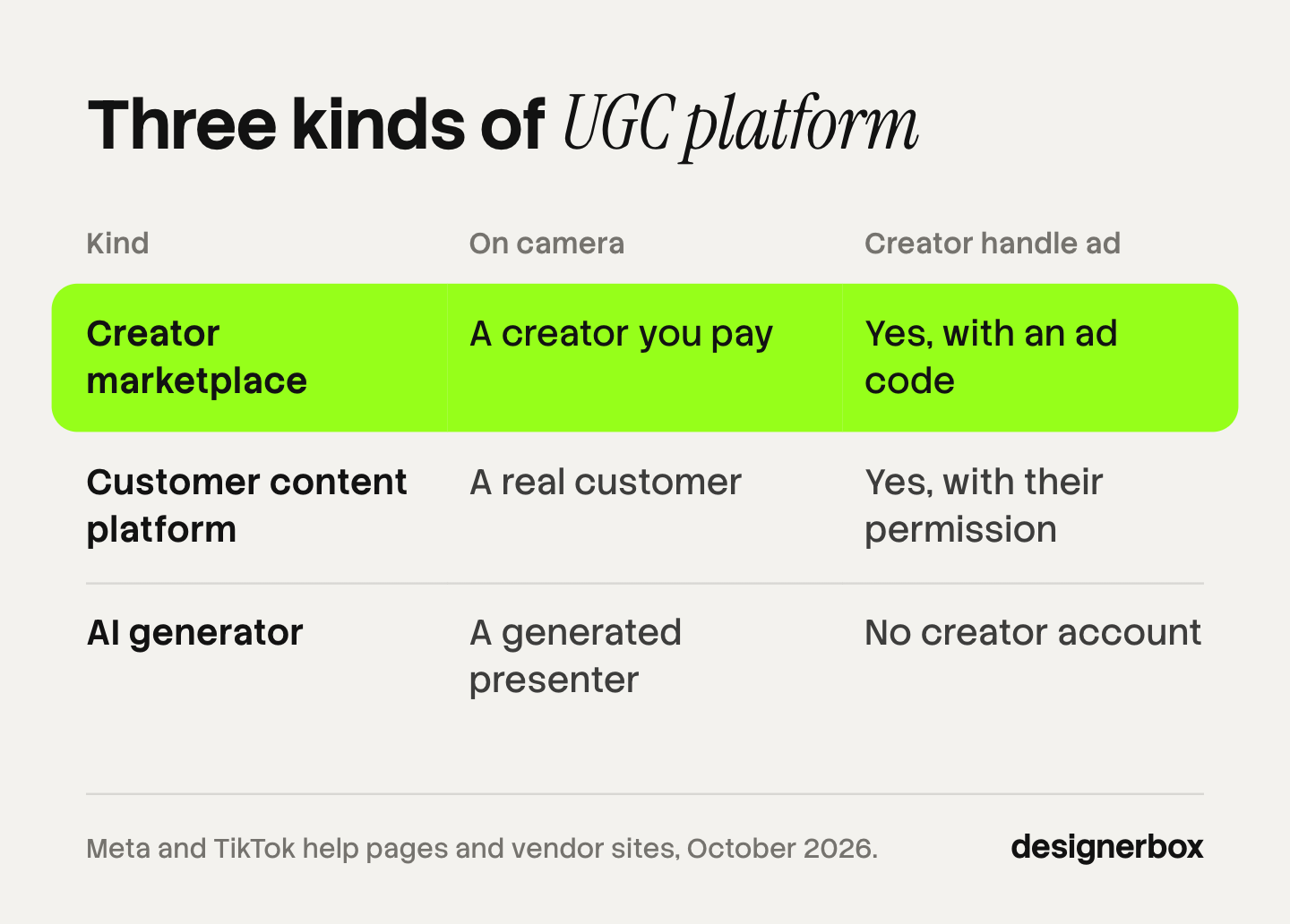
| Kind | Who is on camera | Ad from a creator’s handle | Personal experience claim |
|---|---|---|---|
| Creator marketplace | A creator you pay | Yes, when the creator grants an ad code | Yes, if the creator used the product and discloses the payment |
| Customer content platform | A real customer | Yes, with the customer’s permission | Yes, it is their own experience |
| AI UGC generator | A generated presenter | No, there is no creator account | No, the presenter has no experience |
The last column matters most for ad copy. A script that says “I used this for a month” needs a person who did. Our guide to AI UGC ads and the FTC rule covers that line in detail.
Creator marketplaces: a real person films your product
A creator marketplace connects a brand with people who film product videos for a fee. You post a brief, creators apply or are matched, you ship the product, and the creator sends back a video. The six below state different terms for usage rights and for ad codes, so read those two columns first.
| Marketplace | Usage rights, as stated | Ad codes for Meta and TikTok | Free to start |
|---|---|---|---|
| Billo | Creators “transfer and assign all rights, title, and interest” | Both, stated | Yes |
| Insense | ”Fully-licensed edited + raw footage within 14 days” | Both, stated | Yes, a free trial |
| JoinBrands | ”unlimited usage rights” | Both, stated | Yes, a free plan |
| minisocial | Use “anywhere and for as long as you want” | Both, stated | Not stated |
| Trend | ”100% licensing & distribution rights” | Not stated on the pages we read | A free brief |
| Collabstr | Agreed for each order | Not stated on the pages we read | Yes |
Sources: billo.app, insense.pro, joinbrands.com, minisocial.io, trend.io and collabstr.com, each read in October 2026.

Billo is a video marketplace built around paid social. Its site says brands can “use Meta Partnership Ads or TikTok Spark Ads to leverage creator credibility” (billo.app, October 2026).
Insense runs briefs and creator chat in one place. It says brands get “Meta Partnership Ads (previously whitelisting)” and can “receive Spark Ad codes” (insense.pro, October 2026).
JoinBrands covers video, photos and TikTok Shop content. Its site says “you automatically receive their Spark Ad code” with an order (joinbrands.com, October 2026).
minisocial sells fixed projects. It promises “fully-licensed videos and Meta/TikTok ad codes”, and you “simply pay per project” (minisocial.io, October 2026).
Trend works from a brief and a set of matched creators. It states “100% licensing & distribution rights to use on social, websites, ads” (trend.io, October 2026).
Collabstr is an open marketplace where you browse creator profiles. Brand and creator “agree on deliverables and usage rights” before the order starts (collabstr.com, October 2026). The terms are set order by order, so write the rights into each one.
A marketplace gives you the creator. It does not give you the script. A weak brief returns a weak video, whatever the platform. Our UGC script templates give the beats, the word counts and the brief fields.
Customer content platforms: posts your buyers already made
A customer content platform finds, collects and licenses content that real customers made. It handles reviews, tagged photos and videos, asks the customer for permission, and shows the content on product pages or sends it to ads. This is the older meaning of “UGC platform”.
| Platform | What it does, in its own words | Free to start |
|---|---|---|
| Bazaarvoice | ”Reviews. Moderation. FAQs. Creator Marketing. Syndication.” | Not stated |
| Yotpo | ”Reviews & UGC offers a limited free plan” | Yes, limited |
| Archive | ”Detect product UGC, get usage rights / whitelisting, and repurpose top content for ads” | Demo |
| TrueLoyal (was TINT) | “Capture usage rights and activate authentic customer content” | Demo |
Sources: bazaarvoice.com, yotpo.com, archive.com and trueloyal.com, each read in October 2026.
Bazaarvoice collects reviews and sends them to retailer sites. It serves large retail brands.
Yotpo pairs reviews with loyalty. Its homepage now leads with “Loyalty, Reviews & AI Visibility” (yotpo.com, October 2026).
Archive finds posts about your product on TikTok, Instagram and YouTube Shorts, including posts that did not tag the brand. It now calls itself an “AI Creator Marketing Platform” (archive.com, October 2026).
TINT has a new name. Its old site now serves TrueLoyal, a loyalty platform. TrueLoyal’s own page says: “In 2025, Scaleworks acquired Zinrelo and combined it with TINT, and the company became TrueLoyal” (trueloyal.com, October 2026). UGC is one module of that product. Many 2026 lists still name TINT as a UGC platform on its own.
This kind has one clear strength. The content is a real customer’s real experience, so it can say “I bought this” truthfully. It also has a limit. You cannot brief it. You get what customers chose to post.
AI UGC generators: a generated presenter
An AI UGC generator makes a creator-style video without a creator. You give it a script and a product, pick or build a presenter, and it returns a talking video. It is fast, and it makes variants cheaply. It has no creator account, and its presenter has no experience of the product.
| Generator | What its own site states | Free to start |
|---|---|---|
| Arcads | A “library of 1,000+ Captivating AI Actors, or create your own AI Avatar” | A free trial |
| Creatify | AI avatars and video from a product link | Yes, exports carry a watermark |
| HeyGen | ”You own your AI-generated videos and visuals” | Yes |
| MakeUGC | ”1000+ realistic AI actors” | No |
| Tagshop AI | Avatars and voices “are licensed for commercial use” | Yes, a sample |
Sources: arcads.ai, creatify.ai, heygen.com, makeugc.ai and tagshop.ai, each read in October 2026.
None of the five mentions Meta partnership ads or TikTok Spark Ads on the pages we read. That is a matter of scope. Both formats need a real account that grants permission, and a generated presenter has none.
We compare this kind in depth in a separate guide to AI UGC video generators, with ten tools side by side. Agencies have their own list of AI UGC video tools with seats and white label. To write the clips, start from our AI UGC video prompts. A third guide covers what each free AI UGC video generator allows.
Which UGC platforms let an ad run from a creator’s handle?
Creator marketplaces and customer content platforms can, because both work with real accounts. AI generators cannot. An ad from a creator’s handle shows the creator’s name in the header, and it needs that person’s permission on each platform.
On Meta the format is the partnership ad. Meta says “advertisers need permission from the partner whose handle the ad will include”, and “creators and other partners can revoke these permissions at any time” (facebook.com, read October 2026). Permission is given for one post or for the whole account.
On TikTok the format is Spark Ads. TikTok describes it as “a native ad format that allows you to leverage organic TikTok posts”, including “organic posts made by other creators (with their authorization)” (ads.tiktok.com, read October 2026). The creator sets how long the code works: 7, 30, 60 or 365 days (ads.tiktok.com, read October 2026).
Two practical points follow. Ask for the ad code in the brief, with the duration, before the creator films. And plan for the end date. A 30-day code on a winning ad stops the ad on day 31.
What may each kind of UGC say?
Each kind may say what is true for the person on camera. Two FTC texts set the limits in the United States. This section is general information, not legal advice.
A paid creator must disclose the payment. The FTC’s Endorsement Guides say a material connection “must be disclosed clearly and conspicuously”, and that connections “can include monetary payment or the provision of free or discounted products” (ecfr.gov, 16 CFR 255.5, read October 2026).
No testimonial may come from a person who does not exist. The FTC rule on reviews and testimonials has been in effect since 21 October 2024. It bans a testimonial that misrepresents “that the reviewer or testimonialist exists” or that the person “used or otherwise had experience with the product” (ecfr.gov, 16 CFR 465.2, read October 2026). The FTC’s announcement names “AI-generated fake reviews” as an example (ftc.gov, August 2024).
So a generated presenter can demonstrate, explain and compare. It cannot say “this cleared my skin in two weeks”. Platform labels for AI content are a separate rule: TikTok’s ads policy asks for a label on fully AI-generated ads, and rejects or restricts ads with undisclosed AI content (ads.tiktok.com, read October 2026). Our guide to AI disclosure in advertising covers Meta, the EU and the US states.
How to choose a UGC platform
Choose a UGC platform by the ad you plan to run. Start with the format and the claim, and the kind follows. The vendor comes last.
| The ad you plan | The kind that fits | Why |
|---|---|---|
| A testimonial with a personal result | Creator marketplace or customer content | Only a real user can claim an experience |
| An ad from a creator’s handle | Creator marketplace | The creator grants the ad code |
| Reviews and photos on the product page | Customer content platform | It collects and licenses real posts |
| Ten hook variants of one demo | AI UGC generator | Variants cost little, and no claim of experience is needed |
| The same ad in five languages | AI UGC generator | One script, translated, with the same presenter |
| A product the creator must handle | Creator marketplace | Hands, texture and use are filmed |
Many brands use two kinds together. A creator films the testimonial once. Our guide to testimonial ads covers the permission and proof to collect at that shoot. A generator then makes the hook and language variants around the product demo. The media buyer reads hook rate to see which opening held viewers, and the next brief follows the winner.

Before you sign with any vendor, check four things on its own site:
- Rights. Where the content may run, for how long, and whether paid ads are included.
- Raw files. Whether you get the unedited footage for your own cuts.
- Ad codes. Whether partnership ad and Spark Ads permission comes with the order.
- Revisions. How many, and what counts as one.
What does a creator video cost?
A creator video has a market rate, and two 2026 reports give a range. Both have limits, so treat the numbers as a guide.
One marketplace report covered “472,000+ packages and 21,000 collaborations”. It put the average asking price for a UGC video at $180 and the average payout at $154.
That report is the Collabstr 2026 Influencer Marketing Report. It is the marketplace’s own data, so it is vendor-run (collabstr.com/2026-influencer-marketing-report, read October 2026).
The Influencer Marketing Hub Benchmark Report 2026 surveyed “600+ respondents”, who are marketers and not creators. It says: “For UGC creators, roughly 80% of all responses sit under $500” (influencermarketinghub.com, read October 2026). The report does not give the sample size for that question.
Three costs sit on top of the video fee: the product you ship, extra usage rights where they are not included, and the platform’s own plan. Our UGC ads cost guide sets out how each production route charges.
Creator-style ads inside one workflow
DesignerBox is AI creative production for brands and agencies. It is the third kind in this guide, and only that. It is not a creator marketplace and it does not collect customer posts. It has no creator accounts, so it cannot supply a partnership ad or a Spark Ads code.
What it does is the repeated part. Anyone can make an AI picture. Making hundreds that still look like your brand is the hard part. You set the brand rules once, and a saved workflow reads them on every run: the same presenter, the same script rules, the same sizes. Batch runs that workflow over a whole sheet of products, and you see the cost before each run. The script, the stills, the clips and the finished sizes stay in one place, in one subscription. The AI UGC page shows the presenter workflow.
The limits are plain. A generated presenter shows and explains the product. It does not give a testimonial. AI video starts on the Premium plan, and uploading your own photos starts on the Pro plan. Plans and credits are on the pricing page.
Start from a template, add your brand and your products, and run it. See the templates.
FAQ
What is a UGC platform?
A UGC platform is a service that supplies brands with user-generated content for ads, product pages and social posts. There are three kinds: creator marketplaces that hire people to film, customer content platforms that collect real posts and reviews, and AI generators that make a presenter video.
What are the best UGC platforms for brands?
The best UGC platform depends on the ad. For a testimonial or an ad from a creator’s handle, use a creator marketplace such as Billo, Insense, JoinBrands, minisocial, Trend or Collabstr. For reviews and customer photos, use a customer content platform. For many variants of one demo, use an AI generator.
Is a UGC marketplace the same as an influencer platform?
No. A UGC marketplace pays a creator to make content the brand publishes itself, and audience size matters little. An influencer platform pays a creator to post to their own followers. Some vendors do both, and partnership ads sit between the two.
Can AI UGC replace UGC creators?
Not for every ad. An AI presenter can demonstrate and explain a product, and it makes variants fast. It cannot give a personal testimonial, and it cannot grant a Meta partnership ad or a TikTok Spark Ads code. Those need a real person with a real account.
Do UGC platforms include usage rights for paid ads?
It depends on the vendor. In October 2026, Billo, Insense, JoinBrands, minisocial and Trend each stated broad or full rights on their own sites. Collabstr leaves rights to each order. Read the vendor’s terms before you run a creator video as a paid ad.
Which UGC platforms are for creators looking for work?
Creator marketplaces have a creator side where people apply for briefs. Many lists titled “UGC platforms” are written for those creators. This guide covers the buyer’s side: what a brand or agency gets from each kind.
Sources
- Meta Business Help Center, partnership ads permissions: facebook.com, read October 2026
- TikTok Business Help Center, Spark Ads: ads.tiktok.com, read October 2026
- TikTok Business Help Center, Spark Ads authorization periods: ads.tiktok.com, read October 2026
- TikTok ads policy, misleading and false content: ads.tiktok.com, read October 2026
- FTC Endorsement Guides, 16 CFR 255.5: ecfr.gov, read October 2026
- FTC rule on consumer reviews and testimonials, 16 CFR Part 465: ecfr.gov, read October 2026
- FTC announcement of the final rule: ftc.gov, August 2024
- Vendor sites, read October 2026, not linked: billo.app, insense.pro, joinbrands.com, minisocial.io, trend.io, collabstr.com, bazaarvoice.com, yotpo.com, archive.com, trueloyal.com, arcads.ai, creatify.ai, heygen.com, makeugc.ai, tagshop.ai
- Collabstr 2026 Influencer Marketing Report (collabstr.com/2026-influencer-marketing-report) and Influencer Marketing Hub Benchmark Report 2026 (influencermarketinghub.com), read October 2026
- DesignerBox pricing and product pages, October 2026
Vendor features verified from each vendor’s own site, and platform and FTC rules from their primary sources, as of October 2026. Individual results vary.