


CPG marketing is how a brand sells consumer packaged goods: food, drinks, supplements, personal care and household products that people use and buy again. The work has five parts. You win a place on the shelf, you set price and promotions, you design the pack, you advertise, and you earn the second purchase. Most CPG sales still happen through retailers, so the pack does much of the selling.
The definition is the easy part. A small brand has a more practical problem. Every channel asks for new pictures, and new pictures have meant a new photo shoot.
This guide explains what CPG marketing is, how it differs from DTC and from durable goods, and which channels and levers matter. Then it covers the part that limits a small team most: the supply of images. It ends with a monthly asset plan for a range of about 12 products.
Key Takeaways
- CPG marketing sells products people buy often. The price is low, the purchase is fast, and the same buyer returns. Repeat purchase is the goal, more than the first sale.
- The retailer stands between you and the buyer. The US Census Bureau puts e-commerce at 17.1% of total retail sales in the second quarter of 2026, across all retail. Most sales still happen in stores.
- Retail media is now a main ad channel. IAB and PwC report that US commerce media ad revenue reached $63.4 billion in 2025, up 18.0% from 2024.
- The pack is the brand. Label text, colors and claims have to be accurate in every picture. In the US, the FDA regulates the label and the FTC regulates the advertising.
- Creative supply is the real limit for a small range. A photo shoot returns a fixed set of pictures. Five channels ask for new ones every month, in several shapes.
- Shoot once, then make the rest. Photograph each pack one time with a sharp label. Make new scenes and channel shapes from that source photo, and check every label before you publish.
What is CPG marketing?
CPG marketing is the planning, pricing, packaging, distribution and advertising of consumer packaged goods. CPG stands for consumer packaged goods. These are products that people use within days or weeks and then replace: snacks, drinks, vitamins, shampoo, cleaning products and pet food.

FMCG means fast-moving consumer goods. It names the same kind of product, and you will read it more often in the UK and Europe. FMCG marketing and CPG marketing describe the same work.
A CPG brand is a company that makes and names such a product. The brand can be a global group with hundreds of products. It can also be a team of three people with a dozen drinks. The marketing levers are the same. The budget and the team are very different.
Three facts shape every decision in this category:
- The price is low and the purchase is frequent. A buyer does not research a can of sparkling water for a week. The choice takes seconds.
- The buyer sees the pack before anything else. On a shelf and on a product page, the pack is the first ad.
- Profit comes from the repeat purchase. One sale of a low-priced product rarely pays for the ad that produced it.
How does CPG marketing differ from DTC and durable goods?
CPG is a kind of product. DTC, which means direct to consumer, is a way to sell. A CPG brand can sell DTC from its own store, through retailers, or both. Durable goods are products that people keep for years, such as furniture and appliances.
| CPG | DTC (as a sales route) | Durable goods | |
|---|---|---|---|
| What it describes | A product people use and replace | Selling from your own store to the buyer | A product people keep for years |
| Purchase frequency | Weekly or monthly | Depends on the product | Rare |
| Who owns the buyer data | Often the retailer | The brand | Often the retailer |
| What the buyer sees first | The pack, on a shelf or a listing | The brand’s own page | Reviews and comparisons |
| Main goal | Repeat purchase and shelf space | First order, then retention | One considered purchase |
The middle column explains why many small CPG brands start DTC. You own the storefront, the customer list and the creative. Our guides to what a DTC brand is and DTC marketing for fashion brands cover that route in detail.
Most CPG volume still moves through retail. The US Census Bureau reports that e-commerce made 17.1% of total US retail sales in the second quarter of 2026 (census.gov, October 2026). That number covers all retail and not only packaged goods. It still tells you where most purchases happen.
So a CPG marketer serves two audiences. The first is the shopper. The second is the retailer or marketplace that decides whether the product gets a place.
Which channels does CPG marketing use?
CPG marketing uses five channel groups: retailer and marketplace listings, retail media, search and shopping ads, paid social, and organic social with email. Each one needs pictures of the pack, and each one asks for a different shape.
Retailer and marketplace listings
A listing is the digital shelf. Each marketplace sets its own image rules. Amazon tells sellers to have the product fill 85% or more of the frame. It prefers images larger than 1,000 pixels on each side, so that shoppers can zoom (sell.amazon.com, October 2026).
Walmart Marketplace recommends a minimum of four images for each listing. Main images should show the item on a seamless white background. Its guide also says that AI-generated content must be accurate and truthful (marketplacelearn.walmart.com, October 2026).
Retail media
Retail media means ads that a retailer sells on its own site and app, such as sponsored product placements in search results. IAB counts it inside commerce media. IAB and PwC report that US commerce media ad revenue grew 18.0% to $63.4 billion in 2025, out of $294.6 billion in total internet ad revenue (iab.com, October 2026).
For a CPG brand, retail media reaches a shopper who is already in the store. The ad usually reuses the listing images, so weak listing images make weak ads.
Search and shopping ads
Google Performance Max places one set of assets across Search, Shopping, YouTube, Display and Gmail. Google’s specs page lists three image shapes for it: horizontal 1.91:1, square 1:1 and vertical 4:5 (support.google.com, October 2026). Our guide to Google Ads AI explains which slots you have to fill yourself.
Paid social
Meta recommends a 4:5 image at 1440 by 1800 pixels for a Facebook feed image ad (facebook.com/business, October 2026). An Instagram Reels ad is 9:16. Meta asks you to keep text and logos out of the top 14%, the bottom 35% and 6% on each side (facebook.com/business, October 2026).
Paid social also uses pictures fastest. The same ad shown to the same people loses its effect, and our guide to ad fatigue explains how to see it in your numbers.
Organic social and email
Organic posts and emails keep current buyers close between purchases. They need the most variety: a seasonal scene, a recipe, a new flavor, a restock notice. They are also the first work a small team stops when it has too few pictures.
What are the main levers in CPG marketing?
The main levers in CPG marketing are distribution, price and promotion, the pack, advertising, and repeat purchase. A small brand cannot pull all five hard at once. Pick the one that limits you now.
| Lever | What you decide | What it needs from creative |
|---|---|---|
| Distribution | Which retailers and marketplaces carry you | Listing images to each retailer’s rules |
| Price and promotion | Pack sizes, bundles, discounts, timing | Promotion versions of ads and banners |
| The pack | Label design, claims, colors, formats | An accurate photo of every pack |
| Advertising | Channels, budget, message | New pictures in each channel’s shape |
| Repeat purchase | Subscriptions, email, loyalty | Fresh content for people who already buy |
Read the right column again. Four of the five levers need new pictures, and the fifth needs an accurate one. That is the reason the next section exists.
For rules on what the ads themselves may claim, read our guides to food advertising and supplement advertising.
Why is creative supply the limit for a small CPG brand?
Creative supply is the limit because a photo shoot returns a fixed set of pictures, and every channel asks for new ones each month. A small drinks or supplement brand rarely lacks ideas. It lacks pictures.

The situation looks the same at most small brands with about a dozen products:
- New creative means a full shoot. You book a photographer and a location, style the products, and wait for retouching. One shoot takes a whole day or more. Our guide to product photoshoot cost lists published rates.
- The set is fixed when the shoot ends. If you want a new angle or a new scene next month, you pay for another shoot.
- So the brand publishes only a few new assets a month. Content looks old between shoots, and ads repeat.
- The channels do not wait. Performance Max, organic social, retailer listings and paid social all want new pictures, in several ratios.
- One person does all of it. Coordinating photographers and locations costs time, and the same person also runs the ads.
- A wide range needs one look. Twelve products in twelve different styles do not read as one brand.
The usual advice is to post more often and test more ads. That advice assumes the pictures exist. For a small CPG team, the plan has to start with supply.
Why the pack has to stay accurate in every picture
The pack carries the brand name, the flavor, the size and the claims. A picture that changes any of them shows a product you do not sell.
For food, drinks and supplements, the label is also a regulated surface. The FTC states the split in one line: “advertising for foods, over-the-counter drugs, dietary supplements, medical devices, and cosmetics is regulated by the FTC. Labeling for these products is regulated by the FDA” (ftc.gov, October 2026). The same page says advertising must be truthful and not deceptive.
Supplements have one more rule. When a supplement label carries a structure/function claim, the FDA says the label must state that the FDA has not evaluated the claim (fda.gov, October 2026). If a picture crops or blurs that text, the picture no longer matches the pack. This section is general information, not legal advice.
This matters most when you edit or generate images. Image models can redraw small text, change a color or drop a line from a label. So every picture needs a check against the real pack before you publish it. Our guides to drink photography and bottle product photography show which shots hide the label and which keep it clear.
A monthly asset plan for a 12-product range
A monthly asset plan for a small range has two parts: a source set that you shoot once, and a monthly set that you make from it. The counts below are illustrative arithmetic for a range of 12 products. Change them to fit your own range.
Part 1: shoot once
Photograph every pack one time, with the label sharp and the light even. Take three frames per product: front, three-quarter and back label. That gives 36 source photos for 12 products.
This is the only part that needs a camera. You repeat it only when a pack changes. Our guide to the source product photo explains what one frame has to get right.
Part 2: make the monthly set from the source
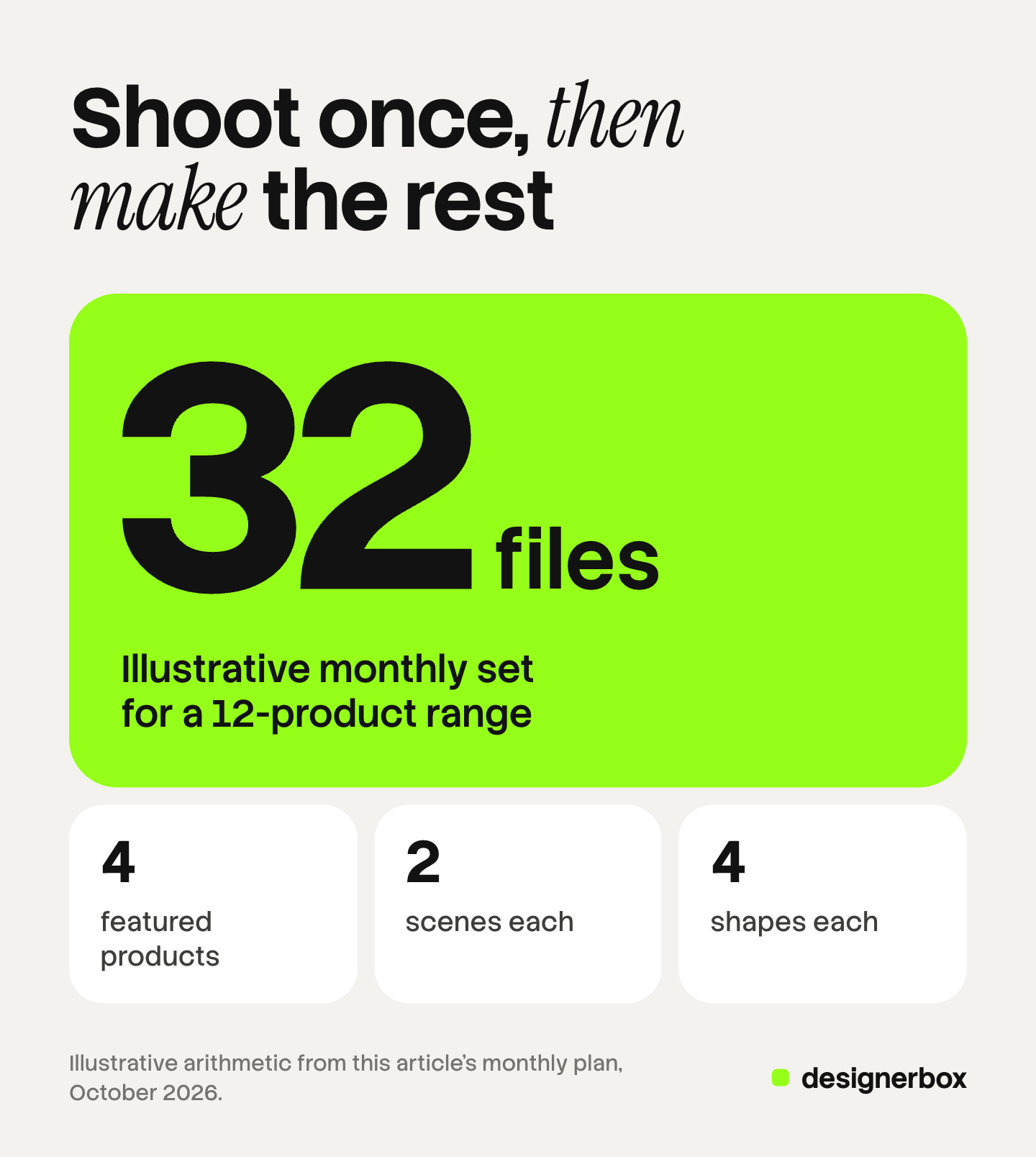
Each month, choose four products to feature. Good reasons are a season, a promotion, a new flavor or a retailer event. Make two new scenes for each, such as a kitchen counter and an outdoor table. That gives eight scenes.
Then make each scene in four shapes: 1.91:1, 1:1, 4:5 and 9:16. Eight scenes in four shapes give 32 files a month.
| Channel | Shape to make | Where it comes from |
|---|---|---|
| Retailer and marketplace listing | Square, white background, pack fills the frame | The source set, updated only when the pack changes |
| Retail media | Usually the listing images | The source set |
| Google Performance Max | 1.91:1, 1:1 and 4:5 | The monthly set |
| Meta feed | 4:5 | The monthly set |
| Reels and Stories | 9:16, with text inside the safe zone | The monthly set |
| Organic social and email | 1:1 or 4:5 | The monthly set, plus scenes you did not use in ads |
Part 3: check, then publish
Compare each file with the real pack before you publish it. Read the label text. Check the colors, the size statement and every claim. Discard a file that changes any of them.
Keep one written list of brand rules beside the plan: logo, colors, fonts, light and the surfaces you use. One list keeps twelve products in one look. Our guide to content scaling covers that step.
After three months, look at which scenes earned clicks and sales, and repeat those settings with other products. For the paid side of the plan, see our guide to ecommerce advertising. For research on how AI-made ads perform against human-made ones, see what 369 million impressions show about AI generated ads.
The monthly set as a DesignerBox workflow
DesignerBox is AI creative production for brands and agencies. It makes images, ads and video from your brand rules, and a product photo is one of the inputs. Anyone can make an AI picture. Making hundreds that still look like your brand is the hard part.
You build a workflow once, for example two scenes and four shapes from one pack photo. Your brand holds the logo, colors, fonts and rules, and the workflow reads them on every run. A batch runs the workflow over a sheet, one product per row. Row one and row two hundred follow the same rules. The AI ad generator page shows the ad side of the same job.
The cost is shown before the run. You keep or discard each result, and you can re-run one row alone. You get the full workflow from the first product photo to the finished ad, in one subscription.
The limits matter for a packaged product. A generated scene can change small label text, so you still compare each result with the real pack. DesignerBox does not check claims for you. It does not send files to an ad account, a retailer or a store. You download the results, or send them with a webhook or an S3 step. Every plan below Ultra is one seat.
Uploading your own photos and the commercial license start on the Pro plan. AI video, virtual try-on, upscaling, the image editor and the video editor start on the Premium plan. Plans and credits are on the pricing page.
There is a free plan, and it runs on sample products. Get started free
FAQ
What does CPG stand for in marketing?
CPG stands for consumer packaged goods. These are products that people use and replace often, such as food, drinks, supplements, personal care and household products. CPG marketing covers the distribution, pricing, packaging and advertising of those products.
What is the difference between CPG and FMCG marketing?
There is no practical difference. FMCG means fast-moving consumer goods and names the same kind of product. FMCG is the more common term in the UK and Europe, and CPG is more common in the US.
Is a CPG brand the same as a DTC brand?
No. CPG describes the product, and DTC describes the sales route. A CPG brand can sell from its own store, through retailers and marketplaces, or both. Many small CPG brands start DTC and add retail later.
What is CPG advertising?
CPG advertising is the paid part of CPG marketing. It includes retail media on retailer sites, search and shopping ads, paid social and video. IAB and PwC report that US commerce media ad revenue reached $63.4 billion in 2025.
What is CPG digital marketing?
CPG digital marketing is the online part of the work: marketplace listings, retail media, search and shopping ads, paid and organic social, and email. Every one of those channels needs accurate pictures of the pack in its own shape.
How many new images does a small CPG brand need each month?
It depends on the range and the channels. In the illustrative plan in this guide, four featured products with two scenes each, made in four shapes, give 32 files a month. Start with the channels you already use and add one at a time.
Can a CPG brand use AI-made images in ads and listings?
Yes, when the image shows the real product accurately. Walmart Marketplace says AI-generated content must be accurate and truthful. The FTC says advertising must be truthful and not deceptive. Compare every image with the real pack, and check each platform’s own rules. In DesignerBox, the cost is shown before the run.
Sources
- E-commerce as a percentage of total US retail sales, second quarter of 2026: US Census Bureau, Quarterly Retail E-Commerce Sales, published 18 August 2026, accessed October 2026
- US internet ad revenue and commerce media ad revenue in 2025: IAB, news release on the IAB/PwC Internet Advertising Revenue Report, full year 2025, published 16 April 2026, accessed October 2026
- FTC and FDA roles for food, drink and supplement advertising and labeling, and the truthful advertising rule: FTC, Advertising FAQs: A Guide for Small Business, accessed October 2026
- The disclaimer on supplement labels with a structure/function claim: FDA, Structure/Function Claims, accessed October 2026
- Product frame fill and preferred image size on Amazon: Amazon, How to take product photos, accessed October 2026
- Walmart Marketplace image count, main image background and the note on AI-generated content: Walmart Marketplace Learn, image guidelines and requirements, last updated 12 May 2026, accessed October 2026
- Performance Max image shapes: Google Ads Help, Performance Max specs and format requirements, accessed October 2026
- Facebook feed image ratio and resolution: Meta Ads Guide, Facebook Feed image, accessed October 2026
- Instagram Reels ratio and safe zones: Meta Ads Guide, Instagram Reels video, accessed October 2026
- DesignerBox workflows, brand rules, batch, the cost shown before the run and plan gates: DesignerBox product pages and pricing page (designerbox.ai/product/batch, designerbox.ai/pricing), October 2026
Census, IAB, FTC, FDA, Amazon, Walmart, Google and Meta facts verified on each publisher’s own page, October 2026. The Census figure covers all US retail. The asset counts in the monthly plan are illustrative arithmetic, not measured results. DesignerBox features verified on designerbox.ai, October 2026. Individual results vary.