


A DTC brand is a brand that sells its own products straight to the people who use them. DTC stands for direct to consumer. No wholesaler and no retailer stands between the brand and the buyer. The brand owns the store, the customer list and the price. It also does the work a retailer would do: the product pages, the images, the ads and the shipping.
The second half of that definition decides how your weeks go. When you remove the retailer, the retailer’s jobs do not disappear. They move to you.
This guide is for a founder who runs a young product brand alone or with one or two people. It explains the model, compares it with wholesale and marketplace selling, and lists what you have to make in your first six months, in order.
Key Takeaways
A DTC brand sells to the buyer with no reseller between them. The brand owns the store, the customer list and the price.
DTC is one kind of ecommerce. Ecommerce is all selling online. DTC is the part where the maker sells its own products.
The model moves the retailer’s work to you. You make the product pages, the images, the ads and the emails, and you ship the orders.
Most retail still happens offline. The US Census Bureau put ecommerce at 17.1 percent of total retail sales in the second quarter of 2026. This is one reason DTC brands later add stores and marketplaces.
Six things come first, in a fixed order. Brand rules, a source product photo, the product page set, product infographics, static ads, then short video.
One good source photo feeds most of that list. It cannot show a side of the product the camera never saw.
What is a DTC brand?
A DTC brand makes or owns a product and sells it to the end customer itself. Shopify’s guide gives the plain definition: “Direct to consumer (DTC) is when a brand or manufacturer sells its own products to its end customers” (shopify.com, October 2026). The same guide says the model works “without the help of third-party retailers or wholesalers”.
You will also see D2C. Shopify’s guide says the two mean the same thing.
Three things belong to a DTC brand that a wholesale brand does not have.
- The store. The brand runs its own website and checkout.
- The customer. The brand knows who bought, and it can email them again.
- The presentation. The brand decides every picture, every word and the price.
A direct to consumer brand is often small at the start. One founder, one product and one website is a normal first year. Lists of well-known DTC brands tend to cover mattresses, eyewear, razors, skincare, supplements and drinks. Those are categories where one product can carry a whole brand. This guide names none of them, because the model matters more than the names.
How DTC differs from wholesale and marketplace selling
DTC, wholesale and marketplace selling are three routes from a maker to a buyer. They differ on four questions: who the buyer pays, who owns the customer, who brings the shoppers, and who makes the page the shopper reads.
| Question | DTC | Wholesale | Marketplace |
|---|---|---|---|
| Who does the shopper pay? | The brand | The retailer | The marketplace, on the brand’s behalf |
| Who owns the customer record? | The brand | The retailer | Mostly the marketplace |
| Who brings the shoppers? | The brand | The retailer | The marketplace |
| Who makes the product page? | The brand, with no template | The retailer, from the brand’s files | The brand, inside the marketplace’s template and rules |
| Who ships the order? | The brand or its warehouse partner | The retailer | The brand or the marketplace |
Wholesale. You sell cases of product to a retailer at a lower price. The retailer sells each unit to the shopper. Shopify’s guide draws the chain as “manufacturer > wholesaler > distributor > retailer > end consumer”.
Marketplace. You list your product on a site that already has shoppers. You are still the seller, and the marketplace sets the page layout and the image rules. Shopify’s guide says Amazon is not a DTC company, because it “acts as a third-party intermediary”.
DTC. The chain is short. The same guide draws it as “manufacturer > advertising/website > end customer”. Notice the word in the middle. In a DTC brand, advertising and the website take the place of the wholesaler, the distributor and the retailer.
What the DTC model costs a founder in work
The DTC model costs a founder time before it costs money. A retailer does six jobs for the brands on its shelf. In a DTC brand, each job is yours.
| The retailer’s job | What it becomes for a DTC founder |
|---|---|
| Show the product | Product pages, product photos and product infographics |
| Bring shoppers to the shelf | Paid ads, social posts and search |
| Remind past buyers | Email, with the legal rules that apply to it |
| Take the payment | A store platform and a checkout |
| Deliver the product | Packing, shipping and delivery promises |
| Handle returns and questions | Customer service |
Three of those jobs produce pictures and words every week. That is where a small team loses its hours. There is no design team and no photographer on staff. Each new piece starts as a brief to a freelancer, and the wait is often several days. Each hour you spend on production is an hour you do not spend on the product, the supply and the customers. Our guide to outsourcing graphic design compares the four ways to buy that work.

Some of the jobs also carry legal duties in the United States. The points below are general information, not legal advice.
- Shipping promises. The Federal Trade Commission’s mail order rule covers orders placed on the internet. If you make no shipment statement, “you must have a reasonable basis for believing that you can ship within 30 days” (ftc.gov, October 2026). If you cannot ship in time, you must ask the customer to accept the delay or send a refund.
- Marketing email. Under the CAN-SPAM Act, each marketing email must include your valid physical postal address and a clear way to opt out. You must honor an opt-out request within 10 business days (ftc.gov, October 2026).
- Health claims. The FTC says claims about the health benefits of foods and dietary supplements need “competent and reliable scientific evidence” (ftc.gov, October 2026). The rule covers your ads, your product page and your images. Our guide to supplement advertising covers the claim rules in detail.
When you sell direct, you are the seller, the sender of the email and the advertiser, so these three duties are yours.
The channels of a DTC ecommerce brand
DTC ecommerce runs on one owned store and a small number of channels that send shoppers to it. Each channel needs its own files.
| Channel | What it does | What it needs from you |
|---|---|---|
| Your store | Takes the order | A product page: photos, infographics and text |
| Reaches past buyers and subscribers | A banner image and a short message for each send | |
| Social posts | Keeps the brand visible | New images or clips every week |
| Paid ads | Reaches people who have never heard of you | Several ad versions, replaced when results fall |
| Search | Answers people who are already looking | Clear page text and product images with alt text |
The store platform is a separate choice. If you are choosing one now, our guide to how Shopify works shows what the platform does and what stays with you. The Shopify launch checklist covers the checks before you open. For the page that takes the order, see Shopify product page optimization, which goes through the nine fields of a product page in order.
Channel strategy is a subject of its own. For budgets, return rates and how much creative each channel uses, read our guide to DTC marketing for fashion brands. The five paid channels are compared in the guide to ecommerce advertising.
Why many DTC brands add retail and marketplaces
Many DTC brands add retail and marketplaces because most shoppers are still somewhere else. The US Census Bureau estimated that ecommerce “accounted for 17.1 percent of total sales” in US retail in the second quarter of 2026, on an adjusted basis (census.gov, release of 18 August 2026, read October 2026). The Bureau notes that it will publish revised estimates in November 2026.

That leaves most retail sales outside ecommerce. A brand that sells only on its own website cannot reach them.
Marketplaces are the second pull. Amazon says that “more than 60% of sales in the Amazon store are from independent sellers” (sell.amazon.com, October 2026, citing Amazon’s 2025 Small Business Empowerment Report). Amazon also runs a program for brand owners, Amazon Brand Registry. To enroll, Amazon asks for a logo with your brand name fixed on the product or its packaging, and a pending or registered trademark (sell.amazon.com, October 2026).
Adding a channel does not end the DTC model. It makes the brand a mixed one. The owned store stays the place where you keep the customer list and test new products. For a packaged-goods brand that sells mainly through retailers, our guide to CPG marketing covers that side.
Each new channel also adds files. A retailer wants a clean product image on white and a sales sheet. A marketplace wants images in its own sizes. Our guide to selling on multiple marketplaces lists the image set each one asks for. For the printed and digital pieces a retail buyer expects, see the guide to marketing collateral.
What a founder-led DTC brand makes in the first six months
A founder-led DTC brand has six things to make in its first six months. The order matters, because each item uses the one before it. The list below is our recommended order. It is a working method, not a measured result.
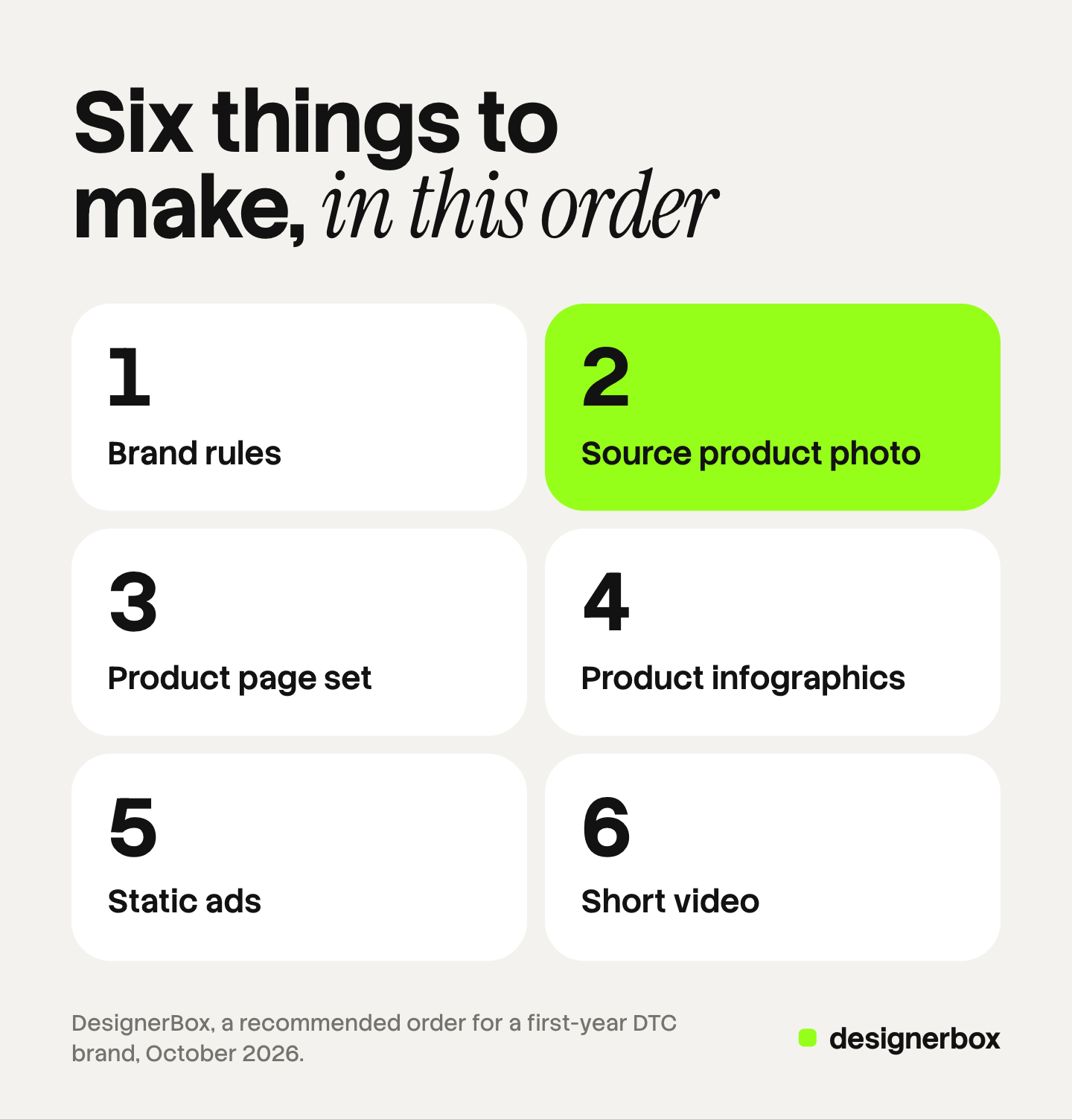
- Brand rules. One page with your colors, fonts, logo files, tone of voice and two or three reference pictures. Every later piece reads this page. Our guide to ecommerce branding shows a one-person system.
- A source product photo. One sharp, evenly lit photo of the real product, with the label readable. Take a second frame of the back if the back has text.
- The product page set. A main image on a plain background, two or three other angles, one image that shows size and one styled scene. The guide to product images explains the role of each one.
- Product infographics. Images that carry text: what is inside, how to use it, what it replaces. Shoppers on a phone read these before they read the description.
- Static ads. Three to five image ads, each with a different argument. Start here before video, because a static ad is faster to make and to replace. The guide to product launch ads gives the stages.
- Short video. Clips of 6 to 15 seconds for ads and social posts. Make these last, because a video uses the stills and the arguments that already worked.
Founders often ask what to make first when ad creative and short video are next on the list. The answer is static ads first. You learn which argument works on a cheap format, and then you spend video time on that argument only.
The work repeats after month six. A new flavor, size or bundle needs items 2 to 6 again. Items 1 and 2 decide how fast that goes.
Why a launch photo shoot stops being used
A launch photo shoot stops being used because it fixes three things on the day: the light, the background and the angle. Your needs change after launch, and the photos cannot change with them.
Take this example. A founder pays for one shoot before launch. The photos look good on the first product page. Three months later the brand needs a seasonal scene, a square ad, a vertical clip and an image for a new retailer. The shoot has none of these, so most of its files sit unused.
The photos are not at fault. A shoot gives you finished pictures. A growing brand needs a source that it can use again in new settings.
So the brief for a first shoot should change. Ask the photographer for clean source frames of each product, front and back, on a plain background, in even light. Ask for the styled scenes as a second, smaller part. If you already paid for a shoot, search it for frames that meet that description. The guide to what a product photoshoot costs explains how photographers price each part.
What one source product photo can and cannot become
One source product photo can become any image that changes the world around the product. It cannot become an image that shows a part of the product the camera never saw. Our guide to the source product photo explains how to take the frame.
| From one good frame | Works? | Why |
|---|---|---|
| Main image on a plain background | Yes | The product edge is already in the photo |
| Styled scene, such as a kitchen counter or a gym bag | Yes | Only the setting changes |
| New light or a seasonal color mood | Yes | The product stays the same |
| Product infographic | Yes | You add text and marks around the same photo |
| Static ad in several sizes | Yes | The layout changes, and the product does not |
| Short video from the still | Yes, with care | Motion makes every flaw in the still easier to see |
| The back of the pack | No | The camera never saw it. Photograph it |
| The product in a hand or in use | Partly | Scale and grip are easy to get wrong. Check each result |
| The texture of the contents, such as a powder or a drink | No | The model would guess. Photograph it |
Two checks apply to every image made this way. First, compare the label with the real label, letter by letter. Image models can change small text. Second, check that the image shows nothing the product does not do or contain. A picture is a claim, and the rules on claims cover it.
Creative production for a one-person brand
Anyone can make an AI picture. Making hundreds that still look like your brand is the hard part. For a founder who works alone, that is the real job in the list above: items 3 to 6, repeated for each product, in one look.
DesignerBox is AI creative production for brands and agencies. It covers images, ads and video. You set your brand rules once: logo, colors, fonts, voice and reference pictures. You build a job once as a workflow, for example the product page set or a set of static ads. The workflow reads your brand on every run, so product two gets the same look as product one. The cost is shown before the run.
You get the full workflow from the first product photo to the finished ad, in one subscription. The page for solo founders shows the same job for a brand run by one person.
The limits are plain. An image model draws a new presentation of a real photo. It cannot show a side the camera never saw, so check each result against the product. You download the results and upload them to your store and your ad accounts yourself. Every plan below Ultra is one seat.
Uploading your own photos and the commercial license start on the Pro plan. AI video, virtual try-on, upscaling, the image editor and the video editor start on the Premium plan. Plans and credits are on the pricing page.
There is a free plan, and it runs on sample products. Start from a template and run it. Get started free.
FAQ
What is a DTC brand?
A DTC brand is a brand that sells its own products directly to the end customer, with no wholesaler or retailer between them. DTC stands for direct to consumer. The brand runs its own store, keeps its own customer list and sets its own price. It also makes its own product pages, images and ads.
Is DTC the same as ecommerce?
No. Ecommerce means all buying and selling online, including retailers and marketplaces. DTC is one model inside ecommerce: the brand that makes the product sells it to the buyer. A DTC brand can also sell offline, for example at a market or in its own shop.
Can a DTC brand sell on Amazon or in stores?
Yes, and many do. A brand that adds a marketplace or a retailer becomes a mixed brand. Its own store remains the place where it owns the customer list. Each added channel needs its own image sizes and files, so plan that work before you add one.
What should a new DTC brand make first?
Make the brand rules first, then one clean source photo of each product. The product page set, the product infographics and the static ads all come from those two. Short video comes last, because it uses the stills and the arguments that already worked in static ads.
Does a DTC brand need a photographer?
A DTC brand needs at least one accurate photo of each real product. A photographer is one way to get it, and a careful phone photo in even light is another. After that, many settings and formats can come from the same frame. Any side or detail the frame does not show still needs a real photo.
How is a DTC brand different from a wholesale brand?
A wholesale brand sells in bulk to retailers, and the retailers sell to shoppers. The retailer owns the customer and builds the product page. A DTC brand sells each unit to the shopper itself. It keeps the customer record, and it does the selling work a retailer would do.
Sources
- Shopify, Direct to Consumer Sales: Guide and Tips: the definition of DTC, the wholesale and DTC chains, DTC and D2C, DTC and ecommerce, published February 2025, read October 2026.
- US Census Bureau, Quarterly Retail E-Commerce Sales: ecommerce as 17.1 percent of total retail sales in the second quarter of 2026, adjusted, release CB26-133 of 18 August 2026, read October 2026.
- Federal Trade Commission, Business Guide to the FTC’s Mail, Internet, or Telephone Order Merchandise Rule: the 30-day shipping basis and delay notices, read October 2026.
- Federal Trade Commission, CAN-SPAM Act: A Compliance Guide for Business: the postal address, the opt-out and the 10 business days, read October 2026.
- Federal Trade Commission, Health Products Compliance Guidance: the evidence standard for health claims, read October 2026.
- Amazon, Sell on Amazon information page: the share of sales from independent sellers, which Amazon attributes to its 2025 Small Business Empowerment Report, read October 2026.
- Amazon, Amazon Brand Registry: the two enrollment requirements, read October 2026.
- DesignerBox pricing, October 2026.
DTC facts verified from Shopify, the US Census Bureau, the Federal Trade Commission and Amazon as of October 2026. Rules and figures change. This guide is general information, not legal advice. Individual results vary.