


The Walmart Creator program is Walmart’s affiliate program for people who post on social media. You apply, Walmart reviews the application, and approved creators get trackable links and a storefront on Walmart.com. You earn a commission when someone buys a qualifying product through your link. You must be 18 or older, live in the United States, and not work for Walmart.
That is the short version. The parts that decide whether the program works for you sit in the terms. Walmart keeps the commission rates inside your account. A commission locks after 30 days. Walmart gets a permanent license to the content you make for the program. The terms, last updated in September 2026, also have a full section on AI-generated content.
Every rule below comes from Walmart’s own terms and its corporate page, read in October 2026.
Key Takeaways
- Four conditions to apply. You are an adult, you live in the US, you have a Walmart.com account, and you are not a Walmart or Sam’s Club employee.
- No public follower minimum. Walmart says anyone who creates content and shares it on social media can apply. Walmart reviews each application.
- The rates are inside your account. Walmart publishes commission rates in its Payout Terms, which you see after you sign in. It can change them without notice.
- A commission locks after 30 days. If the customer returns the product before that, Walmart deducts the commission from your next monthly payment.
- Two disclosure labels are named. The terms ask for “#WalmartPartner” or “paid link” on a post with a link.
- AI content has its own section. It must match the real product, and an AI-made person must be disclosed.
- The limit is content volume. Each link needs a picture of the product, and you can only show what you hold.
What the Walmart Creator program is
Walmart describes Walmart Creator as “an affiliate program that helps creators earn money by sharing and recommending Walmart products through their social channels” (corporate.walmart.com, October 2026).
The program has three working parts:
- Links. Walmart calls them Qualifying Links. Each one tracks a visit from your post to Walmart.com or the Walmart app.
- A storefront. A page on Walmart.com where you display the products you recommend.
- Extras. Walmart lists a tiered bonus program for consistent posting and strong sales, and Walmart Creator Collabs, which offers higher commissions on select Marketplace products.
Who can join and how
The terms list four conditions (creator.walmart.com, terms last updated September 2026, read October 2026):
- You are of majority age where you live, which is at least 18 in most states.
- You live in the United States.
- You have an active Walmart.com or SamsClub.com account.
- You are not a current Walmart or Sam’s Club employee.
You apply with a short form on the Walmart Creator site. Walmart evaluates the application and tells you if it accepts or rejects it. The terms do not state a follower minimum. Walmart’s corporate page says it looks for “authentic creators who love sharing products with their online communities.”
You also need a US bank account, and you verify your identity with impact.com, the company that handles the payments.
The storefront and shoppable links
Your storefront is a page on Walmart.com that you fill with products. The terms set three limits on it:
- You may only feature products that are for sale on Walmart.com and that qualify for commission.
- Walmart owns the storefront and its URL. Walmart decides its design, its ranking and its labels.
- Walmart may change, pause or end the storefront feature at any time.
Links have their own rules. You may only add a link to a product that is “clearly featured” in your content. If you show product details, you must update them within 24 hours of a change on Walmart.com. That includes price and availability. You may not run paid search ads with your links unless Walmart agrees in writing. Section 3 of the terms also prohibits email and text messages that contain your links, so read it before you add links to a newsletter.
How commission is paid
A sale earns commission when the customer follows your link, buys a qualifying product inside the attribution window, accepts delivery and pays in full. Walmart states the length of the attribution window in the Payout Terms, which are inside your account.
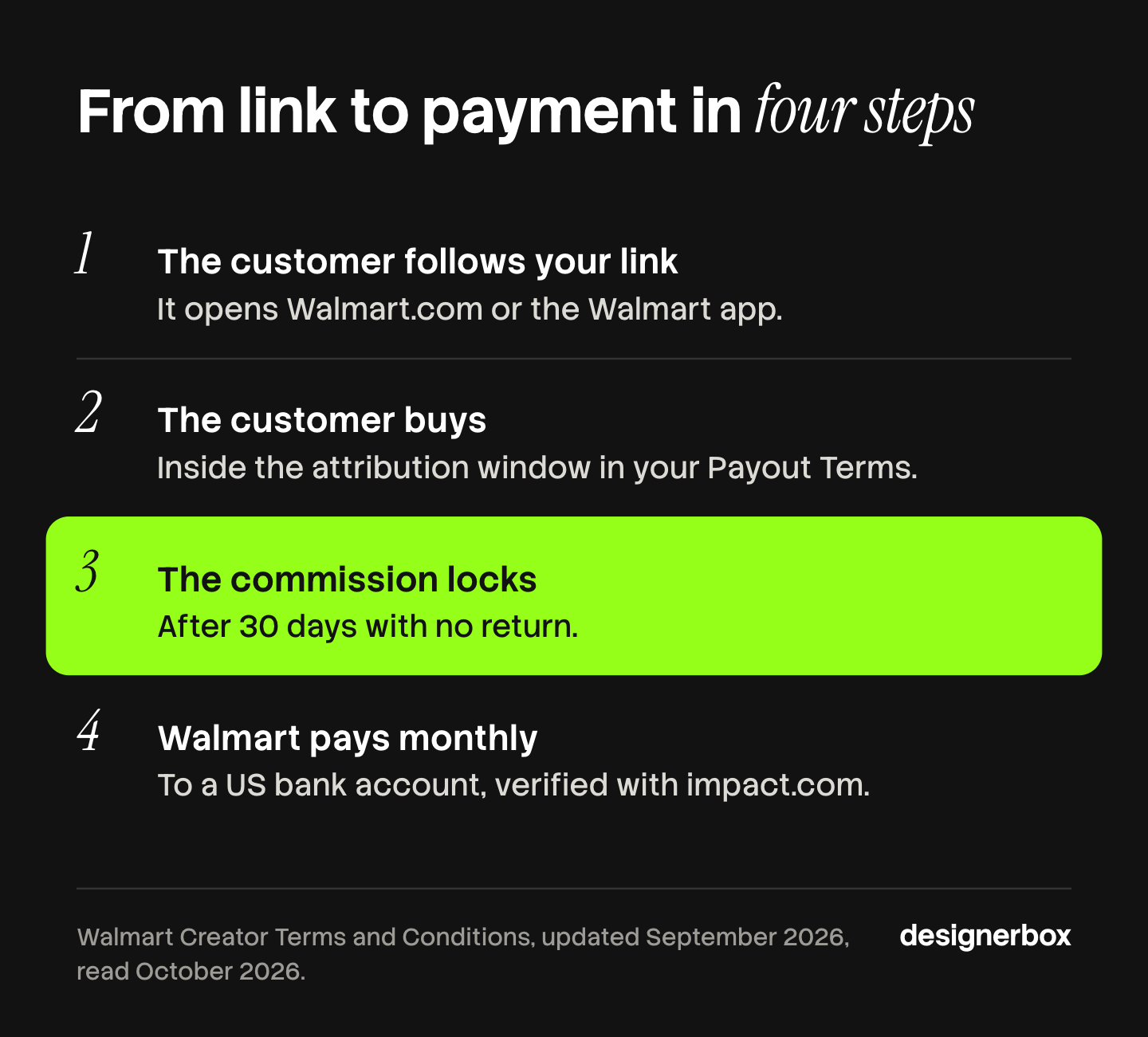
The same is true of the rates. The terms say commission is a percentage of the sale price, that rates vary between programs, and that Walmart may change the Payout Terms at any time without notice. The sale price excludes shipping, taxes, returns and cancellations.
Then there is the wait. The terms describe a 30-day locking period. If a customer returns the product before the 30 days end, Walmart deducts that commission from your next monthly payment.
Some purchases never earn commission. The terms name Sam’s Club purchases, pharmacy, travel, financial services, tires, and anything bought with a gift card.
Content the program asks for
Walmart does not publish a posting quota in its terms. It does reward volume: the bonus program is for “consistent posting and strong sales performance.”

Three formats fit the way the links work:
- One product in use. The item on your counter, in your bag or on you. The product must be clear in the frame, because the link rule says “clearly featured.”
- The roundup. Several products in one picture, one link each in the storefront. The guide to affiliate roundup images covers the layout.
- The seasonal refresh. The same product in a new setting when the season changes.
Know one thing before you post. The terms give Walmart an “irrevocable, perpetual, worldwide” license to use the content you create for the program, with your name and likeness, to market Walmart. Walmart may also place your content on its product pages. When it does, you can earn what the terms call an Onsite Commission.
Walmart’s content and disclosure rules
Section 4 of the terms requires you to follow the FTC’s Endorsement Guides. It adds its own detail:
- Disclose your relationship with Walmart in a “clear and conspicuous” way. The terms say the disclosure “must be unavoidable.”
- Label a post that includes a link as “#WalmartPartner” or “paid link”.
- An endorsement must reflect your honest opinion, based on your “recent use of the product.”
- If you got the product free or at a discount, say so.
The FTC’s own guide for influencers adds placement. Do not put the disclosure only on a profile page, and do not mix it into a group of hashtags. In a video, say it and show it. The FTC also writes: “You can’t talk about your experience with a product you haven’t tried” (ftc.gov, October 2026).
Section 26 covers AI-generated content. Walmart prohibits AI content that misleads viewers, impersonates a person, or “misrepresents, alters, or exaggerates a promoted product.” AI content must match the actual product and its product page. The terms list size, color, material, quantity, accessories and features. If your content shows a realistic AI-made person, you must disclose that to viewers. Walmart may remove a creator who breaks this section.
Walmart applies a similar accuracy rule to sellers, which marketplace rules for AI product photos covers. This section is general information, not legal advice.
Walmart Creator next to Amazon, LTK and Mavely
These four programs differ in scope. Each row below comes from the platform’s own page, read in October 2026.
| Walmart Creator | Amazon Influencer Program | LTK | Mavely (now Later) | |
|---|---|---|---|---|
| What you link | Products on Walmart.com | Products on Amazon | A network of over 7,000 retailers | Thousands of brands |
| How you join | Application. Adult, US resident, Walmart.com account | You must be an Amazon Associate and meet Amazon’s “qualitative and quantitative thresholds” | Application. LTK asks for more than 5,000 followers on at least one platform and daily shoppable posts | App and browser extension. Mavely says you do not need a massive following |
| Your page | A storefront on Walmart.com | An Influencer Page on Amazon | An LTK Shop in the LTK app | A MyShop storefront |
| Where rates are | Payout Terms, inside your account | A public table by category | LTK says brands typically offer 10 to 25% | Mavely describes its rates as transparent |
Sources: Walmart Creator terms; Amazon Associates Program Policies and the Standard Commission Income Statement (affiliate-program.amazon.com); LTK creator page (company.shopltk.com), its application expectations and its how it works page; Mavely creator guide (joinmavely.com).
Amazon publishes its standard rates on a public page. The table lists 4.00% for apparel and shoes, 3.00% for home and beauty, and 1.00% for grocery (affiliate-program.amazon.com, October 2026).
Our guide to the Amazon Influencer Program covers that program’s rules in full. Walmart Creator and Amazon each cover one retailer. LTK and Mavely cover many. Mavely’s site now says “Mavely is now Later.” The guides to Mavely creator content and LTK creator content cover the content side of those two. On TikTok the checkout stays inside the app, and the TikTok Shop affiliate program has its own rules.
For the rest of the stack, CreatorFlow’s creator tools directory lists 190+ tools by job, from link-in-bio and email to scheduling and affiliate platforms. CreatorFlow is built by the same team as DesignerBox (creatorflow.so/creator-tools, October 2026).
The content-volume problem
Every program above pays on a sale, and every link needs a picture. A creator who posts daily needs about 30 product pictures a month.

There are two kinds of product on your link list, and they need different handling:
- Products you hold. You bought them or the brand sent them. Photograph each one once, in daylight, on a plain surface. That photo is your source for every later post.
- Products you only have a link for. You cannot photograph these. You cannot present them as your experience either. You can name them, group them in a list, or show the retailer’s own picture where the program provides it.
AI helps with the first kind only. It can place your own photo of a real product in a new setting, change the season, or build a roundup frame from several of your photos. An AI picture of a product you never held, shown as your own, breaks the FTC’s rule on experience and Walmart’s Section 26 at once. An AI picture that changes the product’s color, size or material breaks Section 26 too. The guide to UGC-style product photography explains where a casual photo becomes a testimonial.
Product content with DesignerBox
DesignerBox is AI creative production for brands, creators and agencies. For a creator, the job is narrow. You photograph a product once, and a workflow returns that product in the settings your posts need. The subject of every picture is the product you link.
Anyone can make an AI picture. Making hundreds that still look like your brand is the hard part. In DesignerBox you save your backgrounds, light and framing once as brand rules, and the workflow reads them on every run. A background workflow covers the seasonal refresh, and batch runs one workflow over a whole sheet of products. The full workflow from the first product photo to the finished ad, in one subscription. The cost is shown before each run.
Three limits apply. You check every result against the real product, because Walmart’s terms make you responsible for that. DesignerBox does not post to Walmart or to social media, so you download the results and post them yourself. A creator who posts a few times a month may not need it.
There is a free plan, and it runs on sample products. Uploading your own photos and the commercial license start on the Pro plan. AI video, virtual try-on, upscaling, the image editor and the video editor start on the Premium plan. Plans and credits are on the pricing page.
FAQ
How many followers do you need for Walmart Creator?
Walmart does not state a follower minimum in its terms or on its corporate page. It says anyone who creates content and shares it on social media can apply. You must be 18 or older, live in the United States, and not be a Walmart or Sam’s Club employee.
How much commission does Walmart Creator pay?
Walmart does not publish the rates on a public page. They are in the Payout Terms inside your Walmart Creator account, and the terms say rates vary and may change without notice.
When does Walmart Creator pay you?
Walmart pays monthly through impact.com, and you verify your identity there first. A commission has a 30-day locking period. If the customer returns the product in that time, Walmart deducts the commission from your next payment. You need a US bank account.
Do you have to disclose Walmart Creator links?
Yes. Walmart’s terms require you to follow the FTC’s Endorsement Guides and to label a post with a link as “#WalmartPartner” or “paid link”.
Can you use AI images for Walmart Creator content?
Walmart’s terms allow AI content with conditions. It must not mislead viewers or alter the product, and it must match the real product and its product page. A realistic AI-made person must be disclosed. You may not present a product you never tried as your own experience, under the FTC’s guide.
Can you join Walmart Creator and the Amazon Influencer Program together?
The Walmart Creator terms say the agreement is made on a non-exclusive basis. They do prohibit sharing Walmart’s licensed materials with sites that compete with Walmart. Read the current terms of each program before you join both.
Sources
- Walmart Creator Terms and Conditions, last updated September 2026. creator.walmart.com, accessed October 2026
- Walmart, “Creators at the Core: Evolving the Walmart Creator Program Together,” 12 November 2025. corporate.walmart.com, accessed October 2026
- US Federal Trade Commission, “Disclosures 101 for Social Media Influencers.” ftc.gov, accessed October 2026
- Amazon Associates Program Policies, Amazon Influencer Program Policy. affiliate-program.amazon.com, accessed October 2026
- Amazon Associates Program Standard Commission Income Statement. affiliate-program.amazon.com, accessed October 2026
- LTK creator page. company.shopltk.com, accessed October 2026
- Mavely creator guide and home page. joinmavely.com, accessed October 2026
- CreatorFlow creator tools directory, 190+ tools in eleven groups. creatorflow.so/creator-tools, accessed 2 October 2026
- DesignerBox pricing page (designerbox.ai/pricing), October 2026
Walmart Creator rules verified from Walmart’s terms and corporate page, the disclosure rules from the FTC, and the other programs from Amazon, LTK and Mavely pages, as of October 2026. Walmart’s commission rates and attribution window are in the Payout Terms inside a creator account and were not read for this guide. This is general information, not legal advice.