
Shoe ads sell in six formats: the product hero, the material close-up, the on-foot street shot, the motion film, the UGC walk test and the colorway drop. Each one answers a question a buyer has before they buy shoes online: what it looks like, what it is made of, how it looks worn, how it moves, how it fits and which color to pick.
The best known shoe ads sell a feeling first. In 1986 Run-DMC released “My Adidas”, and Adidas then signed the group to a $1.6 million deal, the first sneaker deal for anyone outside sport (Guinness World Records). In 1988 Nike launched “Just Do It”. In 2019 Nike’s “Dream Crazy” won the Emmy for Outstanding Commercial. A footwear brand with 60 styles has a smaller budget and a bigger job: ads for every style, in every color, every season.
This guide puts the six formats in one table, with what each one needs and the small-brand route for each. It is for footwear brands with 20 to 500 products, and for the agencies that make their ads. Every format starts from a good photo of the real shoe, and the shoe photography guide covers that set.
Key Takeaways
-
Six formats repeat in shoe ads. The product hero, the material close-up, the on-foot street shot, the motion film, the UGC walk test and the colorway drop.
-
Each format answers one buyer question. Look, material, fit on a foot, movement, comfort and color.
-
Famous shoe ads sell a feeling. Run-DMC’s “My Adidas” (1986), Nike’s “Just Do It” (1988) and Nike’s “Dream Crazy” (Emmy winner, 2019) put a person or a culture first and the shoe second.
-
The shoe in the ad must match the shoe in the box. Sole pattern, stitching, logo placement and color have to survive every AI frame.
-
Check the AI label rules. Meta adds an “AI info” label to ads made or significantly edited with its own AI tools. TikTok asks for its AIGC label, or your own clear disclaimer, on significantly AI-edited ad media.
-
One style in four colors and three formats is 12 files. Plan the set before the shoot.
What makes a good shoe ad?
A good shoe ad shows the real shoe clearly and answers one question a buyer has. Shoppers cannot touch a shoe online, so the ad has to show the material, the shape on a foot and how it moves. The strongest shoe advertisements then add a reason to care: a person, a sport or a culture the buyer wants to join.
Footwear has a problem most products do not have: fit. A buyer can judge a mug from a photo. A shoe also has to feel right, and the ad cannot let them try it on. So shoe ads lean on proof that stands in for a try-on: a foot in the shoe, a person walking, a review from someone who wore it for a week.
The second problem is detail. A sneaker has a sole pattern, a logo, a lace count and stitching on the toe box. Buyers zoom in on those details, and an ad that gets one wrong shows the wrong product. That is why every format below starts from a sharp photo of the real shoe.
The 6 shoe ad formats
Six formats repeat in shoe ads: the product hero, the material close-up, the on-foot street shot, the motion film, the UGC walk test and the colorway drop. Two sell the object, two sell the shoe in use, one sells proof from a wearer, and one sells choice. They differ most in effort, from one product photo to a crew on location.
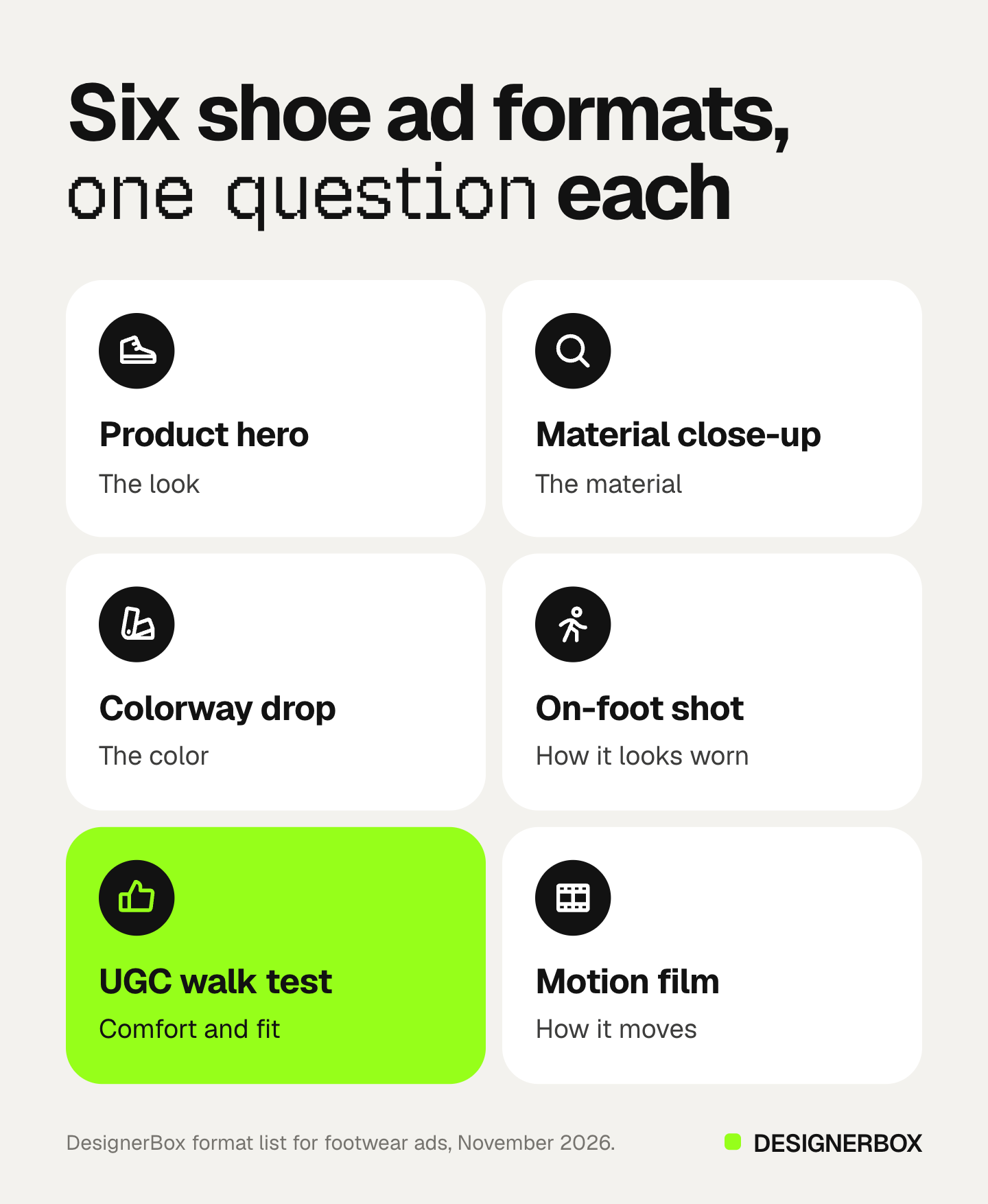
The table runs from the least effort to the most. The order is an estimate of effort only. We found no public data that ranks these formats by sales, so test them against each other.
| Format | The buyer question it answers | What the studio version needs | The small-brand route |
|---|---|---|---|
| Product hero | What does it look like? | One sharp photo, controlled light, a color backdrop | Shoot the shoe once on a plain background, then place it in new scenes |
| Material close-up | What is it made of? | A macro lens and light that shows texture | One close-up per material: leather grain, knit, suede, sole |
| Colorway drop | Which color should I pick? | A shoot per color | Shoot one color, then make the others from it and check each one |
| On-foot street shot | How does it look worn? | A model, a location, a stylist | One on-foot photo per style, with the shoe matched to the real one |
| UGC walk test | Is it comfortable? Does it fit? | Real buyers or paid creators, samples, a disclosure | Send pairs, ask for honest clips, end on the product shot |
| Motion film | How does it move? | A director, athletes or dancers, a crew | Three to five short clips from product stills, cut on a timeline with music |
The product hero
The product hero is the shoe alone, sharp, on a color that makes it stand out. It is the format most shoe ads start from, because every other format ends on it. Shoot the side profile first, because that is the view most people recognize a shoe by, then the three-quarter front.
The material close-up
The material close-up shows what the buyer cannot touch: the grain of the leather, the knit of the upper, the tread of the sole. It works as a carousel card after the hero, or as the first second of a video. Keep it real: a close-up is where an AI frame that invents texture shows the most.
The colorway drop
The colorway drop shows one style in every color, usually as a carousel or a grid. It answers “which one” and it gives a launch a reason to post every day. One shoot of the base color is enough if each new color is checked against a real sample.
Formats that show the shoe in use
The on-foot street shot and the motion film show the shoe on a person. They answer the two questions a product photo cannot: how it looks worn, and how it moves. Both need the shoe to stay accurate when the camera, the light and the angle change.
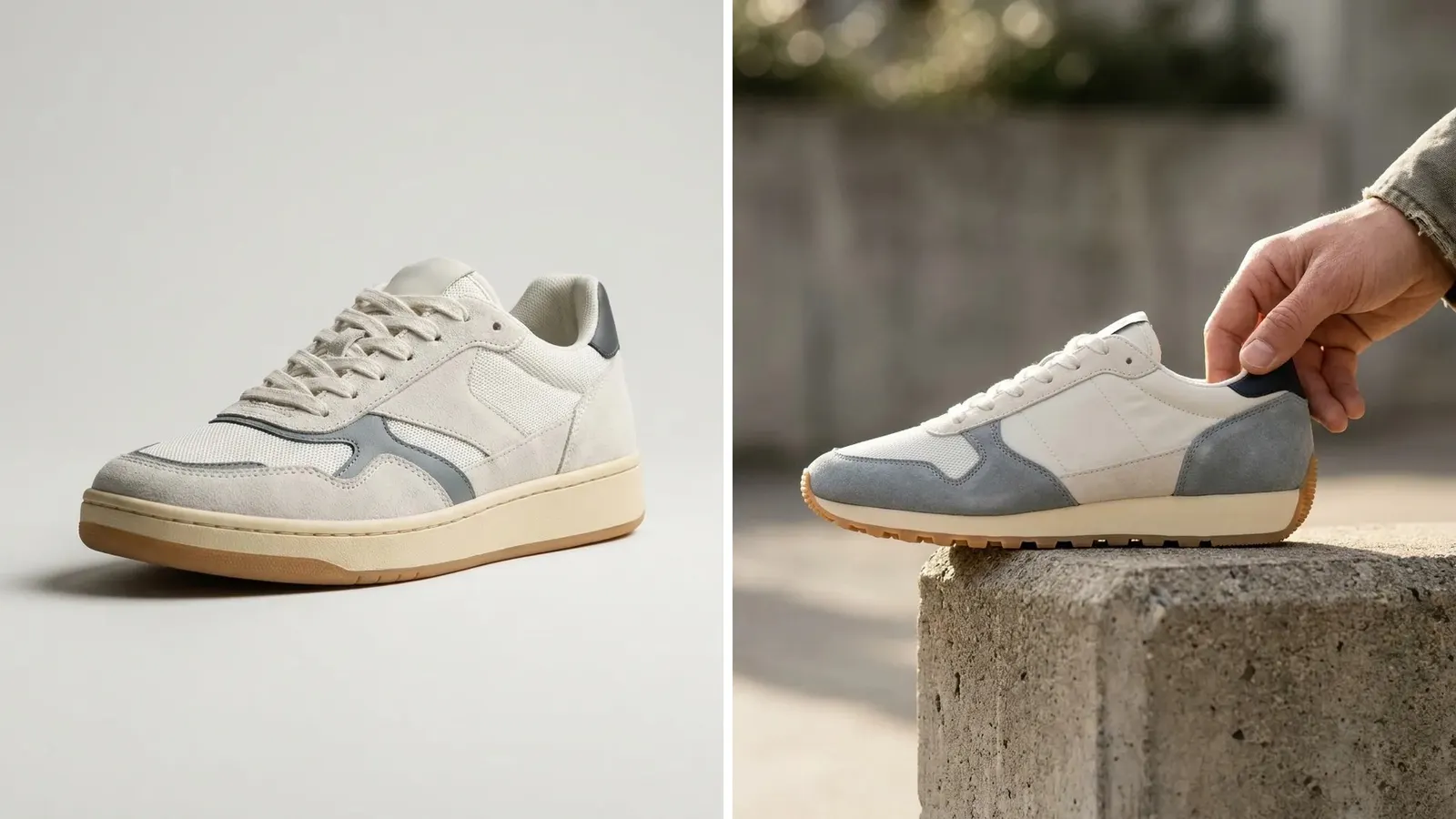
The on-foot shot is the shoe on a foot in a real place: a curb, a stair, a pavement. Crop it at the knee so the shoe stays the subject. Choose a place that matches the buyer: a city street for a sneaker, an office floor for a loafer, a trail for a hiking boot.
The motion film shows the shoe running, jumping or walking. It is the format the big sportswear brands are known for, and the most expensive to shoot. A small brand can build a short version from stills with an image-to-video model, then cut three to five clips on a timeline with music. Check every frame: a sole that changes shape between two frames is easy to see.
The UGC walk test
The UGC walk test is a short clip from a real wearer: they unbox the pair, put it on, walk and say how it feels. It is the closest an ad gets to a try-on. It answers comfort and fit, the two questions that stop people from buying shoes online.
Keep it honest. The FTC’s rule on consumer reviews and testimonials has applied in the United States since 21 October 2024, and it bans fake reviews and testimonials. Send real pairs to real people, ask for honest clips, and disclose free products. The UGC ads guide covers briefs, rights and the hook.
End every walk test on the product hero. The viewer has just seen the shoe on a person. The last frame shows them exactly which shoe to buy.
What famous shoe ads teach
Famous shoe ads teach one thing in common: they sell a person or a culture first and the shoe second. Run-DMC’s “My Adidas”, Nike’s “Just Do It” and Nike’s “Dream Crazy” each put the buyer’s identity at the center. A small brand can use the same idea without the budget.
| Ad | Year | What happened | The lesson for a small brand |
|---|---|---|---|
| Run-DMC, “My Adidas” | 1986 | The group’s song about the Adidas Superstar led to a $1.6 million deal, the first sneaker deal outside sport | The people who already wear your shoe are the ad. Find them and show them |
| Nike, “Just Do It” | 1988 | Dan Wieden of Wieden+Kennedy wrote the line for Nike, his new agency’s first client | One short line can carry every ad for decades. Write the line before the shots |
| Nike, “Dream Crazy” | 2019 (Emmy) | Won the 2019 Emmy for Outstanding Commercial, made by Wieden+Kennedy | A shoe ad can say what the brand believes. The shoe can be almost absent |
Guinness World Records says Run-DMC asked 40,000 fans at Madison Square Garden on 19 July 1986 to hold up their Adidas, with an Adidas executive in the audience. The deal “opened up a new non-sporting market in urban streetwear for Adidas” (Guinness World Records, November 2026). The lesson for a small footwear brand is cheap to apply: your best ad may already exist on a customer’s phone.
We chose these three because they are well documented. Most shoe ads that run today are the six formats above, running in a feed.
AI in shoe ads: labels and accuracy
This is general information, not legal advice. Platform rules change often, so check each page before a campaign runs.
Meta says it applies an “AI info” label to ads created or significantly edited with its own generative AI tools. When those tools add an AI-generated photorealistic human, the label appears next to “Sponsored”. Meta also said it would begin detecting ads made with third-party AI tools and label them in “About this ad” (Meta newsroom, February 2025).
TikTok allows significantly edited and AI-generated ad media if you “apply the AIGC label” or add a clear disclaimer, caption, watermark or sticker of your own. Lighting and color changes and background removal do not count as significant. TikTok says ads with undisclosed AI content will be “rejected or restricted” (TikTok Ads Help, last updated November 2026).
Accuracy is the bigger risk for footwear. An AI frame can change a sole pattern, move a logo, add an eyelet or shift a color. Check each result against the real shoe:
- The sole. Tread pattern, color and thickness.
- The logo. Position, size and spelling on the side, the tongue and the heel.
- The upper. Number of eyelets, stitching lines and the shape of the toe box.
- The color. Compare it with the real sample in daylight, not with the product photo.
The guide to AI disclosure in advertising covers the label rules by country and platform.
One shoe campaign in every color and format
One style in four colors, with three formats each, makes 12 files. Add a second market and it makes 24. That is why the plan matters more than any single shot. Creative assets explains how the file count grows by placement, size and language.
Some parts stay fixed in every file: the shoe, the logo, the light, the end frame and the line. Other parts change: the color, the aspect ratio, the length and the language.
- Lock the product hero first. Every other format uses it as its source or its last frame.
- Make the colorways from the hero. Check each one against a real sample before it goes in an ad.
- Make each film master twice, in 9:16 and in 1:1. A crop from one to the other loses the shoe or the feet.
- Write the on-screen text last. One short line per frame, translated for each market.
- Check every file before it ships. Compare the shoe with the real one, and apply the label rule for that platform.
The stills also work as static ads. Static ad examples sorts 30 static formats, and clothing ads covers the apparel side of the same campaign.
Shoe ads as a workflow
Anyone can make an AI picture. Making hundreds that still look like your brand is the hard part. A footwear brand with 60 styles needs the same hero, the same light and the same end frame on every one of them.
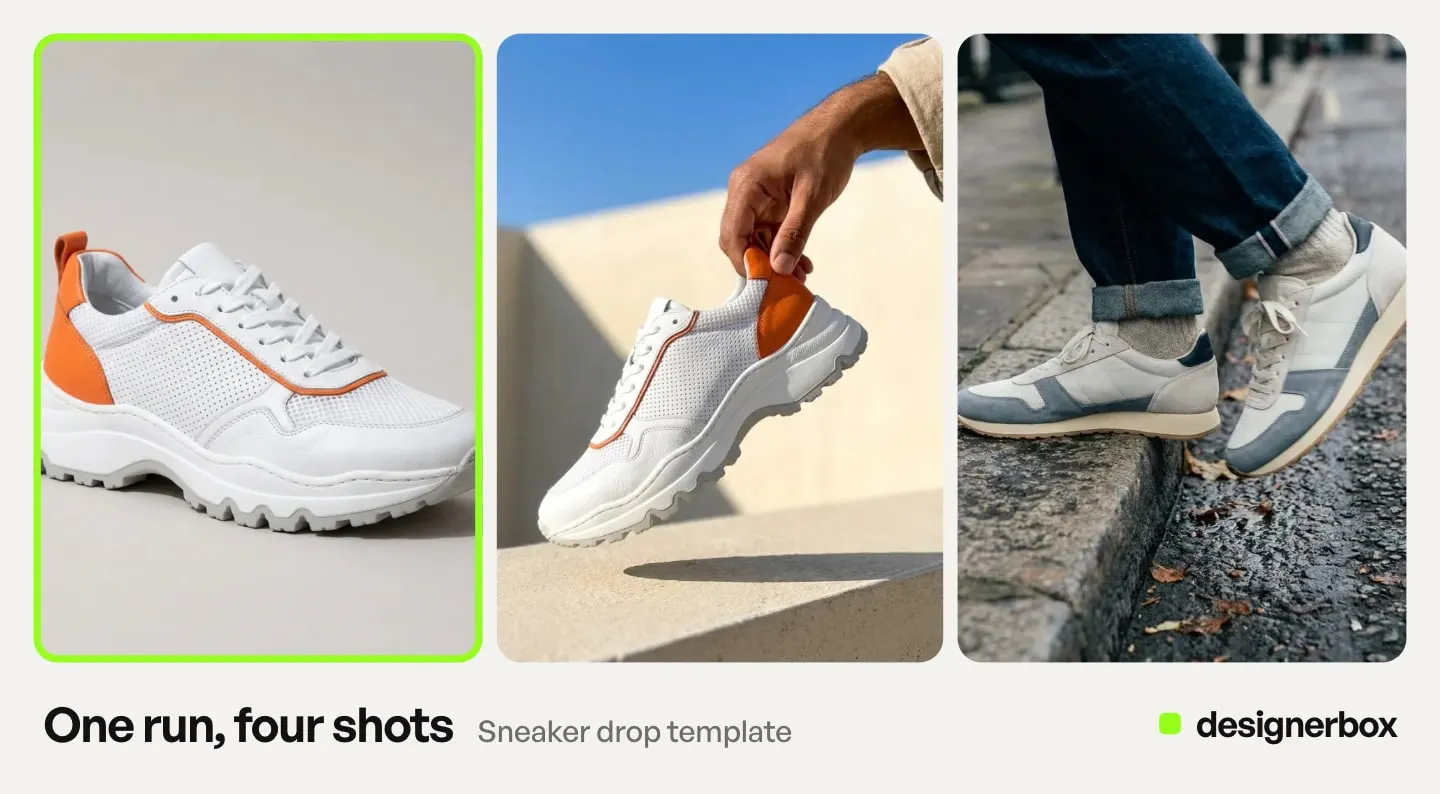
DesignerBox is AI creative production for brands and agencies. Add the real shoe photo and build the campaign once as a workflow: the product hero, the colorways, the scene and the sizes. AI footwear product photography starts from your own shoe photo. The Product in other colors app shows one product in up to six colors you list. The AI ad generator makes ads from the stills, and AI video ads start from one product photo.
You set the brand rules once in Brand, and the workflow reads them on every run. Batch runs one workflow over a sheet, so each style is one row. You keep or discard each result. The stills, the colorways and the video come from the same account and the same brand rules.
DesignerBox’s virtual try-on is for garments, so it does not put a shoe on a foot. For on-foot shots, start from a real on-foot photo. The guide to virtual try-on for shoes covers the tools built for that job. DesignerBox does not post your ads to Meta or TikTok. You download the results, or send them with a webhook or an S3 step. Uploading your own photos starts on the Pro plan. AI video and the video editor start on the Premium plan, and an 8-second clip costs 40 to 560 credits, depending on the model.
A free plan for your first run
There is a free plan, and it runs on sample products. Start from a template and see the cost before you run it. Get started free.
FAQ
What makes a good shoe advertisement?
A good shoe advertisement shows the real shoe clearly and answers one buyer question: what it looks like, what it is made of, how it looks worn, how it moves, how it fits or which color to pick. The famous ones add a person or a culture the buyer wants to join.
What are the most famous shoe ads?
Three well documented examples are Run-DMC’s “My Adidas” (1986), which led to the first sneaker deal outside sport, Nike’s “Just Do It” (1988), written by Dan Wieden of Wieden+Kennedy, and Nike’s “Dream Crazy”, which won the 2019 Emmy for Outstanding Commercial.
Which ad format works best for shoes?
No public data ranks shoe ad formats by sales. Most brands run the product hero and the colorway drop as static ads, and the UGC walk test and the motion film as video. Test them against each other on your own account.
How do you make shoe ads without a big budget?
Shoot the real shoe once on a plain background. Build the colorways, scenes and stills from that photo, send pairs to real wearers for walk-test clips, and cut a short motion film from stills. Check every frame against the real shoe.
Do AI-generated shoe ads need a label?
Often, yes. TikTok asks for its AIGC label or your own clear disclaimer on significantly AI-edited ad media. Meta labels ads made or significantly edited with its own AI tools, and said it would label ads it detects were made with third-party AI.
How many files does one shoe campaign need?
One style in four colors, with three formats each, makes 12 files. A second market makes 24. Plan the set first, so the shoe, the light and the end frame match in every file.
Sources
- Guinness World Records, First non-sporting sneaker endorsement (Run-DMC, Adidas): guinnessworldrecords.com, accessed November 2026
- NPR, “Just Do It: How the iconic Nike tagline built a career for the late Dan Wieden”, 6 October 2022: npr.org, accessed November 2026
- Television Academy, Wieden+Kennedy awards (Outstanding Commercial 2019, Dream Crazy): emmys.com, accessed November 2026
- Meta, Expanding GenAI transparency for Meta’s ads products, February 2025: about.fb.com, accessed November 2026
- TikTok Ads Help, Misleading and false content policy (AIGC): ads.tiktok.com, last updated November 2026, accessed November 2026
- FTC, Consumer Reviews and Testimonials Rule, questions and answers: ftc.gov, accessed November 2026
- DesignerBox, AI footwear product photography: designerbox.ai/ai-product-photography/footwear, accessed November 2026
Shoe ad history and platform rules verified from Guinness World Records, NPR, the Television Academy, Meta, TikTok and the FTC as of November 2026. Individual results vary.