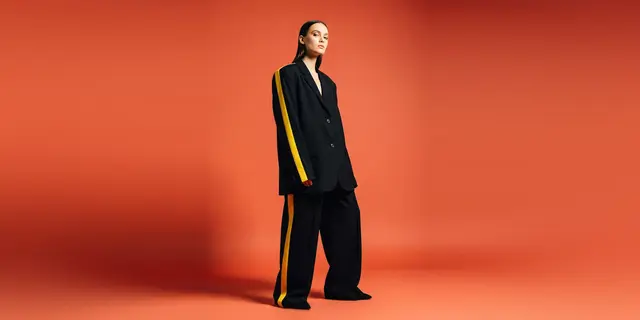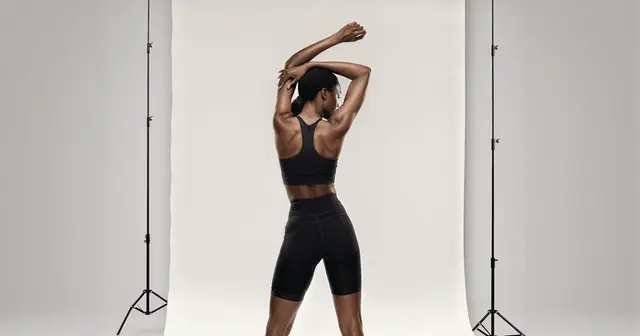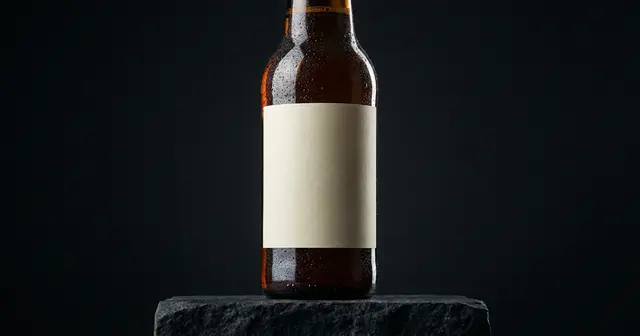
AI photo templates are saved sets of generation settings. Each one locks the prompt, the model, the aspect ratio, the output dimensions and how many images come back. The same look then applies to any product photo you add. In DesignerBox a template is a workflow somebody already built: you open one, add your photo and run it. The fortieth SKU then matches the first.
Most teams meet AI image tools through a blank prompt box. That box is why output drifts. Write the brief on Monday, write it again on Thursday, and you get two different looks for two products in the same catalog. Nobody notices until the grid is live and row three does not match row one.
A template removes the variable. This covers what a template holds, what it costs to run, when it beats writing your own prompt, and the two ceilings that catch teams out.
Key Takeaways
- A template is a locked setup. It holds the prompt, the model, the aspect ratio, the pixel dimensions and the output count. Change none of them and the output stays the same across a catalog.
- DesignerBox templates cover product, ecommerce, fashion and restaurant looks, plus portrait and editorial ones (DesignerBox template catalog, September 2026).
- Some templates return a whole set, not one image. The full listing template returns 6 separate shots from one upload: side profile, on model, three-quarter, top-down, detail, and lifestyle.
- Pinning the model pins the cost, because each model costs a different number of credits. The full listing set runs on Nano Banana Pro.
- Watch the output dimensions. The full listing set renders at 1024x1024. That clears Amazon’s 1,000px zoom threshold and sits under the 2048x2048 that Shopify says displays best for square images, so upscale before you publish there.
- A template does not give you copyright. The US Copyright Office says copyright does not extend to purely AI-generated material, and that prompts alone are not enough for authorship (copyright.gov, September 2026).
- Reference beats guessing. The templates page shows finished results by use case, so you can pick a direction before spending credits on it.
What are AI photo templates?
An AI photo template is a pre-built set of generation settings you apply to your own photo instead of describing a look from scratch. It stores the prompt text, the model that runs it, the aspect ratio, the output resolution, and the number of images returned. You supply the product photo. The template supplies everything else, identically every time.
That last word is the point. A written prompt is a fresh roll of the dice on every run.
What a template locks
An AI photo template locks five things: the prompt, the model, the aspect ratio, the output dimensions and the output count. Each one is a place where hand-written prompts drift.
| What it locks | Why it matters | Example |
|---|---|---|
| The prompt | The exact wording behind the example results | Withheld by design, loaded when you run it |
| The model | Different models render texture and text differently, and they charge differently | The full listing set runs on Nano Banana Pro |
| Aspect ratio | Marketplace grids reject the wrong shape | 1:1 for catalog and listing work |
| Output dimensions | Sets the pixel ceiling before any upscale | 1024x1024 on the full listing set |
| Output count | Decides whether you get one shot or a set | 6 images from a single upload |
The model lock is the one teams underrate, and it does two jobs. Swapping models mid-catalog changes how fabric, glass and printed labels resolve, which is the kind of drift that reads as sloppy on a product grid. Pinning the model also pins what the run costs, because each model costs a different number of credits. DesignerBox runs image and video models, and a template picks one so you are not re-deciding per SKU.
Settings vary between templates, so check the one you plan to run at volume rather than assuming the whole library shares a shape.
Template or written prompt: which should you use?
Neither wins outright. They fail in opposite directions, so the choice is simple: repeatability or control.
| Template | Written prompt | |
|---|---|---|
| Best for | Catalog work, repeat SKUs, whole sets | One-off hero shots, unusual briefs |
| Consistency across SKUs | High, settings are fixed | Low, drifts between sessions |
| Creative control | Bounded by the template | Total |
| Cost per run | Fixed by the pinned model | Changes with the model you pick that day |
| Time to first usable asset | One upload | Several iterations |
| Fails when | Your product needs a look nobody templated | You need SKU 40 to match SKU 1 |
The practical split: template the repeatable work, hand-write the exceptions. A drop of 40 products wants a template. A founder portrait for a press page does not.
Video works differently, because a clip adds camera move, pacing and audio to the list of things that drift. The equivalent mechanics for motion are in AI ad style presets.
If your output already looks synthetic, the template is not the fix on its own. That problem usually traces back to generating from a description instead of your real product photo, which is covered in how to make AI images that don’t look AI-generated.
What the six-shot brand sets are for
Many product templates return a set built to cover one listing in a single run.
The full listing template returns six separate shots from one upload: side profile, on model, three-quarter, top-down, detail or underside, and a lifestyle frame. The template asks the model to keep the product identical across all six, so check each shot against the real product.
That count fits the marketplace. Amazon recommends a main image plus at least six more images and one video. The main image needs a pure white background at RGB 255,255,255. Images need at least 500 pixels on the longest side, up to 10,000, and 1,000 pixels or more turns on zoom (Amazon Seller Central, product image guide, accessed September 2026).
The brand sets run per category. Checked in the catalog in September 2026: sneakers, watches, bags, eyewear, jewelry, beauty, fragrance, supplements, wine, whisky, beverages, cookware, gadgets, activewear, swimwear, intimates, cars, and pet products.
Which shot answers which shopper question, and the order to publish them in, is a separate decision from generating them. That sequencing is covered in PDP images that convert, and the angle definitions in the complete product photography shot list.
Where the resolution ceiling bites
This is the detail that catches teams after they have already published.
The full listing set renders at 1024x1024. Against the two platforms most brands sell on, that lands in different places:
| Platform | Requirement | 1024x1024 verdict |
|---|---|---|
| Amazon | 500 to 10,000px longest side, 1,000px+ turns on zoom | Clears it, with little headroom |
| Shopify | Up to 5000x5000px; 2048x2048 usually displays best for square images | Sits under Shopify’s suggestion |
Sources: Amazon Seller Central and Shopify Help Center, September 2026.
So a template result clears Amazon’s zoom threshold and sits under Shopify’s own suggestion. The fix is an upscale pass with an upscale app before you publish. You do not need a reshoot.
Legacy catalog images have the same problem from the other direction, and which low resolution product images are worth restoring covers where that line sits. On PrestaShop the master size matters even more, because PrestaShop builds every product image size from one master.
Cost of a template run
The model a template pins decides what the run costs. DesignerBox shows that cost before the run. The template fixes the model, so the next product’s run costs the same. You can budget a whole catalog of template runs in advance. A prompt box does not fix the model, so it does not give you that.
Two plan gates matter before you plan a catalog around this. Uploading your own photos and the commercial license start on the Pro plan. AI video, virtual try-on, upscaling, the image editor and the video editor start on the Premium plan. Plans and credits are on the pricing page.
Set that against what the same coverage costs at a studio. What brands really pay for a product photoshoot runs the per-image and day-rate comparison.
Finished results as reference
The DesignerBox templates page shows finished results, grouped by use case such as product imagery, static ads and social creatives.
Its practical job in a template workflow is look selection. Credits are spent on every run, so deciding the direction from finished results beats discovering it through four paid attempts. Browse the use case closest to your product, pick the look, then open the matching template.
Treat it as reference. An example image of a product that is not yours never becomes your catalog asset, and the copyright position below applies to AI results whatever the source.
What a template does not give you
Three limits no template changes, and all three are easier to handle before publishing than after.
Copyright. The US Copyright Office says copyright does not extend to purely AI-generated material, or material where there is insufficient human control over the expressive elements. It also says prompts alone do not make you the author. Human authorship can attach through creative selection, arrangement, or modification of the results (US Copyright Office, Copyright and Artificial Intelligence Part 2, January 2025, accessed September 2026). Using an image commercially and owning a copyright in it are separate questions. This is general information, not legal advice.
Ad platform disclosure. Meta adds an “AI info” label to ads made with its own generative AI tools. Meta’s ad policy also says that since 1 June 2026 it has checked ads for signs of third-party AI, such as C2PA metadata, and adds the label in “About this ad” when it finds them (Meta Business Help, AI info labels on ads, accessed September 2026). Plan for creative being labeled rather than being surprised by it.
Your brand’s specifics. A template carries a look. It does not carry your palette, your packaging conventions, or your model casting. A brand guidelines template lists the sections to write down first. You set those once in a brand profile, and the workflow reads it on every run, which is why brand consistency in AI sits alongside templates rather than inside them.
First template run
- Browse the templates and filter to your category.
- Check the template’s model, output dimensions and image count. The model sets what the run costs. The dimensions tell you whether you can publish it.
- Add the real product photo. Sharp, evenly lit, and shot against something plain gives the model the most to work with.
- Run it, then review the set for the shot that carries your main listing image.
- Upscale if your platform wants more pixels than the template returns.
- Save what worked as a workflow, then run it again for the next product.
Step 6 is where a template stops being a shortcut and becomes a system. The look, the model, the ratio and the shot count are settled once. A saved workflow runs the same way on the next product, and batch runs that workflow over a whole sheet of products at once. Anyone can make an AI picture. Making hundreds that still look like your brand is the hard part.
For product catalog work, AI product photography is where the product side lives, and the social creatives templates cover social formats. When a template carries type, pick the model with care: OpenAI says GPT Image models have much better text rendering and can still struggle with precise text placement and clarity (OpenAI image generation guide, accessed September 2026). For the YouTube-specific version, including the three-variant test unit, see how to make YouTube thumbnails with AI.
The full workflow from the first product photo to the finished ad, in one subscription. The subscription covers the templates, the workflows, the image editor and Assets. There is a free plan, so start there and run one template on the sample products.
FAQ
Are AI photo templates free to use?
The templates are free to browse, and running one costs credits. The cost depends on the model the template pins, and DesignerBox shows it before the run. There is a free plan, and it runs on sample products. The commercial license starts on the Pro plan.
Which looks do DesignerBox photo templates cover?
Product, ecommerce, fashion, restaurant, editorial and portrait looks, as of September 2026. Six-shot sets cover categories such as sneakers, watches, bags, jewelry, beauty, supplements, activewear and swimwear. The templates page shows the current set.
Can I use my own product photo with a template?
Yes, that is the intended flow: pick a look, add your photo, run it. Uploading your own photos starts on the Pro plan. The template applies its saved settings to your product instead of generating a lookalike from a description.
What is the difference between a template and an app?
A template is a workflow somebody already built, like a garment flat lay template: you open it, add your photo and run it. An app is a workflow with a form. A colleague completes the form and presses Run, without opening the workflow. What the DesignerBox apps do explains each one.
Do AI photo templates work for fashion and apparel?
Yes. The catalog includes activewear, swimwear, intimates, footwear and accessory sets, several of which return on-model frames. Garment texture and drape are where fashion output is judged, so review at full crop before committing a drop to one template.
Can I edit a template’s prompt?
Template prompts are withheld and load when you run the template, so the saved setup stays intact. For full prompt control, write your own brief instead.
Will template output pass marketplace image requirements?
Check the dimensions per template. The full listing set renders at 1024x1024, which clears Amazon’s 1,000 pixel zoom threshold and falls under the 2048x2048 that Shopify says usually displays best for square images (sellercentral.amazon.com and help.shopify.com, September 2026). Upscale before publishing where a platform suggests more.
Sources
All accessed September 2026 unless stated.
- Amazon image recommendations: a main image plus at least six more images and one video, pure white main image at RGB 255,255,255, longest side 500 to 10,000 pixels with 1,000 or more for zoom: Amazon Seller Central, product image guide
- Shopify image limits and the 2048x2048 display suggestion for square images: Shopify Help Center, product media types
- Copyright and purely AI-generated material, prompts and authorship, and human selection and arrangement: US Copyright Office, Copyright and Artificial Intelligence Part 2, published 29 January 2025
- Meta AI info labels, including detection of third-party AI from 1 June 2026: Meta Business Help, AI info labels on ads
- GPT Image text rendering and its stated limits: OpenAI, image generation guide
- Template model, dimensions, image count, shot composition and category sets: DesignerBox template catalog, checked in the product, September 2026
- DesignerBox plan gates for the commercial license, video and try-on: DesignerBox pricing page (designerbox.ai/pricing), September 2026
Template settings and category sets checked in the DesignerBox template catalog as of September 2026. Marketplace image requirements verified from Amazon Seller Central and the Shopify Help Center, the copyright position from copyright.gov, and ad labeling from Meta, all September 2026. This is general information, not legal advice. Individual results vary.