

ShopMy vs LTK is a choice between two affiliate platforms that pay you a commission when a follower buys through your link. LTK asks for 5,000 followers and daily shoppable posts. ShopMy asks for 1,000 followers and adds paid brand work through Opportunities. Both review an application, both pay on the last click, and both require you to disclose commissions.
Both platforms changed their terms in 2026, so a comparison written last year can be out of date.
This guide is for a creator who is choosing between the two, or who already posts on LTK and is thinking about ShopMy. Every fact below was read on LTK’s or ShopMy’s own pages in October 2026. Where a page sits behind a login, we say so and print no number.
Key Takeaways
- The follower floor is different. LTK asks for more than 5,000 followers on at least one platform. ShopMy asks for a minimum of 1,000.
- The commission ranges overlap. LTK says its brands typically offer 10 to 25%, and up to 30%. ShopMy says 10 to 30%. The brand sets the rate on both.
- ShopMy publishes its payout rule. It pays every Friday once you have at least $11 ready. LTK moved to weekly payouts in August 2024.
- The AI wording is not the same. LTK bans AI content that deceives. ShopMy’s terms list content “generated by automated tools” among content it can remove.
- The work is the same on both. You need fresh product content every week, and you need the right to post each image.
ShopMy vs LTK at a glance
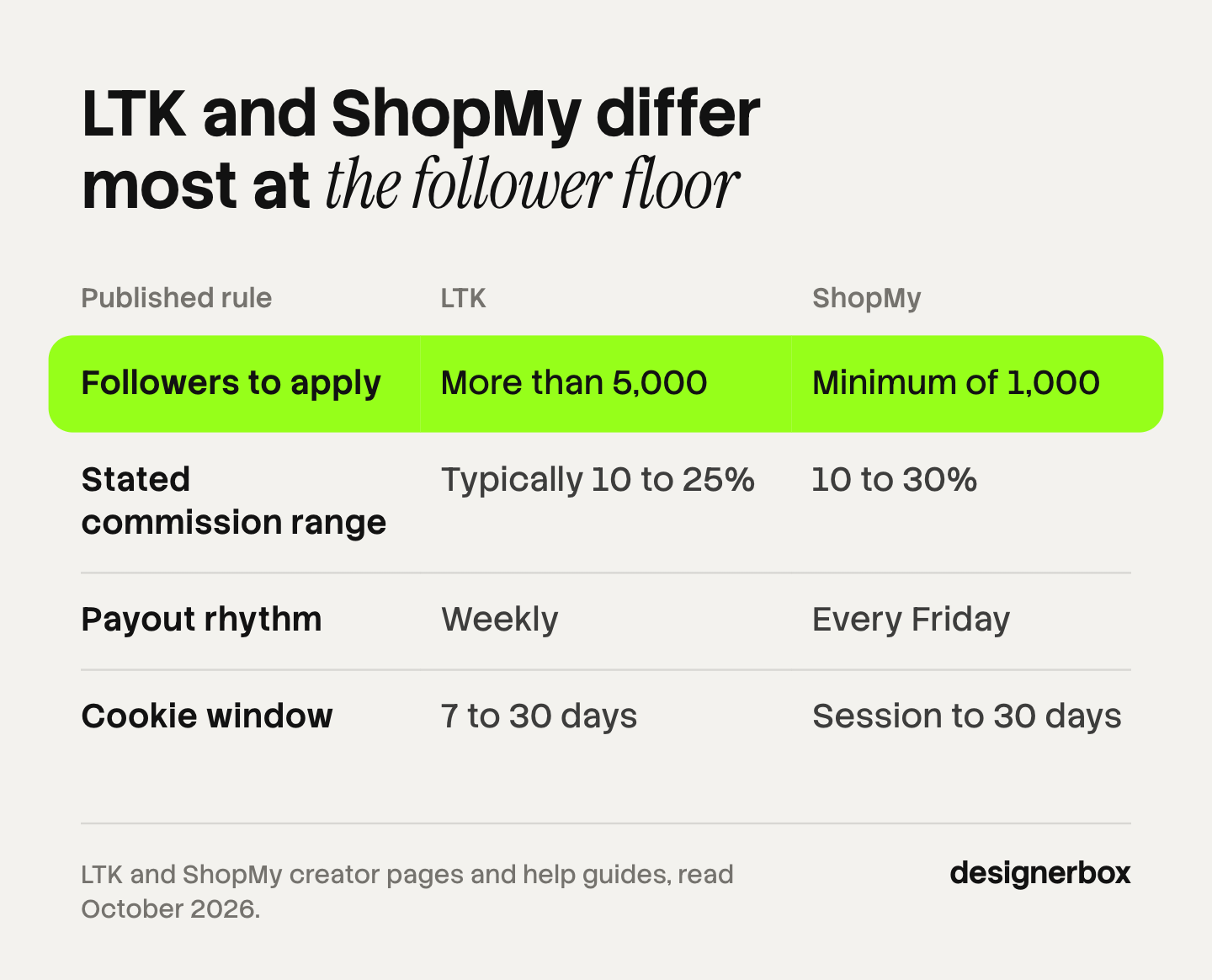
Both platforms do the same core job. You get a link for a product, you share it, and you earn a commission when someone buys. The table shows where the published rules differ.
| LTK | ShopMy | |
|---|---|---|
| Followers to apply | More than 5,000 on at least one platform | A minimum of 1,000 |
| Application review | Online application, reviewed by LTK | Typically 3 to 5 business days |
| Stated commission range | Typically 10 to 25%, up to 30% | 10 to 30% |
| Payout rhythm | Weekly, since August 2024 | Every Friday, with at least $11 ready |
| Cookie window | Most brands 7 to 30 days | One browser session to 30 days |
| Attribution | Last click | Last click, on the full cart |
| AI content wording | No AI content that deceives or misrepresents | Content “generated by automated tools” is listed as inappropriate |
Sources for each row are in the sections below. LTK’s payment help page opens only after a creator login, so we print no LTK payout minimum here.
LTK creator application and ShopMy application
LTK tells applicants what it wants in plain numbers. Its expectations page asks for “an engaged social media following with over 5,000 followers on at least one platform”, and “high-quality, shoppable content posted daily” (company.shopltk.com, October 2026).
So the answer to how to become an LTK creator is short. You need a public profile, 5,000 engaged followers and a habit of posting products most days. You apply online, and after approval you create posts in the LTK Creator app and tag products.
LTK also sets a pace for the first month. It asks new creators to post shoppable content at least 10 times in the first 30 days.
ShopMy describes its network as selective and reviews each application. Its guide says the process “typically takes 3-5 business days” and that accounts “must have a minimum of 1000 followers” to activate an account (guide.shopmy.us, October 2026).
If ShopMy approves you, the email includes an invitation code. If it declines, you can apply again after 90 days.
How to make money on LTK and on ShopMy
On both platforms the first income is commission. You place a link, a follower clicks it and buys, and the brand pays a percentage through the platform.
LTK says: “The average commission rate is between 10-25%, but can reach up to 30%” (company.shopltk.com, October 2026). The brand sets the rate. LTK introduced weekly commission payouts on 20 August 2024 (onbrand.shopltk.com, October 2026). Payment takes the brand’s return period into account, so a sale is not paid in the week it happens.
ShopMy says creators earn in two ways: “performance-based commissions (10-30% on sales you drive) and paid brand partnerships” (shopmy.us, October 2026). The paid work runs through a feature called Opportunities. ShopMy also lists gifting and custom codes from brands.
ShopMy publishes its payment rule in full. “Payouts occur weekly, every Friday”, through PayPal or Stripe, and you need at least $11 under “Next Payment” (guide.shopmy.us, October 2026). The same page says commissions “typically remain pending for 30 to 120 days” while the retailer confirms and pays.
Neither platform publishes what a typical creator earns, and we print no earnings figure. For a program with no application review, see how the Mavely app works. A retailer can also run its own program: see the Amazon Influencer Program and the Walmart Creator program.
How links, cookies and storefronts work
A commission depends on tracking. Both platforms use last-click attribution, which means the last affiliate link a shopper clicked before buying gets the sale.

LTK explains it this way: you lose credit if “the shopper clicks another commissionable link, either from another Creator or another affiliate before purchasing”. It says most brand cookie windows “fall between 7 and 30 days, generally between 7 - 14 days on average” (onbrand.shopltk.com, article dated October 2022, read October 2026).
ShopMy says the cookie window “can range from when a single browser session ends to up to 30 days”, and the brand decides. If your link was the last one clicked, you earn on the whole order, which ShopMy calls full cart commission.
The storefronts differ in shape. On LTK you publish posts to your LTK Shop. LTK DM sends your links to followers who comment a trigger word, with up to 10 trigger words per post. On ShopMy you build a storefront with shoppable posts, gift guides and collections, and ShopMy says more than 47,000 brands offer commission through it.
On Instagram, CreatorFlow, built by the same team as DesignerBox, also answers a keyword comment with a DM that holds the link. It works on Reels, posts and Stories (creatorflow.so, October 2026).
Content formats each platform rewards
LTK is specific about the post it wants. Its expectations page says top performing posts include “4-8 products from 1-2 brands”, with links to the exact products.

That makes the LTK post a small roundup. Our guide to affiliate roundup images covers how to make several products look like one picture.
ShopMy describes its formats on its creator page: shoppable posts, gift guides and collections in one storefront. A collection is a list you keep and update, such as a packing list or a skincare shelf. The picture of each product matters more there, because a shopper sees a grid of products and reads no caption.
Short clips help on both, and shoppable video clips for creators covers the formats that carry a link.
AI content and disclosure rules on LTK and ShopMy
This is where the two sets of terms differ most. This is general information, not legal advice.
LTK’s Community Guidelines, last updated on 18 March 2026, do not allow “inauthentic activity or content, including AI-generated content that deceives or misrepresents identity, experience, or engagement” (company.shopltk.com, October 2026). The test is deception. Our article on AI content for LTK creators reads that rule line by line.
ShopMy’s terms of service, last revised on 16 September 2026, use wider words. The list of inappropriate content includes content that “is generated by automated tools or that is misleading or repetitive” (shopmy.us, October 2026). The terms do not define “automated tools”. If you plan to post AI-made images to a ShopMy storefront, ask ShopMy creator support first and keep the answer.
The same terms ask you to confirm that you are “the exclusive owner of any content you publish”. A photo copied from a brand’s product page does not meet that. LTK’s guidelines make the same point about content rights.
Both platforms require disclosure. LTK says: “If you receive compensation, commissions, free products, discounts, or other benefits in connection with content you post, disclose it clearly.” ShopMy’s terms require you to follow guidance on “endorsements, testimonials, influencer marketing, and disclosure of material connections”, and they name the FTC’s guides.
The FTC rule that matters most here is about experience. Its guidance says: “You can’t talk about your experience with a product if you haven’t tried it” (ftc.gov, October 2026). An AI image that shows you wearing a dress you never received is a claim about your experience. That is a problem with the FTC and with LTK’s rule, whatever tool made it.
The rules of the app you post on apply as well, and labeling AI-generated fashion images covers those labels.
What you produce every week on either platform
The platform you choose changes the rate and the payout day. It does not change the workload.
Take LTK’s own numbers. A post each day with 4 to 8 products is 28 to 56 product placements a week. That is our arithmetic from LTK’s guidance. ShopMy states no posting pace, but a collection goes stale when the season changes.
So each week you need three things:
- A clear picture of each product. One you took, or one the brand gave you with permission.
- A setting that looks like you. The same light, surfaces and colors, so a shopper recognizes your shop.
- A short clip for the products that sell on movement. Fabric, fit and texture read better in video.
A brand that works with creators often supplies pictures you may post, and Mavely creator content shows what such a pack contains. Ask for it before you copy a product photo.
Weekly product content without a daily shoot
DesignerBox is AI creative production for brands, creators and agencies. For a creator, the job is the list above: product pictures every week, in one consistent look, without a new shoot each day.
Anyone can make an AI picture. Making many that still look like one shop is the hard part. In DesignerBox you save the look once as a workflow: the light, the surface, the crop and your brand rules. You add a photo of the next product and run the same workflow. Templates for social creatives give you a starting point. The full workflow from the first product photo to the finished post is in one subscription, and the cost is shown before each run.
The subject of every picture is the product you link. Start from a photo of the real product that you took or have permission to use. Do not use any tool to show yourself wearing or using something you never had. On ShopMy, check the “automated tools” wording with support before you post an AI-made image.
There is a free plan, and it runs on sample products. Uploading your own photos and the commercial license start on the Pro plan. AI video, virtual try-on, upscaling, the image editor and the video editor start on the Premium plan. Plans and credits are on the pricing page.
One honest limit: if you post a few times a month, your phone and good daylight may be all you need. DesignerBox does not publish to LTK or ShopMy. You download the results and post them yourself.
FAQ
Is ShopMy or LTK better for a small creator?
It depends on your follower count first. ShopMy’s guide sets a minimum of 1,000 followers, and LTK asks for more than 5,000 on at least one platform. Below 5,000 followers, only ShopMy’s stated floor is within reach.
Does ShopMy or LTK pay more?
The published ranges overlap. LTK says its brands typically offer 10 to 25% and up to 30%. ShopMy says 10 to 30%. The brand sets the rate on both, so the same product can pay differently on each.
Can I use LTK and ShopMy at the same time?
We found no rule on either platform’s public pages that forbids it, as of October 2026. A sale goes to the last link the shopper clicked, so two links for one product do not pay twice.
How do you make money on LTK?
You tag products in an LTK post and share the post or the links on your social profiles. When a follower clicks and buys, the brand pays a commission through LTK. LTK asks for daily shoppable content and says top posts include 4 to 8 products from 1 or 2 brands.
When does ShopMy pay creators?
Every Friday, through PayPal or Stripe, once you have at least $11 under “Next Payment”. A commission first stays pending, typically for 30 to 120 days, while the retailer confirms the order and pays ShopMy.
Can I post AI images on LTK or ShopMy?
LTK does not allow AI content that “deceives or misrepresents identity, experience, or engagement”. ShopMy’s terms list content “generated by automated tools” as inappropriate and do not define the phrase, so ask ShopMy support. On both, never present an AI image as your own experience of a product.
Sources
- LTK, creator application expectations. company.shopltk.com, accessed October 2026
- LTK, “How it works: Creators.” company.shopltk.com, accessed October 2026
- LTK Community Guidelines, last updated 18 March 2026. company.shopltk.com, accessed October 2026
- LTK, “How commission is earned through your LTK links,” October 2022. onbrand.shopltk.com, accessed October 2026
- LTK, “LTK Creators Get New Customization to LTK DM, Weekly Commission Payouts,” 20 August 2024. onbrand.shopltk.com, accessed October 2026
- ShopMy, creators page. shopmy.us, accessed October 2026
- ShopMy guide, “How do I join?” guide.shopmy.us, accessed October 2026
- ShopMy guide, “Payment FAQ.” guide.shopmy.us, accessed October 2026
- ShopMy End User License Agreement and Terms of Service, last revised 16 September 2026. shopmy.us, accessed October 2026
- FTC, “The FTC’s Endorsement Guides: What People Are Asking.” ftc.gov, accessed October 2026
- CreatorFlow comment-to-DM on Reels, posts and Stories. creatorflow.so, accessed 2 October 2026
- DesignerBox pricing page (designerbox.ai/pricing), October 2026
Application rules, commission ranges, payout rules and content terms verified from LTK and ShopMy pages, and disclosure guidance from the FTC, as of October 2026. Individual results vary.