
To make YouTube thumbnails with AI, export in 16:9 at the largest size your tool allows, up to the 3840x2160 YouTube recommends and never below 1280x720. Make three variants per video rather than one, because YouTube’s own A/B testing tool accepts up to three and picks the winner by watch time. Keep the words short and check each one. YouTube does not require an AI disclosure on thumbnails.
Your brand channel publishes eight videos a month, or your agency runs that schedule for a client. Each video needs a thumbnail, and the real job is three thumbnails, because you have no idea which frame earns the click until it runs.
That is twenty-four images a month. Commissioning each one separately is what makes the job expensive, so it is tempting to ship one thumbnail per video and never learn which one works.
This covers the YouTube thumbnail size and the other specifications YouTube publishes, and why three variants is the correct unit of work. It also covers the disclosure rule that surprises people, how to keep a look consistent across a channel, and what a month of thumbnails costs. It is written for brand teams and agencies running a company channel without a designer on staff.
Key Takeaways
- Up to 3840x2160, 16:9. YouTube now recommends 3840x2160 pixels for video thumbnails, with a minimum width of 640 pixels, in an image format such as JPG or PNG. The file limit is 2MB from a phone and 50MB from a computer (support.google.com, September 2026).
- Three variants is the unit. YouTube’s A/B test accepts up to three titles and thumbnails and shows the winner to everyone once it ends. With one thumbnail you cannot test thumbnails.
- The winner is chosen by watch time. YouTube decides the test on watch time rather than clicks, so a thumbnail that overpromises can win the click and still lose the test.
- Thumbnails are exempt from YouTube’s AI disclosure. YouTube lists “production assistance, like using generative AI tools to create or improve a video outline, script, thumbnail, title, or infographic” among the uses that do not require disclosure (support.google.com, September 2026).
- The thumbnails policy still applies. A misleading or shocking thumbnail breaks it whether a model made it or a person did.
- A month of thumbnails is a repeat job. Eight videos with three variants each is 24 images.
- Text is where AI thumbnails often fail. OpenAI says its image models can still struggle with precise text placement and clarity. Check every word before upload, and prefer three or four words over a sentence.
YouTube thumbnail size and specs
YouTube recommends 3840 x 2160 pixels at a 16:9 aspect ratio for a video thumbnail, with a minimum width of 640 pixels. The file size limit is 2MB when you upload from a phone and 50MB from a computer (YouTube Help, accessed September 2026). The table has the full set.
| Specification | Value |
|---|---|
| Recommended resolution, videos | 3840x2160 pixels |
| Recommended resolution, Shorts | 2160x3840 pixels |
| Minimum size | 640 pixels wide for videos, 640 pixels tall for Shorts |
| Aspect ratio | 16:9 for videos, 9:16 for Shorts, 1:1 for podcast playlists |
| File formats | Image formats such as JPG or PNG |
| Maximum file size | From a phone: 2MB for videos, 10MB for podcasts. From a computer: 50MB |
All values from YouTube Help (September 2026). Your account must be verified to upload a custom thumbnail. Three details matter.
The file limit depends on where you upload. From YouTube Studio on a computer it is 50MB. From a phone it is 2MB, and a large PNG with a photographic background can pass that. Export photographic frames as JPG, or upload from a computer.
The podcast exception is easy to miss. A podcast playlist wants a 1:1 thumbnail instead of 16:9. If you run a podcast alongside a channel, that is a second format in every set.
Shorts take custom thumbnails too, at 9:16, but only from YouTube Studio on a computer. YouTube also says a vertical video with a 16:9 custom thumbnail gets an automatic 4:5 thumbnail on the home, explore and subscription pages.
How to make YouTube thumbnails with AI: three per video
When you make YouTube thumbnails with AI, plan three per video. This is the part that changes how you brief the work.
YouTube’s A/B testing tool lets you upload up to three thumbnails, three titles, or three combinations, and it shows them to viewers at the same time before settling on one. At the end of the test, the option with the highest watch time is shown to all viewers (support.google.com, September 2026). YouTube said its thumbnail test had been used over 15 million times since it launched in 2023 (YouTube Blog, September 2025).
Read the deciding metric again, because it is the useful part. The test is decided on watch time, which YouTube says it uses over metrics like click-through rate. A thumbnail that wins the click and loses the viewer at second eight does not win the test. So the test rewards thumbnails that describe the video accurately. Setting the deciding metric before a test starts is covered in ad creative testing.
Some constraints on the feature, worth knowing before you plan around it:
- It runs on desktop in YouTube Studio, and you need advanced features enabled on the account.
- Shorts, scheduled live streams, and Premieres are outside it. A Premiere becomes eligible after it ends and converts to a long-form video, and live archives can be tested.
- Videos made for kids, for mature audiences, or set to private are outside it.
- A test takes a few days and can run up to two weeks.
- If any thumbnail is below 1280x720, YouTube downscales every thumbnail in the test to 854x480.
So the real production unit is three images per eligible video. Once that is the unit, making them one at a time by hand is the slow part, and making them as a set becomes necessary.
YouTube Studio can also suggest thumbnails itself. Ask Studio reads your video’s transcript and themes, then suggests thumbnails made for that video. You can change a suggestion with another prompt, for example to make the text larger (YouTube Help, accessed September 2026).
The disclosure rule that surprises people
You might expect to disclose AI creative everywhere. On YouTube thumbnails specifically, you do not have to.
YouTube requires creators to disclose realistic content that AI made or changed in a meaningful way: a real person appearing to say or do something they did not, changed footage of a real event or place, or a realistic scene that did not happen (YouTube Help, September 2026). The list of uses that need no disclosure is explicit, and thumbnails are on it: “production assistance, like using generative AI tools to create or improve a video outline, script, thumbnail, title, or infographic”. Caption creation, color adjustment, lighting filters, and beauty filters sit in the same exempt group.
What does require disclosure is the video itself when it is realistic and AI made or changed it in a meaningful way. YouTube’s own examples include AI-generated extra footage of a real place and making it appear that someone gave advice they did not give.
Two cautions before you rely on this.
YouTube’s thumbnails policy applies to every custom thumbnail, however it was made. It lists a thumbnail that misleads viewers about what is in the video, and violent imagery meant to shock, among the images YouTube does not allow. YouTube removes a thumbnail that breaks the policy and may issue a strike (support.google.com, September 2026).
YouTube may also add an AI label itself: for content made with YouTube’s own AI tools, content with C2PA metadata, and content its systems detect as AI-made or AI-changed (support.google.com, September 2026). The exemption covers making a thumbnail with AI. A thumbnail that shows something the video does not contain still breaks the thumbnails policy.
The broader picture of which platform wants which label, and the rules that apply to the video rather than its thumbnail, is set out in the guide to AI for social media content.
Keeping a channel’s thumbnails consistent
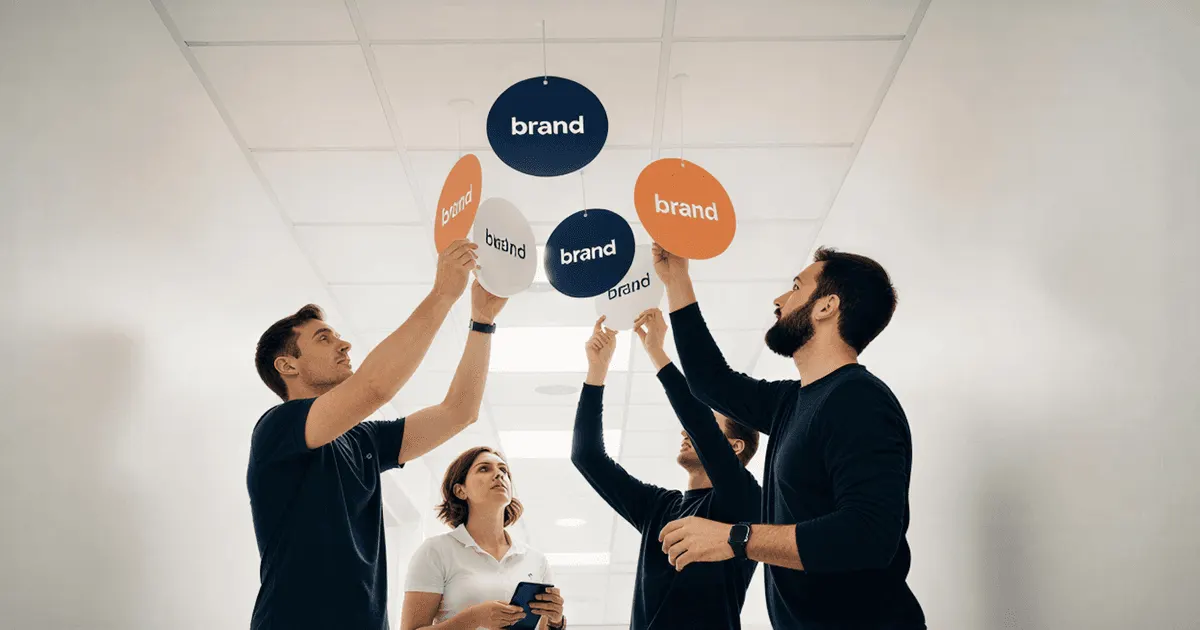
A batch of three variants per video creates a second problem. Twenty-four images a month, generated independently, will not look like one channel.
Three things hold a look together.
Lock the frame before the prompt. Decide the composition rules once: where the subject sits, where type sits, how many words, which two colors. Then vary only the subject inside that frame. Consistency comes from the layout more than from the wording of the prompt.
One recurring face, if a face appears. A channel with a presenter needs the same presenter every week. That is a reference-set job, and it works the same way here as anywhere else. The mechanics are covered in the guide to AI avatars for brands.
Save the steps. Next month’s thumbnails should come from the same steps as this month’s. In DesignerBox, a saved workflow holds those steps, so they run again without a rebuild. For an agency, one workflow per client channel keeps each brand’s frame separate. The steps around the thumbnail, from plan to schedule, are in the guide to a social media workflow.
On models, thumbnails are a text-in-image problem more than a photography problem, because most of them carry three or four words of type. Seedream 5 and GPT Image 2, both in DesignerBox’s model list, are positioned for legible type. ByteDance’s Seedream 5.0 Pro page leads with high-density infographics (seed.bytedance.com, September 2026). OpenAI calls text rendering in its GPT Image models significantly improved, and says they “can still struggle with precise text placement and clarity” (developers.openai.com, September 2026). OpenAI released GPT Image 2.5 on 8 September 2026, so GPT Image 2 is no longer its newest image model (OpenAI API changelog, September 2026).
Rendered text is a known weak spot, and OpenAI names it as a limit of its own image models. Words can misspell and letters can warp, and a thumbnail with a typo is worse than a plain one. Read every word at full size before upload, and keep the copy to three or four words so there is less to go wrong.
Cost of a month of thumbnails
DesignerBox has no flat per-image price. The cost of a run depends on the model the workflow uses, and the cost is shown before the run. You pick the model for each step when you build the workflow, and every run after that uses it. A template comes with its model already picked. For a thumbnail job, the model choice is the budget question.
Count the images first. Eight videos with three variants each is 24 images a month, or 32 if you add a 1:1 podcast cut per video. Run one three-variant set, then compare its cost with your plan’s allocation before you make the month.
A brand or client channel needs the commercial license. Uploading your own photos and the commercial license start on the Pro plan. AI video, virtual try-on, upscaling, the image editor and the video editor start on the Premium plan. Team features, shared brand kits and white label are on the Ultra plan, and every plan below Ultra is one seat. Plans and credits are on the pricing page.
If your thumbnails and your link previews share a look, the link preview images app makes the preview images for your web links. The same testing argument applied to product imagery rather than thumbnails is in the guide to ecommerce image testing.
The five-step batch
- Lock the frame once. Subject position, type position, word count, two colors. Write it down. This is the channel’s look.
- Make three variants per video. Vary one thing across them: the expression, the object, or the color. Varying everything teaches you nothing when one wins.
- Proofread the type at full size. Every word, every variant. This is the step that gets skipped and it is the one that ships typos.
- Export at full size. 16:9, as large as your tool allows up to 3840x2160, never below 1280x720. Use JPG for photographic frames if you upload from a phone, where the limit is 2MB.
- Run the A/B test, then keep the winner. Note which variable won. After six videos you have a pattern, which is worth more than any single thumbnail.
The channel is the catalog here. The locked frame, the type rules and the presenter all go into the saved workflow from the consistency section. Your brand sits in a record that the workflow reads on every run. Every thumbnail in the sidebar then looks like the same channel. The full workflow from the first product photo to the finished ad, in one subscription. The thumbnail set, the link previews, the editors and your brand record stay in one place. The steps above decide whether the result is worth uploading. Start from the social creatives templates.
FAQ
What size should a YouTube thumbnail be?
YouTube recommends 3840x2160 pixels at a 16:9 aspect ratio for video thumbnails, with a minimum width of 640 pixels, in an image format such as JPG or PNG. The file limit is 2MB from a phone (10MB for podcasts) and 50MB from a computer (support.google.com, September 2026). Shorts thumbnails use 9:16 at 2160x3840, and podcast playlists use 1:1.
Do I have to disclose an AI-generated YouTube thumbnail?
No. YouTube lists production assistance, including using generative AI to create or improve a thumbnail, title, script, outline, or infographic, among the uses that do not require disclosure (support.google.com, September 2026). The video itself still needs disclosure if it contains realistic content that AI made or changed in a meaningful way, and YouTube’s thumbnails policy applies to the thumbnail either way.
How many thumbnails should I make per video?
Three. YouTube’s A/B test accepts up to three thumbnails or titles per video and shows the winner to all viewers once the test ends. With only one thumbnail you cannot test thumbnails.
Does YouTube pick the thumbnail with the most clicks?
No, it picks the one with the highest watch time. That distinction matters: a thumbnail that wins the click but loses the viewer early does not win the test. If no option clearly wins, YouTube keeps the first title and thumbnail you uploaded.
Can AI write the text on my thumbnail?
It can, and this is where AI thumbnails often fail. OpenAI names precise text placement and clarity as a limit of its own image models (developers.openai.com, September 2026). Keep the copy to three or four words, use a model positioned for text rendering such as Seedream 5 or GPT Image 2, and read every word at full size before uploading.
How much does a month of AI thumbnails cost?
The model the workflow uses sets the cost. In DesignerBox the cost of a run is shown before the run, so you can price one three-variant set before you make the month.
Can I A/B test thumbnails on Shorts?
No. Shorts, scheduled live streams, and Premieres are outside YouTube’s A/B test, along with videos made for kids, made for mature audiences, or set to private. A Premiere becomes eligible after it ends. The test runs on a computer in YouTube Studio and needs advanced features turned on. Shorts can still have a custom thumbnail, uploaded from a computer.
Sources
- Add custom thumbnails on YouTube, YouTube Help, accessed September 2026
- A/B test titles & thumbnails, YouTube Help, accessed September 2026
- Disclosing use of GenAI content, YouTube Help, accessed September 2026
- Thumbnails policy, YouTube Help, accessed September 2026
- New in YouTube Studio, YouTube Blog, 16 September 2025
- Seedream 5.0 Pro, ByteDance Seed, accessed September 2026
- Image generation guide, OpenAI, accessed September 2026
- API changelog, OpenAI, GPT Image 2.5 released 8 September 2026, accessed September 2026
- DesignerBox pricing page (designerbox.ai/pricing), September 2026
Thumbnail specifications, A/B test behavior, AI disclosure rules and the thumbnails policy verified from YouTube Help as of September 2026. Platform rules change, so check the current help page before you upload. Individual results vary.