


The most useful Instagram ad examples are sorted by placement, because each placement has its own shape. A feed image is 4:5. Stories and Reels are 9:16, with space kept clear at the top and bottom. A carousel holds 2 to 10 cards. This guide gives 18 formats across feed, carousel, Stories, Reels, Explore and catalog ads. Each one lists the frame, the text and the reason it fits.
Every format is a pattern, shown with one illustrative product: a stoneware mug from a small homeware brand. The brand, the text lines and the offers are made up. The specs are Meta’s, read from the Meta Ads Guide and the Meta Business Help Center on 4 October 2026.
Key Takeaways
- Two ratios cover most of Instagram. Meta recommends 4:5 for feed images and 9:16 for Stories, Reels and feed video.
- Stories and Reels have a safe zone. Keep about 14% of the top, 35% of the bottom and 6% of each side free of text and logos.
- Reels text is short. The recommended primary text is 44 characters on Reels and 125 characters on feed and Stories.
- One concept needs three files. A 4:5 image, a 9:16 image and a 9:16 video cover feed, Stories and Reels.
What counts as an Instagram ad example?
An Instagram ad example is one finished ad in one placement: the picture or video, the text on it, the primary text under it and the button. A useful one also states the ratio and the length.

Meta now marks these ads with an “Ad” label. Its help pages say that ads “previously marked with a ‘Sponsored’ label will now display an ‘Ad’ label instead” (facebook.com, October 2026).
The 18 formats here are photo and video patterns for a product. For formats that copy the look of a screen, a quiz or a note, see the 30 static ad examples. Specs and lengths for video on Facebook are in Facebook video ads.
Instagram ad specs by placement
This table holds Meta’s recommended values for Instagram.
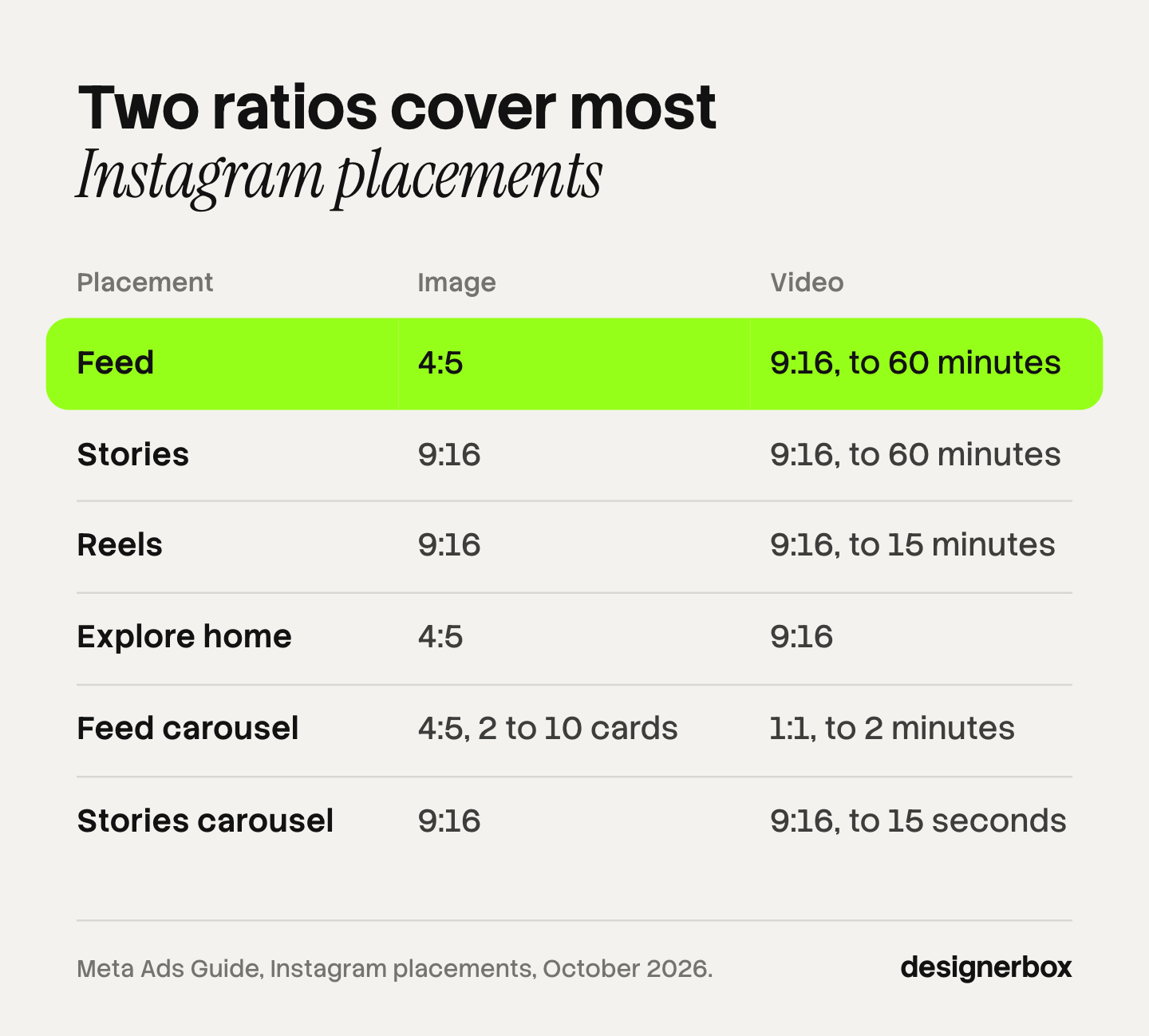
| Placement and format | Ratio | Recommended resolution | Length or count | Primary text |
|---|---|---|---|---|
| Feed image | 4:5 | 1440 x 1800 pixels | One image | 125 characters |
| Feed video | 9:16 | 1080 x 1920 pixels | 1 second to 60 minutes | 125 characters |
| Feed carousel | 4:5 for images, 1:1 with video | At least 1080 x 1080 pixels | 2 to 10 cards | 125 characters |
| Stories image or video | 9:16 | 1440 x 2560 pixels | 1 second to 60 minutes | 125 characters |
| Reels video | 9:16 | 1440 x 2560 pixels | Up to 15 minutes | 44 characters |
| Explore home image | 4:5 | 1440 x 1800 pixels | One image | 125 characters |
Every row is from the Meta Ads Guide (facebook.com, October 2026). For other platforms, see ad resizing for every platform.
Feed image and feed video ad examples
- The product alone. In the frame: the mug on a plain clay-colored surface, from the front. On-image text: one line, “Stoneware, made in small runs”. It fits the feed because one object reads at once.
- The product in use. In the frame: two hands hold the mug at a breakfast table. No text on the image. It fits because a person shows the size of the mug.
- The detail crop. In the frame: a close view of the glaze and the handle. On-image text: “Glazed by hand”. The tall 4:5 crop gives room for one detail and one line.
- The 9:16 unpacking video. First second: the mug is already in a hand. Text sits in the middle band, because a 9:16 feed video follows the Stories and Reels safe zone.
- The one-change loop. First second: the mug in sage green. Each second the color changes and the frame stays the same. On-image text: “Six glazes”. The loop shows the range with no cut to follow.
Instagram carousel ads
Instagram carousel ads hold 2 to 10 cards, “each with its own link”. Meta’s guide says: “Ratio: 4:5 for carousels containing only images. Currently, for carousels containing videos, only 1:1 is supported.” A video card runs 1 second to 2 minutes (facebook.com, October 2026).
- One product, five views. Cards: front, back, in a hand for scale, the glaze, the box. Each swipe answers one question a buyer has.
- The range. One card per product: mug, bowl, plate, jug. On-image text: the product name only. Each card links to its own product page.
- The sequence. Card 1: “Morning”. Card 2: “Desk”. Card 3: “Evening”. The same mug appears in three places, and the last card holds the offer.
Keep every card in one ratio. AI social media carousels covers how to hold one look across ten slides.
Instagram Story ads
Instagram Story ads are full-screen and appear between organic Stories. Meta recommends 9:16 at 1440 x 2560 pixels. It also says to leave “roughly 14% of the top, 35% of the bottom, and 6% on each side” free from text and logos (facebook.com, October 2026).
Meta says Stories “will play video ads that are less than 16 seconds for the full duration”, and that longer videos “may be split into separate Stories cards” (facebook.com, October 2026).
- The full-screen still. In the frame: the mug fills the middle half of a 9:16 image. On-image text: “Stoneware mug. Six glazes.” The bottom third stays empty for the button.
- The three-beat video. First second: coffee pours into the mug. Then a hand lifts it. Then the mug sits on a shelf with five others. It runs 10 seconds, so it plays as one card.
- The Story carousel. Card 1: the product. Card 2: the detail. Card 3: the offer. Meta shows 1 to 3 cards before the viewer taps to expand, so the offer goes in the first three. A video card runs 1 to 15 seconds.
Instagram Reels ads
Instagram Reels ads are full-screen vertical ads between organic Reels. Meta’s guide lists 9:16, 1440 x 2560 pixels and a length of up to 15 minutes. For sound, the guide says “Optional, but strongly recommended”. The recommended primary text is 44 characters (facebook.com, October 2026).
The same page says a Reels ad should not contain licensed music, a face or camera effect, a GIF or product tags.
- The result first. First second: the finished shelf with six mugs. Then the video returns to the empty shelf and fills it. Sound: the real sound of the room.
- The hands demo. First second: a hand lowers the mug into a full dishwasher rack. On-image text: “Dishwasher safe”, inside the safe zone. Use only a claim the product can prove.
- The Reels still or carousel. Reels also takes a 9:16 image ad and a carousel of up to 10 images. It fits a brand that has photos and no video yet.
Video hooks lists seven patterns for the first second and how to test them.
Explore, profile feed and search placements
In Explore home, ads “appear as a tile in the Explore grid with other recommended content”. In profile feed, ads appear “within the feed view of public Instagram profiles of people 18 and up” (facebook.com, October 2026).
- The Explore tile. In the frame: the mug on a strong plain color, with no text. A tile is small, so one object and one color read best.
- The image that explains itself. In the frame: the mug, the brand name and one line, “Mugs, bowls and plates in stoneware”. In a profile feed or in search results the viewer did not choose your brand.
Meta’s ratio table recommends 4:5 for images and 9:16 for videos in Explore home and in Instagram search results (facebook.com, October 2026).
Catalog and collection ad examples
Meta’s guide says a collection ad in the feed “includes a cover image or video followed by 3 product images”. A tap opens a full-screen Instant Experience, which the format requires (facebook.com, October 2026).
- The collection. Cover: a 10-second video of the table set for breakfast. Under it: the mug, the bowl and the plate from the catalog. The cover sells the scene and the tiles sell each product.
- The catalog carousel. One card per product, each on a white backdrop, all in the same ratio. No text on the images. Meta’s catalog page says to provide all images in 1:1 or 4:5, and that shops show product images in 1:1 (facebook.com, October 2026).
Live Instagram ad examples in the Meta Ad Library
The Meta Ad Library is free. Meta says it “contains all active ads that are shown across Meta technologies”, and that “anyone can view and search” it (facebook.com, October 2026).
For an ordinary active ad, the library shows the creative, the Page and the date the ad started. It does not show spend or results, and it does not keep the ad after it stops. Ads delivered to the EU or the United Kingdom stay for one year after the last impression. Ad spy tools explains what paid databases add.
AI labels and partnership ad disclosure
Two disclosure rules apply. This is general information, not legal advice.
AI info label. Meta says it “will automatically apply an AI info label” when you use its features such as Background Generation or Image Generation to “create or significantly edit an image or video”. It also applies the label when it detects that an ad “was created or edited by third-party generative AI tools”, using signals such as C2PA (facebook.com, October 2026). AI disclosure in advertising covers the laws that add to this.
Paid partnership label. Meta defines branded content as organic content “for which the creator has been compensated by a brand or business partner”, which “may include when products and services are gifted for free”. The creator must tag the business partner, and people then see a “Paid partnership with” label (facebook.com, October 2026).
A partnership ad is the paid version, and our guide to partnership ads covers the setup. Both accounts can appear in the header. The creator gives permission at account level, or shares an ad code for one post (facebook.com, October 2026).
File count for one Instagram ad concept
One concept needs three files to cover feed, Stories and Reels in Meta’s recommended ratios.
- A 4:5 image for the feed and Explore home.
- A 9:16 image for Stories and for a Reels image ad.
- A 9:16 video for Reels, Stories and the feed.
Add a 1:1 file when a feed carousel includes video. Five concepts are then 15 files, or 20 with the square.
You can upload fewer. Meta says that if you do not provide every ratio, “the system helps fill the gaps using adjustment options such as padding, media expansion, cropping and additional AI-enabled features” (facebook.com, October 2026).
Instagram ad sets from one product photo
DesignerBox is AI creative production for brands and agencies. A brand with 20 to 500 products, or its agency, needs three files per concept for every product. Anyone can make an AI picture. Making hundreds that still look like your brand is the hard part.
In DesignerBox you build a workflow once. It starts from the product photo and makes the concept in each Instagram ratio. The workflow reads your brand rules on every run, so the logo, the colors and the text style stay the same. The social creatives page shows feed posts and carousels, and the AI ad generator page shows static ads.
Batch runs the same workflow over a sheet of products, and you keep or discard each row. The cost is shown before the run. The full workflow from the first product photo to the finished ad, in one subscription.
Here are the limits. DesignerBox does not connect to an ad account and does not launch ads. You download the results, or send them with a webhook or an S3 step, and upload them in Meta Ads Manager. Uploading your own photos and the commercial license start on the Pro plan. AI video, virtual try-on, upscaling, the image editor and the video editor start on the Premium plan. Plans and credits are on the pricing page.
A free plan for your first run
There is a free plan, and it runs on sample products. Start from a template and make one concept in two ratios. Get started free
FAQ
What are good Instagram ad examples to copy?
Copy a format that fits the placement. Good examples are the product alone on a plain color, the product in use, a five-view carousel, a full-screen Story still and a Reel that opens on the result.
What size are Instagram story ads?
Meta recommends 9:16 at 1440 x 2560 pixels for Story image and video ads. Keep about 14% of the top, 35% of the bottom and 6% of each side free of text and logos (facebook.com, October 2026).
How long can Instagram Reels ads be?
Meta’s Ads Guide lists a video length of up to 15 minutes for Reels ads, in 9:16 at 1440 x 2560 pixels. The recommended primary text is 44 characters (facebook.com, October 2026).
How many cards can Instagram carousel ads have?
A carousel ad has 2 to 10 cards, and each card has its own link. In the feed, Meta lists 4:5 for image-only carousels and 1:1 when the carousel includes video (facebook.com, October 2026).
Where can I see the best Instagram ads from other brands?
Use the Meta Ad Library. It shows every active ad from a Page, with the creative and the start date. It does not show spend or results for ordinary ads (facebook.com, October 2026).
Does DesignerBox post ads to Instagram?
No. DesignerBox makes the images and videos in each ratio. You download the results, or send them with a webhook or an S3 step, and upload them in Meta Ads Manager. The cost of a run is shown before the run.
Sources
- Meta Ads Guide, image ad specs on Instagram Feed: facebook.com, October 2026
- Meta Ads Guide, video ad specs on Instagram Feed: facebook.com, October 2026
- Meta Ads Guide, carousel ad specs on Instagram Feed: facebook.com, October 2026
- Meta Ads Guide, image and video ad specs on Instagram Stories: facebook.com and facebook.com, October 2026
- Meta Ads Guide, carousel ad specs on Instagram Stories: facebook.com, October 2026
- Meta Ads Guide, video, image and carousel ad specs on Instagram Reels: facebook.com, facebook.com and facebook.com, October 2026
- Meta Ads Guide, image ad specs on Instagram Explore home: facebook.com, October 2026
- Meta Ads Guide, collection ad specs on Instagram Feed: facebook.com, October 2026
- Meta Business Help Center, text overlays and the safe zone for ads in Stories and Reels: facebook.com, October 2026
- Meta Business Help Center, ad placements across Meta technologies: facebook.com, October 2026
- Meta Business Help Center, aspect ratios supported by placements: facebook.com, October 2026
- Meta Business Help Center, best practices for aspect ratios: facebook.com, October 2026
- Meta Business Help Center, product image specifications for catalogs: facebook.com, October 2026
- Meta Business Help Center, the Meta Ad Library: facebook.com, October 2026
- Meta Business Help Center, AI info on ads created or edited with generative AI: facebook.com, October 2026
- Meta Business Help Center, branded content: facebook.com, October 2026
- Meta Business Help Center, how to create a partnership ad: facebook.com, October 2026
- DesignerBox plans and feature gating: DesignerBox pricing page (designerbox.ai/pricing), October 2026
Meta specs and policies checked against Meta’s own pages as of October 2026. The product, text lines and offers in the 18 formats are illustrative. This is general information, not legal advice. Individual results vary.