


A UGC creator is a person a brand pays to make content that looks like a customer made it. UGC means user-generated content. The creator films a review, an unboxing or a demo on a phone and sends the files to the brand. The brand posts them on its own channels and runs them as ads. The creator needs no audience, because the brand buys the content and not the reach.
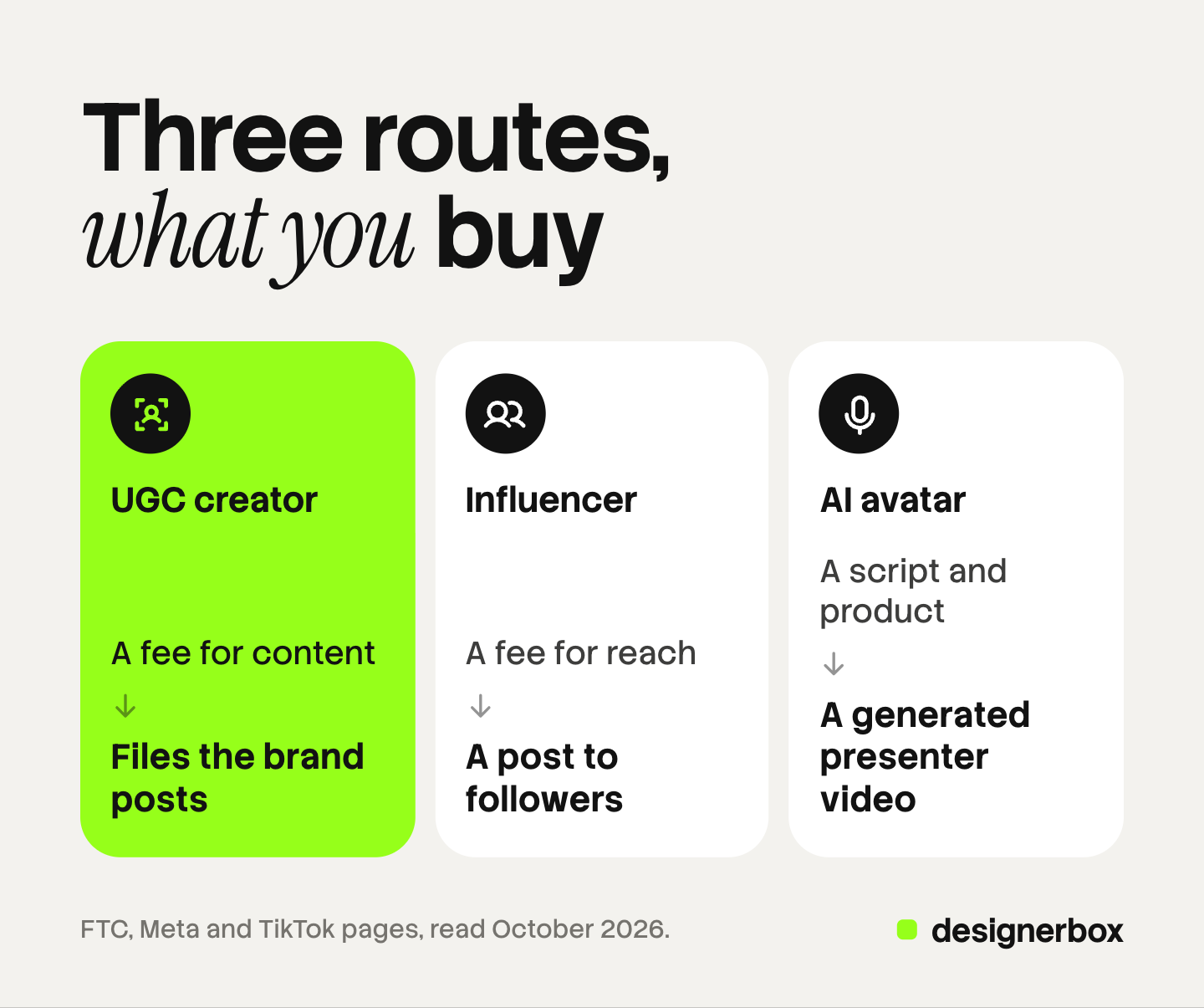
That last point separates a UGC creator from an influencer. An influencer is paid to post to followers. A UGC creator is paid to deliver a file. In 2026 a third route sits beside both: an AI avatar, a generated presenter that reads a script.
This guide is for the brand or agency that hires UGC content creators. It compares the three routes and covers the rules on paid endorsements and AI-generated people.
Key Takeaways
- A UGC creator sells content. The brand gets video or photo files and posts them itself. Follower count is not part of the deal.
- An influencer sells reach. The post goes out from the influencer’s own account to the influencer’s own audience.
- An AI avatar sells volume. One script becomes many hooks, languages and versions with no filming day.
- Choose by what the ad has to prove. A real person who used a real product needs a creator. A test of ten opening lines does not.
- Two sets of rules apply. The FTC covers paid endorsements and fake testimonials. Meta and TikTok cover labels for AI-generated realistic people.
- Both fit in one test. A creator films the proof. An avatar carries the versions around it.
What is a UGC creator?
A UGC creator is a freelancer who films creator-style content for brands on request. The work looks like a post from a customer: phone framing, a real room, one person who talks to the camera.
Three things define the job.
- The brand posts the content. It goes on the brand’s social accounts, product pages and ad accounts.
- The fee is for the deliverable. A creator with 300 followers and a creator with 300,000 can deliver the same video.
- The creator is a real person. They can hold the product, use it and say what happened.
The word “UGC” first meant content that customers made without payment, such as a review or a tagged photo. A paid UGC creator makes commissioned content in that style. Our guide to the three kinds of UGC platform sorts the vendors by who is on camera.
UGC creator vs influencer vs AI avatar
The table compares the three routes on the five points a brand decides before it spends.
| UGC creator | Influencer | AI avatar | |
|---|---|---|---|
| What the brand buys | Content files | A post to an audience | A generated presenter video |
| Who posts | The brand | The influencer | The brand |
| Rights | Set in the contract, per video | Set in the contract, often time-limited | Set by the terms of the product you use |
| Turnaround | Depends on shipping, filming and revisions | Depends on the influencer’s calendar | No shipping or filming; depends on review |
| Disclosure | The paid connection | The paid connection | An AI label on some platforms |
Rights for a creator video are a contract term. The fee for filming and the license to run the video as a paid ad are often separate lines.
The routes also mix. A brand can run a creator’s own post as an ad from the creator’s handle. Meta calls this a partnership ad, and TikTok calls it a Spark Ad. An AI avatar has no account, so neither format is open to it.
How do brands hire UGC creators?
Brands hire UGC creators in three ways: a direct message to a freelancer, a creator marketplace, or an agency. The steps after that are the same.
- Write the brief. State the product, the one claim, the format, the length and what the creator must not say.
- Agree the deliverables. Count the videos, the hooks, the raw footage and the revision rounds.
- Agree the rights. State where the brand may use the video, for how long, and whether paid ads are included.
- Send the product. The creator has to use it before they can describe it.
- Review against the brief. Check the claim, the product name and the disclosure before anything runs.
This guide prints no rate. What creators charge per video, with sources, is in our UGC ads guide to formats and costs. For the brief itself, see how to write a UGC script.

The creator should say only what is true for them. A script that tells a creator to describe a result they did not have creates a false testimonial.
What is an AI avatar in an ad?
An AI avatar is a generated person who presents a product on screen. Other names are digital avatar, virtual presenter and AI-generated actor. The brand supplies a script and usually a product image, and the software returns a video.
The ad platforms now offer this themselves. TikTok describes its Symphony Digital Avatars as “Voiceover Avatars that use avatars of licensed actors to voice over a script (available in over 30 languages), and Product Avatars that use avatars to showcase a product on screen” (ads.tiktok.com, October 2026). Independent products do the same job.
An avatar does three things well.
- Hook tests. The same presenter reads ten opening lines, and you compare them.
- Languages. One script becomes versions for each market with no new shoot.
- Controlled versions. The face, the room and the light stay the same while one element changes.
An avatar also has a hard limit. It has never used your product, so it can state facts and cannot give a personal experience.
We found no independent, dated study that compares AI avatars with human creators on ad results. Vendor figures are vendor-run. Treat any “performs better” claim as untested until you run both in your own account.
Which route fits which ad?
Start from what the ad has to prove. Then pick the route that can prove it.
| The ad has to prove | Route |
|---|---|
| A real person used the product and liked it | UGC creator |
| How the product feels, fits, tastes or sounds | UGC creator |
| A known person recommends it to their audience | Influencer |
| Which of ten opening lines stops the scroll | AI avatar |
| The same message in six languages | AI avatar |
The first two rows are about evidence. Texture, fit and a first reaction are things a camera has to see happen.

The last two rows are about volume. Each extra version from a creator needs more filming. Each extra version from an avatar needs a new line in the script.
Rules for paid creators and AI avatars
Two kinds of rule apply in the United States and on Meta and TikTok. This section is general information, not legal advice.
FTC rules on paid endorsements
The FTC’s Endorsement Guides cover a creator who is paid or given a free product. The rule text says a connection that “might materially affect the weight or credibility of the endorsement” and is “not reasonably expected by the audience” must be “disclosed clearly and conspicuously” (law.cornell.edu, October 2026). Payment and free products are both named as material connections.
The brand cannot hand this duty to the creator or the platform. The FTC says: “Your company is ultimately responsible for what others do on your behalf.” It also says it is “always best to add your own disclosure even if a platform offers its own disclosure tool” (ftc.gov, October 2026).
A second line covers ads that present people as customers. Such ads “should utilize actual consumers in both the audio and video”, or clearly disclose that the people are not actual consumers (law.cornell.edu, October 2026).
FTC rules on fake and AI-generated testimonials
The FTC’s rule on consumer reviews and testimonials took effect on 21 October 2024. It bans fake reviews and fake testimonials. The FTC’s own Q&A says: “The rule has no blanket prohibition on the use of AI-generated avatars in marketing.” An avatar breaks the rule “only if the underlying testimonials were fake or false”. The same answer adds that avatars “could also be deceptive in violation of the FTC Act” (ftc.gov, October 2026).
So an avatar may state true product facts. It should not say “I used this for a month”. Our guide to AI UGC ads and the FTC line sorts script lines into allowed and risky.
Meta and TikTok rules on AI-generated people
Meta labels some ads itself. Its help page says: “We will automatically apply an AI info label when we detect your ad was created or edited by third-party generative AI tools.” Meta finds these ads with signals such as C2PA metadata, and it says the feature may not be available in every region. Advertisers must disclose AI themselves in ads about social issues, elections or politics (facebook.com, October 2026).
TikTok puts the duty on the advertiser. Its ads policy allows AI-generated media on one condition: “Apply the AIGC label, or by adding a clear disclaimer, caption, watermark, or sticker of your own.” It adds: “If we identify AI-generated content that has not been disclosed, your ad will be rejected or restricted” (ads.tiktok.com, October 2026).
For organic posts, TikTok’s Community Guidelines “require creators to label AI-generated or significantly edited content that shows realistic-looking scenes or people” (tiktok.com, October 2026).
How to test a creator and an avatar together
A fair test changes one thing at a time. Keep the product, the offer, the audience and the budget the same.
- Choose one claim. Both routes say the same thing about the product.
- Film the proof with a creator. One video in which a real person uses the product.
- Make the versions with an avatar. The same claim with different opening lines or languages.
- Run them side by side. Same campaign settings, same dates.
- Read the result at the level you changed. Compare hooks with hooks and routes with routes.
The creator video holds the evidence. The avatar versions find the opening line, and the winning line goes into the next creator brief.
Avatars and product visuals in one workflow
DesignerBox is AI creative production for brands and agencies. It makes images, ads and video, and a product photo is one of the inputs. It covers the avatar route and the visuals around it. It does not find, hire or pay human creators.
Anyone can make an AI picture. Making hundreds that still look like your brand is the hard part. In DesignerBox you build a workflow once with your brand, your products and your rules, and the workflow reads the brand profile on every run.
For a presenter, three parts are live today. An avatar run returns nine fixed poses for 25 credits. A talking avatar speaks your script with lip sync. The video editor is a timeline where you add captions, cuts and audio. The AI UGC page shows the creator-style workflows. The full workflow from the first product photo to the finished ad, in one subscription.
You see the cost of a run before you press Run. An 8-second clip costs 40 to 560 credits, depending on the model.
Here are the limits. You download the results, or send them with a webhook or an S3 step. Every plan below Ultra is one seat. Uploading your own photos and the commercial license start on the Pro plan. AI video, virtual try-on, upscaling, the image editor and the video editor start on the Premium plan. Plans and credits are on the pricing page.
A free plan for your first run
There is a free plan, and it runs on sample products. Start from a template and see how a run works. Get started free
FAQ
What is a UGC creator?
A UGC creator is a person a brand pays to film content in the style of a customer post. The brand posts the files on its own channels and runs them as ads. The creator does not need followers.
What is the difference between a UGC creator and an influencer?
A UGC creator sells content, and an influencer sells reach. The brand posts a UGC creator’s video on the brand’s own accounts. An influencer posts to their own audience from their own account.
Can an AI avatar replace a UGC creator?
For some ads. An avatar can read a script, show a product and make many versions. It cannot give a real experience of the product. The FTC says an avatar breaks its testimonial rule only when the testimonial behind it is fake or false (ftc.gov, October 2026).
Are AI-generated actors legal in ads?
In the United States, the FTC says its reviews and testimonials rule has no blanket ban on AI-generated avatars in marketing (ftc.gov, October 2026). The script is what counts. This is general information, not legal advice.
Does a paid UGC creator have to disclose the payment?
The FTC’s Endorsement Guides say a connection the audience would not expect must be disclosed clearly. Payment and free products both count as connections. The FTC also holds the brand responsible for what creators do on its behalf (law.cornell.edu and ftc.gov, October 2026).
Do ads with an AI avatar need a label?
On TikTok, yes. The advertiser adds the AIGC label or a clear disclaimer of its own. Meta adds an AI info label itself when it detects AI signals in an ad (ads.tiktok.com and facebook.com, October 2026). Check that the label is on the ad before it runs on either platform.
Sources
- FTC, “FTC’s Endorsement Guides: What People Are Asking”: ftc.gov, October 2026
- FTC, “The Consumer Reviews and Testimonials Rule: Questions and Answers”, including the answer on AI stock avatars: ftc.gov, October 2026
- 16 CFR 255.5, disclosure of material connections: law.cornell.edu, October 2026
- 16 CFR 255.2, endorsements presented as coming from actual consumers: law.cornell.edu, October 2026
- Meta Business Help Center, about AI info on ads created or edited with generative AI tools: facebook.com, October 2026
- TikTok advertising policies, misleading and false content, AI-generated content section: ads.tiktok.com, October 2026
- TikTok Community Guidelines, integrity and authenticity: tiktok.com, October 2026
- TikTok for Business, “Meet TikTok Symphony”: ads.tiktok.com, October 2026
- DesignerBox plans and feature gating: DesignerBox pricing page (designerbox.ai/pricing), October 2026
Rules and platform features checked against each source’s own pages as of October 2026. This is general information, not legal advice. Individual results vary.