

Ecommerce product videos convert when they follow a framework: a fixed order of beats, each with a time budget. Seven frameworks cover most stores: the proof-first demo, problem-fix-proof, before and after, feature walk, detail loop, in-context scene and customer voice. Pick one by the doubt your buyer has, then fit its length to the placement.
Most weak product videos have a problem with order. The product appears at second nine. The best feature sits after a logo animation. The offer card lands after the viewer has scrolled away. Each shot can be good and the video can still sell nothing.
This guide gives you the seven frameworks as beat sheets with seconds on them. It covers which buyer doubt each one answers and which placement each one fits. It also covers how to test them against each other without guessing. It is for brand teams with 20 to 500 products, and for agencies that make these videos for client brands.
Key Takeaways
- A framework is a beat sheet with a clock. Name each beat, give it seconds, and put the product on screen in the first beat.
- Pick by the doubt, not by taste. “Does it work?” wants a demo. “Will it fit my life?” wants a scene. “Is it real?” wants a customer voice.
- The platforms agree on the front. TikTok asks for the proposition in the first 3 seconds (ads.tiktok.com, September 2026). Amazon says successful videos show the key feature in the first 5 to 10 seconds (sell.amazon.com, September 2026).
- The placement sets the length. Amazon shoppable video runs 1 to 12 minutes. A feed ad runs 15 to 30 seconds. A PDP loop can run 6.
- Test frameworks, not shots. Keep the product and the offer fixed, change only the framework, and you learn which order sells.
- A saved framework is what makes 200 products possible. Write it once, then run it on the next product the same way.
What is an ecommerce product video framework?
An ecommerce product video framework is a repeatable order of beats for a short video that sells one product. Each beat has one job, such as the hook, the proof or the offer, and a time budget in seconds. The framework stays fixed while the product changes, so every video in a catalog follows the same logic and can be compared.
The idea is older than short video. Google’s ABCD guidelines for YouTube ads name four jobs: attention, branding, connection and direction (Google Ads Help, September 2026).
Google reports that ads following them delivered up to a 30% lift in short-term sales likelihood and a 17% lift in long-term brand contribution. That comes from a Google and Kantar study published in April 2021. It is one vendor’s study, and it measured YouTube ads, not product pages.
TikTok’s own guide gives the same shape in one line: have a hook, highlight your unique selling points, and end with a clear call to action (ads.tiktok.com, September 2026). Every framework below is a version of that line. What changes is the proof in the middle.
Why do product videos need a framework?
There are three reasons, and each is a cost you can measure.
- Speed. A framework removes the blank page. The team writes the beats for the next product in minutes because the order is already decided.
- Comparison. Two videos with different structures and different products teach you nothing. Two products in the same framework show you which product copy works.
- Fit. Placements punish the wrong length. A 90-second walk-through wastes a Reels slot. A 6-second loop cannot meet Amazon’s 1-minute floor.
Amazon reports that product detail pages saw an average 24% increase in sales after their first shoppable video was added, against pages without video (sell.amazon.com, September 2026). That figure is Amazon’s internal data for January to June 2026. It compares video with no video. It says nothing about which framework won, so do not read it as a promise for any one structure.
An older Amazon study measured up to 9.7% more third-party seller revenue over 90 days, on 2022 US data (Amazon Seller Forums, September 2026). Why the published figures differ so much is covered in do product videos convert?.
The seven frameworks at a glance
| Framework | The doubt it answers | Length | Best placement |
|---|---|---|---|
| Proof-first demo | Does it work? | 15 to 30 s | TikTok, Reels, PDP |
| Problem, fix, proof | Why do I need it? | 20 to 35 s | Meta and TikTok ads |
| Before and after | Will it change anything? | 10 to 20 s | Meta ads, PDP |
| Feature walk | Is it worth the price? | 30 to 90 s | Amazon, PDP |
| Detail loop | Is the quality real? | 6 to 10 s | PDP gallery, Shopify |
| In-context scene | Will it fit my life? | 15 to 30 s | Reels, Pinterest, PDP |
| Customer voice | Do people like me use it? | 20 to 45 s | TikTok, Meta ads |
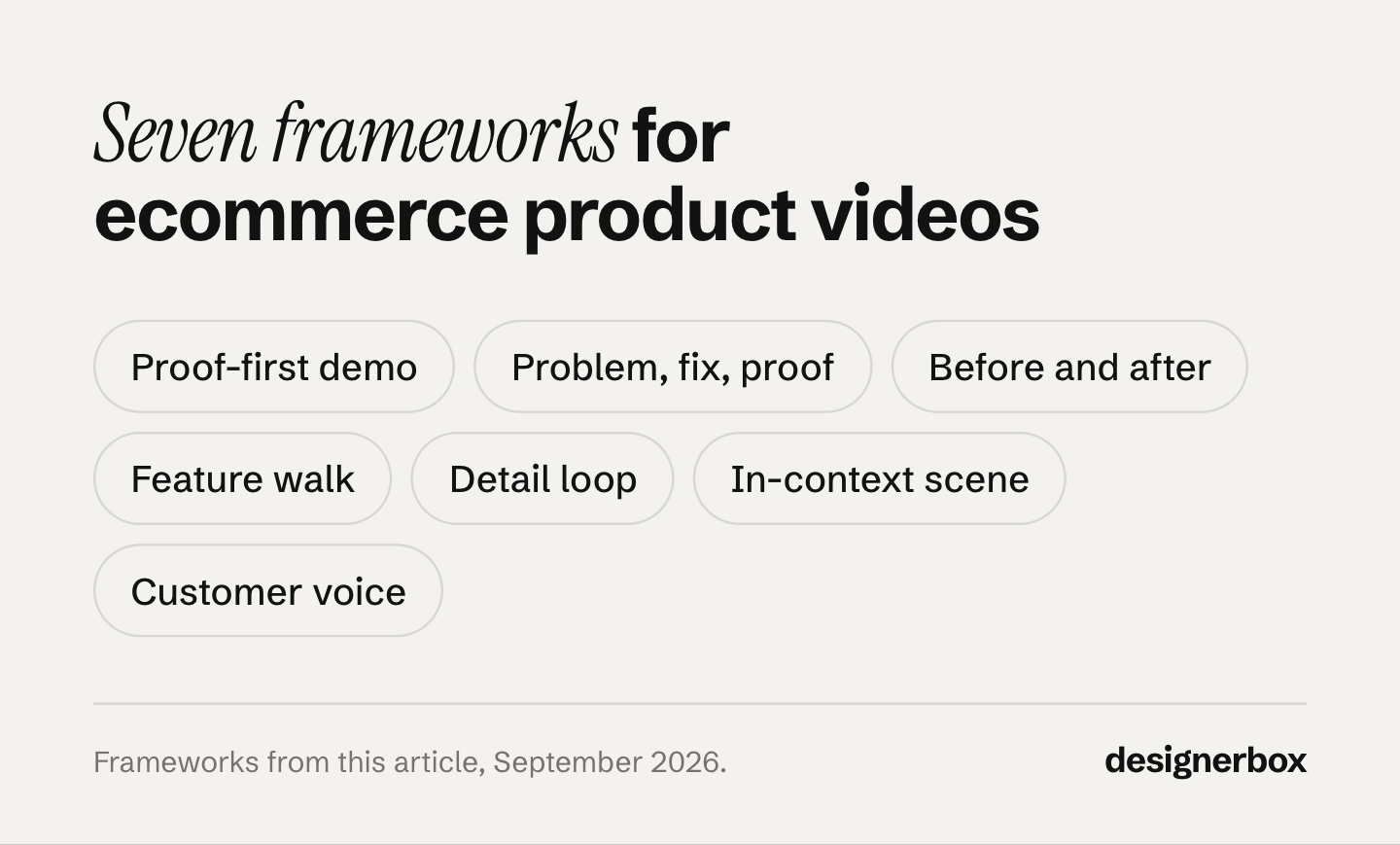
The lengths are working ranges from practice, set inside each platform’s limits. They are not platform rules. The platform limits are in the placement table further down.
1. Proof-first demo
The proof-first demo opens on the result, then shows how the product got there. It answers “does it work?” before the viewer has time to ask it.
| Beat | Seconds | What is on screen |
|---|---|---|
| Result | 0 to 2 | The finished outcome: the clean surface, the poured drink, the zipped bag |
| Product | 2 to 5 | The product, name legible, in hand or in frame |
| Demo | 5 to 20 | One continuous action, no cuts inside the key moment |
| Offer | 20 to 25 | Price, bundle or the reason to buy today, plus one call to action |
The key moment needs one continuous take. A cut inside it reads as a trick. If the demo needs a hand operating a mechanism, film that shot. Our guide on making a product video without a studio explains which shots a model can make from a photo and which need a phone.
2. Problem, fix, proof
This is the classic direct-response order. Name a problem the viewer has, show the product fixing it, then prove the fix. Do not skip the third beat. The proof makes the first two believable.
| Beat | Seconds | What is on screen |
|---|---|---|
| Problem | 0 to 3 | The problem in one image, with a caption of 5 to 10 words |
| Fix | 3 to 12 | The product doing the one thing that removes it |
| Proof | 12 to 25 | A close-up, a measurement, a side-by-side or a review line |
| Offer | 25 to 30 | One call to action |
Keep the problem specific. “Frizzy hair” is a category. “Frizz by 3 pm on a humid day” is a moment someone remembers. For captions, TikTok recommends 5 to 10 words per second when you use on-screen text (ads.tiktok.com, September 2026).
3. Before and after
Before and after is the shortest framework to make and the easiest to get wrong. The two states have to differ in a way the camera can see. A change in color grade is not a result.
| Beat | Seconds | What is on screen |
|---|---|---|
| After | 0 to 2 | The result first, so the scroll stops |
| Before | 2 to 5 | The same frame, same angle, same light, before the product |
| Change | 5 to 12 | A wipe or a cut between the two, held long enough to compare |
| Offer | 12 to 15 | The product and one call to action |
Lock the camera between the two states. The same framing, the same light and the same distance make the change believable. Some product categories have their own ad rules for before-and-after images, so read the platform’s ad policy for your category before you run one.
4. Feature walk
The feature walk shows three features, each tied to one benefit. It fits buyers comparing options on a product page or an Amazon listing, where they have already decided to look closely.
| Beat | Seconds | What is on screen |
|---|---|---|
| Hero | 0 to 5 | The product whole, with the strongest feature named |
| Feature one | 5 to 25 | The feature, then what it does for the buyer |
| Feature two | 25 to 45 | Same shape |
| Feature three | 45 to 65 | Same shape |
| Recap | 65 to 75 | The product whole again, and the three features as text |
Put the strongest feature first. Amazon’s own advice is to show the most important feature in the first 5 to 10 seconds and keep most videos at 30 to 90 seconds (sell.amazon.com, September 2026). Amazon also sets a floor of 1 minute for shoppable video, so a feature walk is the framework that fits it best. Our guide to Amazon product listing videos with AI covers the upload side.

5. Detail loop
The detail loop is a silent 6 to 10 second clip that plays on the product page, in the image gallery. It answers “is the quality real?” with texture: the weave, the grain, the stitching, the finish.
| Beat | Seconds | What is on screen |
|---|---|---|
| Whole | 0 to 2 | The product, same framing as the main photo |
| Push in | 2 to 6 | A slow move toward the best detail |
| Hold | 6 to 8 | The detail, sharp, filling the frame |
| Return | 8 to 10 | Back to the first frame, so the loop is invisible |
It is the cheapest framework to make at volume. It needs no voice, no captions and no offer. It is also the one a model makes most reliably from one good product photo, because the motion stays inside what the photo already shows. Shopify accepts product videos up to 10 minutes, 1 GB and 4K (Shopify Help Center, September 2026), so a short loop sits well inside the limits. The loop is one part of the page, and Shopify product page optimization covers the nine fields in order.
6. In-context scene
The in-context scene puts the product in the place it will live: a kitchen shelf, a desk, a body, a bathroom counter. It answers “will it fit my life?” for products that sell on look and size.
| Beat | Seconds | What is on screen |
|---|---|---|
| Place | 0 to 3 | The room or the person, with the product already in frame |
| Use | 3 to 15 | The product in normal use, at real scale |
| Detail | 15 to 22 | One close-up that proves the quality |
| Offer | 22 to 28 | The product name and one call to action |
The product must be in the first frame. A scene that opens on an empty room and brings the product in at second six is a mood video. The scene is also where brand consistency breaks first across a catalog. Forty products in forty different kitchens do not read as one brand. Pick one set of places, and use them for every product.
7. Customer voice
Customer voice is a person talking to the camera about the product. It answers “do people like me use it?”. It is also the framework most often called UGC.
| Beat | Seconds | What is on screen |
|---|---|---|
| Claim | 0 to 3 | The person’s strongest line, said to the camera |
| Context | 3 to 10 | Who they are and what they needed |
| Experience | 10 to 30 | The product in their hands, with one specific detail |
| Recommendation | 30 to 40 | Who should buy it, and one call to action |
The specific detail carries this framework. “I love it” sells nothing. “It fits in the side pocket of my gym bag” sells to everyone with a gym bag.
If you use a paid creator or a generated presenter, say so where the platform requires it. TikTok asks advertisers to turn on its AI disclosure for ads with fully AI-generated or heavily AI-edited media (ads.tiktok.com, September 2026). This is general information, not legal advice. Our UGC ads guide covers the rest of that workflow.
Which framework fits which placement?
The placement decides the length, the ratio and whether sound plays. Choose the framework after you know where the video runs.
| Placement | Limits from the platform | Frameworks that fit |
|---|---|---|
| TikTok in-feed | 9:16, at least 720p, proposition in the first 3 s, hook in the first 6 s | Proof-first demo, problem-fix-proof, customer voice |
| Instagram Reels ads | 9:16, 0 s to 15 min, captions recommended, sound strongly recommended | Proof-first demo, in-context scene, before and after |
| Amazon shoppable video | 1 to 12 min, up to 1080p, .mov or .mp4, max 5 GB | Feature walk |
| Shopify product page | Up to 10 min, 1 GB, 4K, .mp4, .mov or .webm | Detail loop, feature walk, in-context scene |
Sources for the table: TikTok (ads.tiktok.com, September 2026), Meta (Instagram Reels ad specs, September 2026), Amazon (sell.amazon.com, September 2026) and Shopify (help.shopify.com, September 2026).

Many product pages play video with the sound off until the shopper taps it. Build the PDP frameworks so they work silent, and put any claim that matters on screen as text. On TikTok and Reels, sound is part of the format, so the voice and the music carry more of the load there. For TikTok alone, six TikTok product ad examples break down the formats and the safe zone. Video is one of six formats a shopper uses to judge a product, and visual commerce covers what each one needs.
How do you test product video frameworks?
Change one thing at a time. Keep the product, the offer, the call to action and the audience fixed, and change only the framework. Then the result tells you which order sells, and not which product or offer won.
TikTok recommends 3 to 5 different creatives per ad group (ads.tiktok.com, September 2026). That fits three frameworks for one product, plus one or two hook variants of the winner. Run them until each has enough spend to judge. Then keep the winning framework for the next ten products and test hooks inside it.
The test only works if each video follows its framework exactly. When the beats drift, the second video is a new structure and the comparison breaks. The method for reading those results is in our guide to ad creative testing. If the test includes static ads next to video, seven product ad formats covers the still side.
How to write a product video script from a framework
A script is the framework filled in for one product. Write it as a table, one row per beat, before you film or generate anything.
- Pick the doubt. Write the one question the buyer has about this product. It chooses the framework.
- Write the first 3 seconds first. One line and one image. If the product is not in it, rewrite it.
- Fill each beat with one shot and one line. A beat with two ideas becomes two beats, and the video runs long.
- Name the proof. Write the exact shot that proves the claim: the close-up, the side-by-side, the measurement.
- Write the on-screen text. For silent placements, the text alone has to tell the story.
- Cut the last beat to one ask. One call to action, not a list of offers.
For a video built from product photos, turning one product photo into a video ad works through the shot list step by step. When the video runs as a paid ad, the four numbers behind ROAS show which beat to change.
One framework for every product
Anyone can make an AI picture. Making hundreds that still look like your brand is the hard part. Video is the same. One good product video is a day of work. The hard part is the same framework, the same places and the same look on the next 200 products.
In DesignerBox you build the framework once as a workflow. You set the beats, the shots, the brand rules and the model for each step. The workflow reads your brand on every run, so video forty follows the same rules as video one.
Publish the workflow as an app, and a colleague adds a product photo and presses Run. Batch runs it over a whole sheet of products, and you review the results in one pass.
You cut the finished clips in the video editor. It is a real timeline, with several tracks, transitions, animated text and audio. That is where you cut generated shots against any phone footage you filmed. The full workflow from the first product photo to the finished ad, in one subscription.
You see the cost before each run. An 8-second clip costs 40 to 560 credits, depending on the model. AI video starts on the Premium plan. Plans and credits are on the pricing page. For the ad side, see AI video ads from one product photo.
The first job, built once
Start from a template, add your brand and your products, and run it. See the templates.
FAQ
What are the main types of ecommerce product videos?
Seven frameworks cover most stores: proof-first demo, problem-fix-proof, before and after, feature walk, detail loop, in-context scene and customer voice. Each one answers a different buyer doubt. A demo answers “does it work?”, a scene answers “will it fit my life?” and a customer voice answers “do people like me use it?”.
How long should an ecommerce product video be?
The placement sets the length. A product page detail loop can run 6 to 10 seconds. A TikTok or Reels ad usually runs 15 to 30 seconds. Amazon shoppable video must run between 1 and 12 minutes, and Amazon says most successful videos run 30 to 90 seconds.
What is the best framework for a product page video?
A silent detail loop in the image gallery, plus a feature walk further down the page. The loop proves quality at a glance. The feature walk serves the shopper who is comparing options. Both work without sound, which matters on pages where video plays muted.
How do you write a product video script?
Start from the buyer’s doubt, choose the framework that answers it, and write one row per beat with seconds, one shot and one line. Write the first 3 seconds first and put the product in them. End with one call to action.
Should ecommerce product videos have sound?
Build product page videos to work without sound, with any claim shown as on-screen text. On TikTok and Reels, sound is part of the format: Meta calls sound on Reels ads “strongly recommended” and captions “recommended”. Use both there.
Can you make ecommerce product videos with AI?
Yes, for most of the seven frameworks. Detail loops and in-context scenes generate well from one good product photo. Shots with hands working a mechanism are still better filmed. A before-and-after must show a real result, so film both states. In DesignerBox an 8-second clip costs 40 to 560 credits, depending on the model, and you see the cost before the run.
Sources
- Google’s ABCDs of effective video ads, and the Google and Kantar figures of up to 30% short-term sales likelihood and 17% long-term brand contribution (April 2021): (Google Ads Help, September 2026)
- TikTok creative best practices: hook in the first 6 seconds, proposition in the first 3 seconds, 9:16 at 720p or higher, 5 to 10 words per second, 3 to 5 creatives per ad group: (ads.tiktok.com, September 2026)
- TikTok AI-generated content disclosure for ads: (ads.tiktok.com, September 2026)
- Amazon shoppable video: 1 to 12 minutes, 30 to 90 seconds recommended, key feature in the first 5 to 10 seconds, up to 1080p, max 5 GB, and the 24% average sales increase (Amazon internal data, January to June 2026): (sell.amazon.com, September 2026)
- Amazon study of third-party seller revenue after a first video, up to 9.7% over 90 days on 2022 US data: (Amazon Seller Forums, September 2026)
- Instagram Reels ad specs: 9:16, 0 seconds to 15 minutes, captions recommended, sound strongly recommended: (Meta ads guide, September 2026)
- Shopify product video limits: 10 minutes, 1 GB, 4K, .mp4, .mov or .webm: (Shopify Help Center, September 2026)
- DesignerBox plan gates and the video credit range: DesignerBox pricing, September 2026
Platform specs and guidance verified from TikTok, Meta, Amazon, Shopify and Google documentation as of September 2026. Individual results vary.